On this page: Confirm your personalized content renders correctly for every type of recipient by testing variants generated with AI, entered manually, imported from a file, or based on simulated users, then previewing them and sending proofs.
When your content includes personalization or conditional logic, you need to verify that it renders correctly for every type of recipient before sending it.
The Simulate content variations experience in Journey Optimizer solves this by letting you test multiple variants of your content from a single screen, generated automatically with AI, entered manually, imported from a file, or based on reusable simulated users. You can preview how each variant renders and send proofs, all without creating persistent profiles in Adobe Experience Platform beforehand.
From your content, click Simulate content to open a single experience where you can:
- Auto-generate variants using AI to cover personalization and conditional branches
- Add variants manually or from a CSV or JSON file
- Use simulated users to preview and proof with saved, reusable test data
- Preview rendering and send email proofs for selected variants
All attributes used in your content for personalization are automatically detected. A variant is a version of the content with different values for its attributes.
Guardrails & limitations limitations
Before starting testing your content using sample input data, consider the following guardrails and prerequisites.
-
Channels - Simulating content variations is available for:
- the Email, Mobile messages and Push notification channels;
- all inbound channels (Web, Code-based experience, In-app, Content cards);
- Orchestrated campaigns.
-
Supported capabilities - Content variations can be used with Journey Optimizer multilingual content and content experiment capabilities. This allows you to test messages in multiple languages and optimize content through experimentation.
You can also leverage content variations to test your content templates.
note NOTE For now, inbox rendering and spam reports are not available in the current experience. To use these features, click Simulate content, then select Simulate content (AEP profiles) from the dropdown to access the previous user interface. -
Attributes - Both profile and contextual attributes are supported.
-
Data types - Only the following data types are supported when entering data for your variants: number (integer and decimal), string, boolean and date type. Any other data type will show an error.
-
Number of variants - You can add up to 30 variants to test your content when adding them using a file or manually. When using AI auto-generation, the system determines how many variants to create based on your content (personalization fields and conditional branches), up to a maximum of 40 variants.
Create content variants
To create variations for your content, click the Simulate content button.
You can create variants in the following ways:
Once your variants are created, you can preview your content and send proofs.
Add variants manually or from a file profiles
When accessing the content variations experience, all personalization fields used in your content are automatically detected and displayed in a blank variant.
For example, if your email contains two personalization fields "First name’ and “City”, they will appear in the list. Initially, no values are entered, and no personalized content is shown in the preview pane.
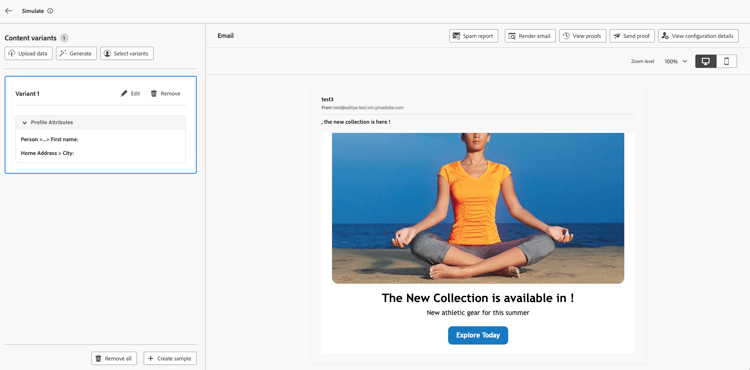
You can add variants manually or upload them from a file.
To edit the value of the default variant, click the Edit button to provide custom values for each personalization field. The preview pane will update to show how your content renders with the entered values.
To add a new variant, click the Create sample button. A new blank variant appears, containing all the detected personalization fields. You can edit the new variant as needed.
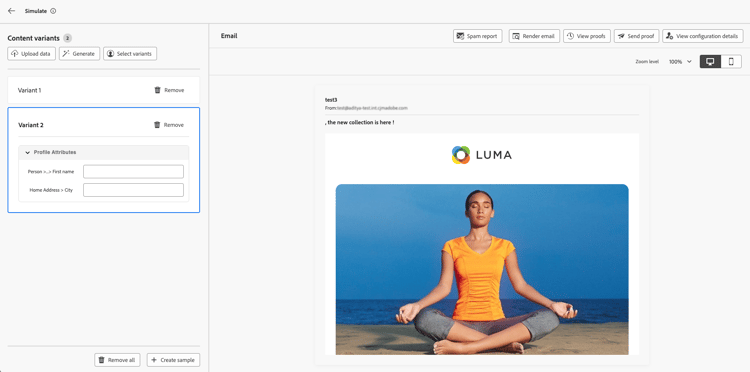
You can upload a file with predefined variants and values to speed up the process.
-
Click the Upload data button to open the file upload screen.
-
Select Download sample to download a a CSV, JSON, or JSONLINES file template.
-
Open the template file and fill in your desired values for each profile attribute. The template includes a column for each profile attribute used in your content for personalization.
Example JSON syntax:
code language-json { "profile": { "attributes": { "person": { "name": { "lastName": "Doe", "firstName": "John" } } } } } -
Once your file is ready, select Confirm to load it. After uploading, a new variant is added to the list for each entry in the file.
Auto-generate content variants auto-generate-variants
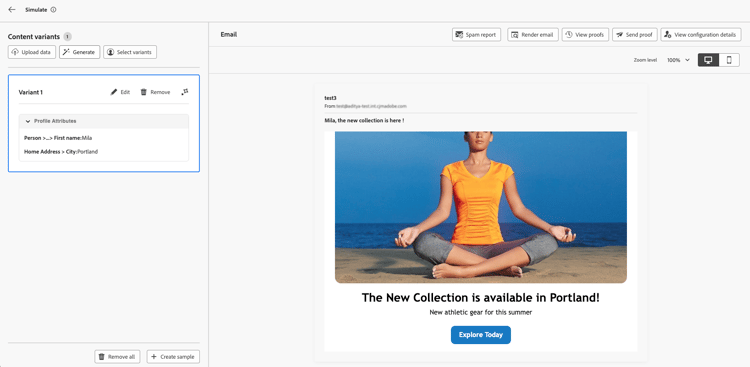
Journey Optimizer can use AI-based simulation to automatically generate content variants so you can validate your personalization logic without building variants by hand. The system analyzes your content, identifies personalization fields and conditional branches, and creates as many variants as needed to cover them with meaningful values for a near-realistic preview.
To auto-generate variants, click the Generate button and wait for the system to complete generation. Review the generated variants in the variants list and their rendering in the preview pane.
Select variants from simulated users simulated-users
In Simulate content variations, you can base your variants on simulated users. Simulated users are temporary, profile-like entities created for testing without using persistent profiles in Adobe Experience Platform. Unlike variants added only for the current browser session, simulated users are saved and can be reused across journeys and by other users.
Simulated users are created and managed from the journey Simulation feature. For the full procedure to create, save, and reuse them, see Create and manage simulated users.
Once your simulated users are created, you can use them to preview your content. To do so, follow these steps:
-
Click the Select variants button.
-
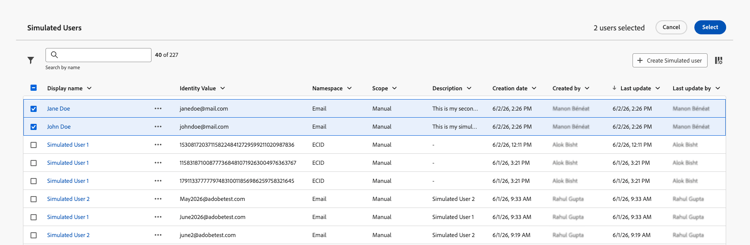
In the list of existing simulated users, select the ones you want to use, then click Select.
-
The selected simulated users are added to your list of content variants, where you can preview your content with their attribute values. You can also edit a variant’s values manually for testing, but these changes are not saved back to the simulated user.
Preview content and send proofs preview-proofs
Once variants have been added, you can use them to preview your content in the right pane, and to send email proofs.
Preview content variations preview
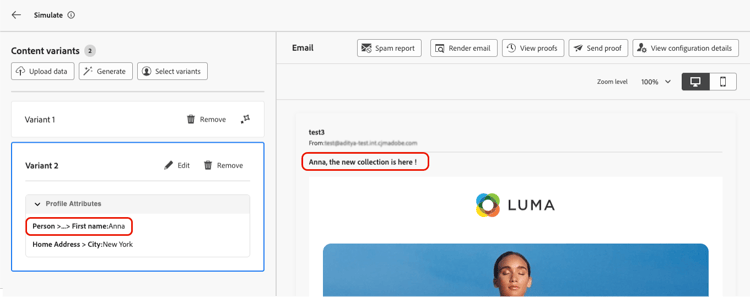
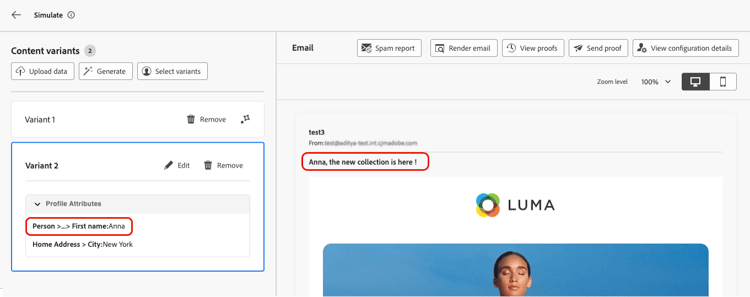
To preview your content using a variant, select the relevant variant from the list to update the content in the preview pane with the information entered for this variant.
In the example below, we have added two variants for the email subject line:
Send proofs proofs
Journey Optimizer allows you to send proofs to email addresses while impersonating one or multiple variants that you have added in the simulation screen. The steps are as follows:
-
Verify that variants have been added to test your content and click the Send Proof button.
-
In the Recipients field, enter the email address to which you want to send the proof then click Add. Repeat the operation to send the proof to additional email addresses. You can add up to 10 proof recipients.
-
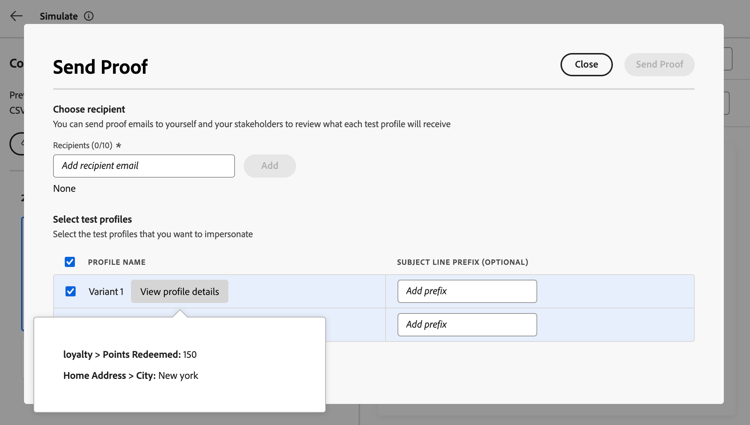
In the bottom section of the screen, select the variant that you want to use in the proof. You can select multiple variants, in which case the email will include as many proofs as selected variants.
For more information on a variant, select the View profile details link. This allows you to display the information entered in the previous screen for the different variants.
-
Click the Send Proof button to start sending the proof.
-
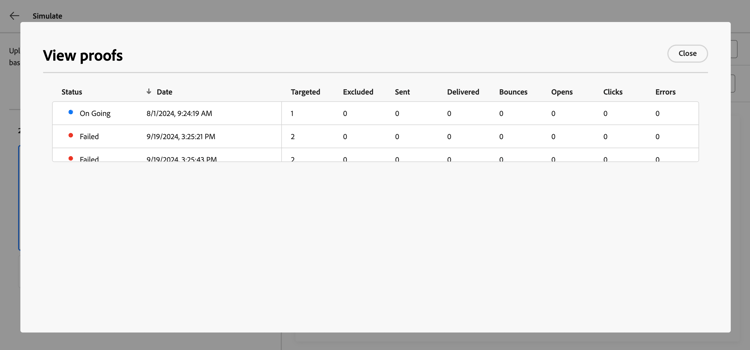
To track the proof sending, click the View proofs button in the simulate content screen.
This section contains structured knowledge intended to support interpretation, retrieval, and question answering related to this topic.
For complete understanding, this information should be combined with the documentation on this page. Neither source is intended to stand alone; the page describes the feature, while this section provides additional context that helps disambiguate terminology, intent, applicability, and constraints.
- TL;DR: This page explains the classic Simulate content variations experience, where you test content variants generated with AI, entered manually, imported from a file, or based on simulated users, then preview them and send email proofs without creating persistent Adobe Experience Platform profiles.
Intents:
- Open the classic experience by clicking Simulate content
- Rely on automatic attribute detection and create variants manually with Create sample or by uploading a file (Upload data / Download sample)
- Auto-generate variants with AI using Generate
- Select variants from reusable simulated users
- Preview variant rendering and send email proofs with Send Proof / View proofs
- Access the previous interface with Simulate content (AEP profiles) for inbox rendering and spam reports
Glossary:
- Simulate content variations (classic experience): The experience that lets you test multiple content variants from a single screen before sending. (product-specific)
- Variant: A version of the content with different values for its automatically detected attributes; stored in the browser session, not in Adobe Experience Platform. (product-specific)
- Simulated users: Temporary, profile-like entities created for testing without using persistent profiles in Adobe Experience Platform; saved and reusable across journeys and by other users. (product-specific)
- Simulate content (AEP profiles): A dropdown option under Simulate content that opens the previous user interface, needed for inbox rendering and spam reports. (product-specific)
- Send Proof: Sends proofs to email addresses while impersonating one or more of the added variants. (product-specific)
Guardrails:
- Available for the Email, Mobile message, and Push notification channels; all inbound channels (Web, Code-based experience, In-app, Content cards); and Orchestrated campaigns.
- Supported data types when entering variant data: number (integer and decimal), string, boolean, and date; any other data type shows an error.
- Both profile and contextual attributes are supported.
- You can add up to 30 variants when adding them using a file or manually.
- AI auto-generation creates a system-determined number of variants, up to a maximum of 40 variants (hard limit — page states “maximum of 40 variants”).
- Clicking Generate replaces all existing content variants, including any added manually or from a file.
- Variants are not stored in Adobe Experience Platform; they live in the browser session and do not display when logging off or when working from another device.
- You can add up to 10 proof recipients.
- Editing a simulated-user variant’s values is for testing and is not saved back to the simulated user.
Terminology:
- Canonical name: Simulate content variations (classic experience) — variants: sample input, custom profiles
- Do not confuse: “Simulate content” (button that opens the experience) ≠ “Simulate content (AEP profiles)” (dropdown option that opens the previous user interface)
- Do not confuse: “Create sample” (add a new blank variant) ≠ “Upload data” (import variants from a file) ≠ “Generate” (AI auto-generation)
- Do not confuse: “variants” (browser-session test data, not stored in Adobe Experience Platform) ≠ “simulated users” (saved, reusable test entities)
- Do not confuse: “Send Proof” (send email proofs) ≠ “View proofs” (track sent proofs) ≠ “View profile details” (display a variant’s entered information)
FAQ:
- Q: Are variants stored in Adobe Experience Platform? — No. Variants are stored in your browser session, not in Adobe Experience Platform; they do not display when you log off or work from another device.
- Q: How many variants can I create? — Up to 30 when adding manually or from a file; AI auto-generation creates a system-determined number up to a maximum of 40.
- Q: Which channels support content simulation? — The Email, Mobile message, and Push notification channels; all inbound channels (Web, Code-based experience, In-app, Content cards); and Orchestrated campaigns.
- Q: How do I get inbox rendering and spam reports? — Click Simulate content, then select Simulate content (AEP profiles) from the dropdown to access the previous user interface.
- Q: How many recipients can receive a proof? — Up to 10 proof recipients.
- Q: What data types can I enter for variants? — Number (integer and decimal), string, boolean, and date; any other data type shows an error.