[AEM Assets]{class="badge positive" title="Applies to AEM Assets)."}
Asset reports asset-reports
Asset reporting lets you assess the utility of your Adobe Experience Manager Assets deployment. With Assets, you can generate various reports for your digital assets. The reports provide useful information about your system’s usage, how users interact with assets, and which assets are shared.
Use the information in the reports to derive key success metrics to measure the adoption of Assets within your enterprise and by customers.
The Assets reporting framework uses Sling jobs asynchronously to process report requests in an ordered manner. It is scalable for large repositories. Asynchronous report processing increases the efficiency and speed with which reports are generated.
The report management interface is intuitive and includes fine-grained options and controls to access archived reports and view report run statuses (success, failed, and queued).
When a report is generated, you are notified via an inbox notification. You can view, download, or delete a report from the report listing page, where all the previously generated reports are displayed.
AEM Assets provides several distinct reporting mechanisms for different purposes. Confusing one for another or misconfiguring the permissions needed to run them is the most common source of My report is empty or stuck or missing error types.
Experience Manager Assets generates the following standard reports for you:
- Upload
- Download
- Expiration
- Modification
- Publish
- Brand Portal publish
- Disk Usage
- Files
- Link Share
Report types report-types
The table below describes the available report types and what each report measures.
contentbackflow-import-service integration) are not included, even if they exist in the target folder, the report is not a folder inventory, it is a log of the upload or download events.publish URLs rather than Dynamic Media. Publish-URL traffic is not visible in any AEM Assets report.Dynamic Media license billing is based on the aggregated page views or visits, and not a per-operation (transcode or crop or download) breakdown. The DM Delivery Report and CDN or asset reports do not natively split usage by the operation type, so do not expect an operation-level cost report out of the box.
Permissions required to generate and use reports permissions-required-to-generate-and-use-reports
-
Asset reports (Tools > Assets > Reports) are restricted with the administrator product profile at the IMS level. This is by design, there is no configuration or alternate role that grants non-administrators the ability to review, create, or download the Asset reports.
-
If you need to run the expiration or scheduled reports, you must not be granted write access to
/libs/dam/gui. The correct permission structure is:- Read access to
/libs/dam/gui - Write access to
/var/dam/reports
- Read access to
-
Excess
/libswrite access is a common misconfiguration. This does not just fail to work, it can silently corrupt the report generation for sharing the affected group.
Generate reports generate-reports
Adobe Experience Manager administrators can easily generate and customize these reports for your implementation. An administrator can follow these steps to generate a report:
-
In Experience Manager interface, click Tools > Assets > Reports.

-
On the Asset Reports page, click Create from the toolbar.
-
From the Create Report page, choose the report you want to create and click Next.
note NOTE Entitle yourself to an AEM Administrator product profile to create a Download report. See Assigning AEM Product Profiles to entitle yourself to an AEM Administrator product profile. 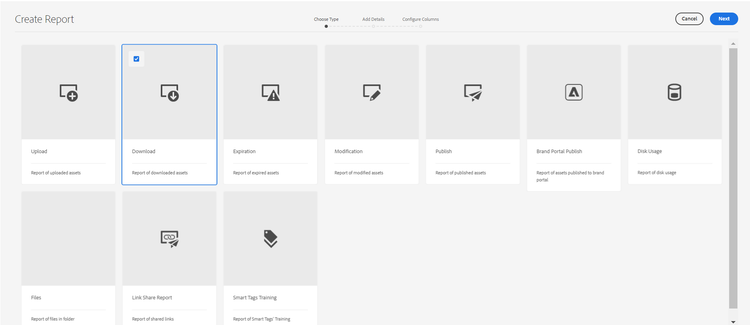
-
Configure report details, such as title, description, thumbnail, and folder path. By default, the folder path is
/content/dam. You can specify a different path to execute the report on a specific folder.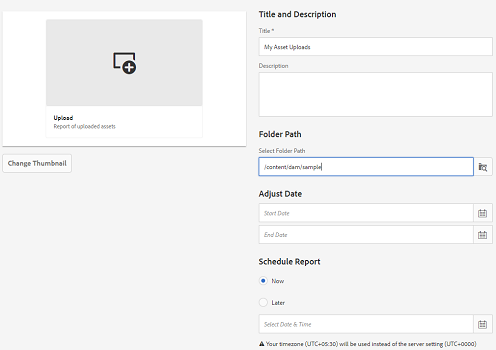
Choose the date range for your report. You can choose to generate the report now or at a future date and time.
note NOTE If you choose to schedule the report later, ensure that you specify the date and time in the Date and Time fields. If you do not specify any value, the report engine treats it as a report that is to be generated instantly. Configuration fields may differ based on the type of report you create. For example, the Disk Usage report provides options to include asset renditions when calculating the disk space used by assets. You can choose to include or exclude assets in sub-folders for disk usage calculation.
note NOTE The Disk Usage report does not include date range fields because it indicates current disk space usage only. 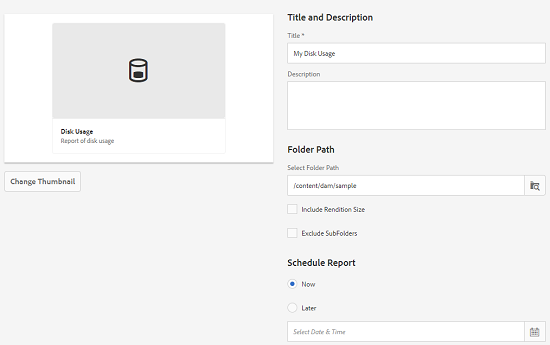
When you create the Files report, you can include/exclude sub-folders. However, you cannot include asset renditions for this report.

The Link Share report displays URLs to assets that are shared with external users from within Assets. The columns are not customizable.
The Link Share report, does not include options for sub-folders and renditions because it merely publishes the shared URLs that appear under
/var/dam/share.
-
Click Next from the toolbar.
-
In the Configure Columns page, some columns are selected to appear in the report by default. You can select more columns. Cancel the selection of a column to exclude it in the report.
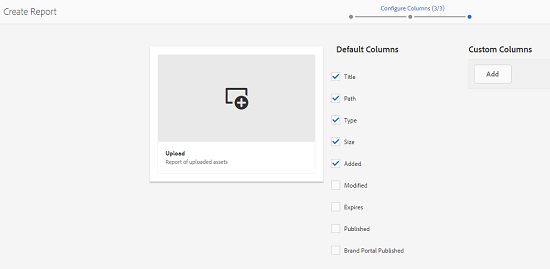
To display a custom column name or property path, configure the properties for the asset binary under the
jcr:contentnode in CRX. Alternatively, add it through a property path picker.
-
Click Create from the toolbar. A message notifies that report generation has been initiated.
-
On the Asset Reports page, the report generation status is based on the current state of the report job, for example, Success, Failed, Queued, or Scheduled. The same status appears in the notifications inbox. To view the report page, click the report link. Alternatively, select the report, and click View from the toolbar.
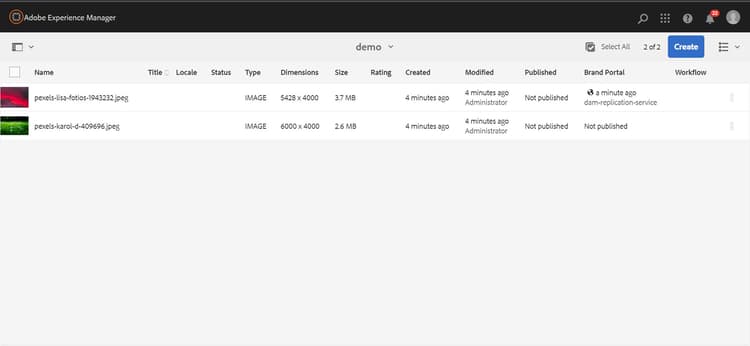
Click Download from the toolbar to download the report in CSV format.
note NOTE You can generate reports based on the events generated during the past 360 days. Experience Manager retains the user ID data for 30 days.
Add custom columns to reports add-custom-columns
You can add custom columns to the following reports to display more data for your custom requirements:
- Upload
- Expiration
- Modification
- Publish
- Brand Portal publish
- Files
To add custom columns to these reports, follow these steps:
-
In the Manager interface, click Tools > Assets > Reports.
-
On the Asset Reports page, click Create from the toolbar.
-
From the Create Report page, choose a report to create. Click Next.
-
Configure the report details such as title, description, thumbnail, folder path, and date range as applicable. Click Next.
-
Select the applicable information from the list of Default Columns. To display a custom column, specify the name of the column under Custom Columns.
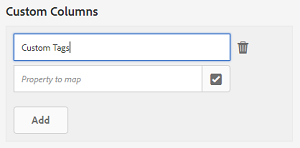
-
Add the property path under the
jcr:contentnode in CRXDE using the property path picker. Alternatively, type the path in the property path field.
To add more custom columns, click Add and repeat the above steps.
-
Click Create from the toolbar. A message notifies that the report generation is initiated.
Troubleshooting information tips-troubleshoot
- If the Disk Usage Report does not generate and if you are using Dynamic Media, ensure that all assets are processed correctly. To resolve, reprocess the assets and generate the report again.
- Check for an unexpected node at
/libs/dam/gui/content/reports. If you have write access to/libs/dam/guiand trigger the report creation, AEM creates a straygeneratereport.export.jsonnode there. Its presence causes report-generation requests to be routed to the default servlet instead of the intended report-generation servlet, so the report never appears in the listing and no email notification is sent for anyone, not just the one who created the node.- To fix the issue, remove
create/modify/deletepermissions on/libs/dam/guifrom the affected users or groups, then delete the stray node, then retest.
- To fix the issue, remove
- Check for a
NullPointerExceptiontied to the report configuration. If no values were selected under Configure columns when creating the report, thereportColumnsvalue is null and the report gets stuck in a queued state indefinitely. This also blocks the report deletion or cancellation.- To fix the issue, recreate the report and explicitly select the default columns.
- Confirm the requesting user has the administrator product profile. A non-administrator cannot see or use the Reports feature at all.
- Distinguish report ran but looks incomplete whether the report is broken. If an Upload or Download report is missing in assets you expect to see, first confirm whether those assets were created by a named user versus a
system/importprocess, and whether they fall within the selected date range, before treating it as a defect. - Periodically audit for users or groups with
/libswrite access who only need the report-generation capability. This prevents the stray-node failure mode before it happens.
See also
- Translate Assets
- Assets HTTP API
- Assets supported file formats
- Search assets
- Connected assets
- Asset reports
- Metadata schemas
- Download assets
- Manage metadata
- Manage Dynamic Media templates
- Manage reports in Assets view
- Search facets
- Manage collections
- Bulk metadata import
- Publish Assets to AEM and Dynamic Media