在此页面上:管理收件人如何取消订阅讯息并选择退出个性化,以便您尊重他们的同意选择,并履行您的法律和品牌信誉义务。
向收件人提供取消订阅功能以用于停止从品牌接收通信并确保尊重用户的选择,这是法律要求。 未能遵守这些法规会为您的品牌带来法律监管风险。 它有助于避免向收件人发送未经请求的通信,这种通信可能会使他们将您的消息标记为垃圾邮件并损害您的声誉。
在 Experience Platform 文档中进一步了解适用的法规。
管理历程和营销活动中的取消订阅 opt-out-ajo
在从历程或活动发送消息时,必须始终确保客户可以取消订阅未来的通信。 取消订阅后,轮廓将自动从未来营销消息的受众中删除。
虽然 Journey Optimizer 提供了在电子邮件和移动消息中管理选择退出的方法,但推送通知不需要您采取任何操作,因为收件人可以通过其设备自行取消订阅。 例如,在下载或使用应用程序时,用户可以选择停止接收通知。 同样,他们可以通过移动操作系统更改通知设置。
查看推送选择禁用状态 push-opt-out-status
在设备级别处理移动设备应用程序的推送选择退出:如果用户在其设备上禁用通知,将从其用户档案中移除推送令牌。 因此,用户档案上 存在推送令牌 是隐式推送同意的指示符。
要在 Adobe Experience Platform 中验证用户档案的推送同意状态,请执行以下操作:
- 在 Adobe Experience Platform 的 用户档案 部分打开用户档案。
- 转到 属性 选项卡并查找 推送通知详细信息 字段组。
- 如果存在推送令牌,则用户档案已隐式同意接收推送通知。 如果未找到令牌,则表示用户已在设备级别选择退出。
要了解如何在Journey Optimizer电子邮件和移动消息中管理选择退出,请参阅以下部分:


实施个性化同意 opt-out-personalization
您的客户还可以选择不展示个性化内容。 用户选择退出个性化后,您需要确保其数据不被用于个性化,并且必须使用后备版本替换任何个性化内容。
在决策管理中 opt-out-decision-management
使用产品建议时,个性化首选项不会自动实施决策范围(在决策 API 请求或 Edge 决策 API 请求中所使用的)。 在这种情况下,您需要手动实施个性化同意。 要实现此目的,请执行以下步骤。

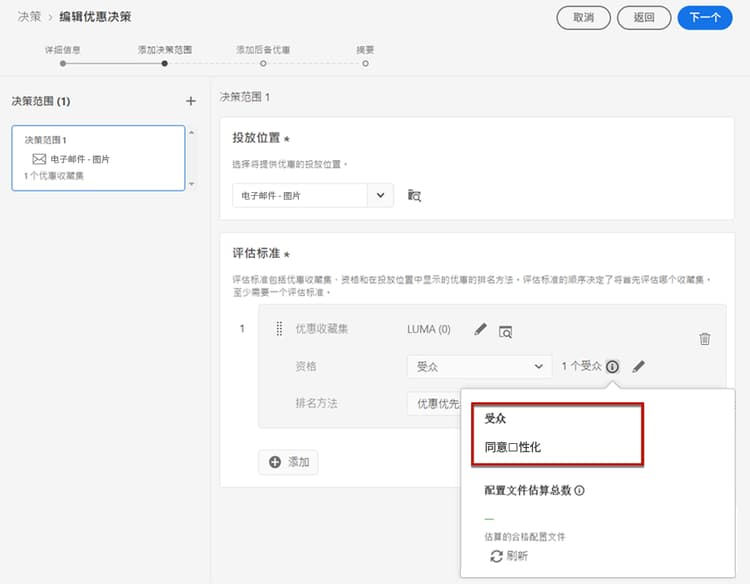

如果用户:
-
同意进行个性化,决策范围将确定适用于该轮廓的最佳产品建议。
-
不同意进行个性化,则相应的轮廓将不符合推荐准则中任何产品建议的条件,因此将收到非个性化的后备产品建议。
在个性化编辑器中 opt-out-expression-editor
个性化编辑器本身不会执行任何同意检查或进行强制执行,因为表达式编辑器不涉及消息投放操作。
但是,使用基于权限的访问控制标签可限制将哪些字段用于个性化。 此消息预览和电子邮件渲染服务将屏蔽用敏感信息标识的字段。
在 Journey Optimizer 营销活动中,同意政策的实施如下所示:
-
您可以在创建受众时包含同意策略定义,以确保为营销活动选择的受众已筛选掉不符合同意条件的轮廓。
-
Journey Optimizer 将在渠道级别执行一般同意检查,以 确保轮廓已选择同意 接收特定渠道上的营销通信。
note NOTE 此时,Journey Optimizer 营销活动对象本身不会执行任何额外的同意政策实施检查。
要在营销活动中手动强制执行个性化同意,请遵循以下方法之一。
使用区段规则生成器
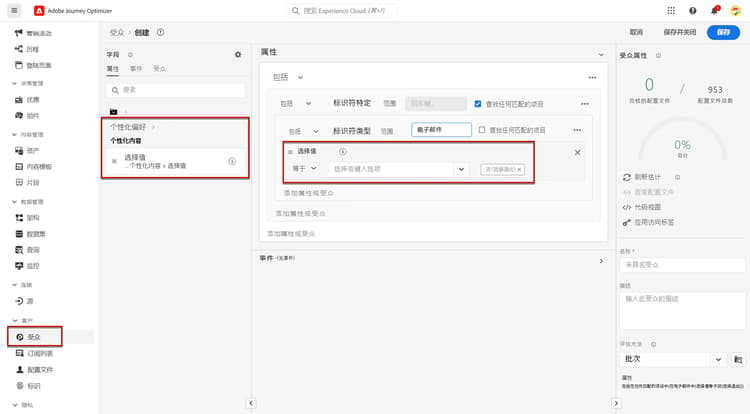
您可以使用区段规则生成器创建包含选择退出轮廓的受众。
-
使用细分服务创建 Adobe Experience Platform 受众。

-
选择轮廓属性,例如个性化内容 = 否(选择退出),排除未同意个性化的用户。
-
单击保存。
您现在可以使用此受众从营销活动中筛选出未同意个性化的轮廓。
在组合工作流中使用拆分活动
您还可以通过将拆分活动添加到组合工作流来向受众添加个性化同意检查。
-
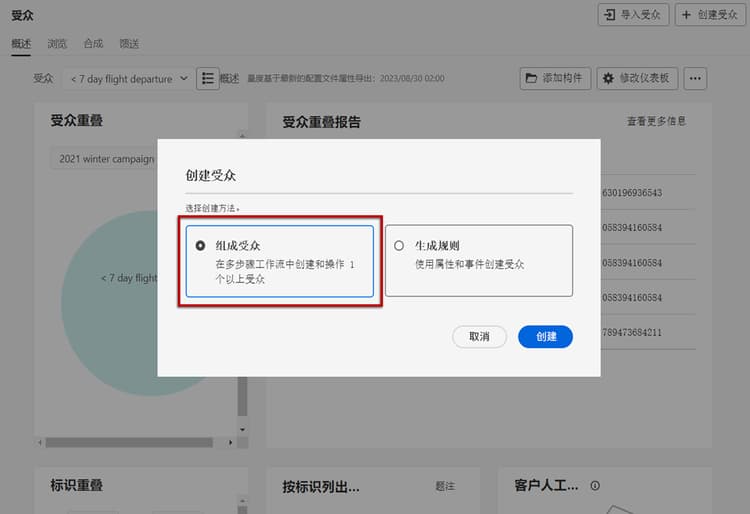
使用 组合受众 选项创建受众。 了解有关创建构成工作流的更多信息
-
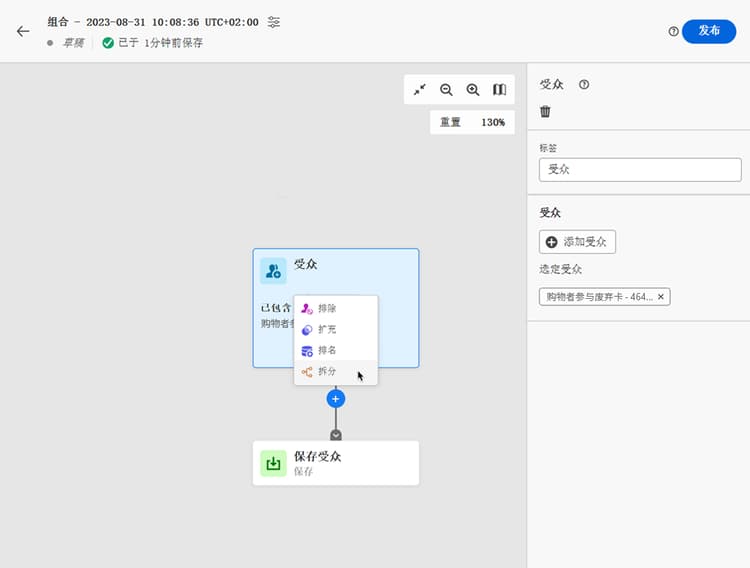
使用右侧的专用按钮添加初始受众。
-
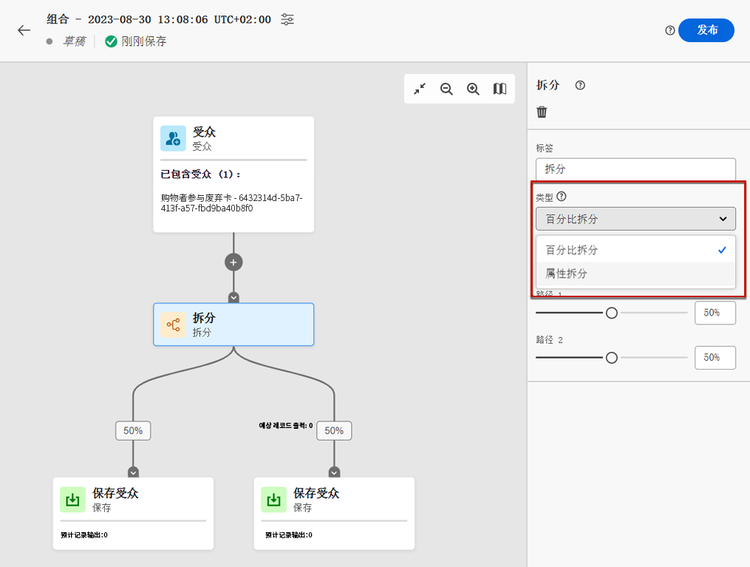
单击 + 图标并选择 拆分 活动,创建拆分受众。
-
在右窗格中,选择 属性拆分 作为拆分类型。
-
单击 属性 字段旁边的铅笔图标,调出 选择轮廓属性 窗口。
-
搜索个性化同意属性 (
profile.consents.personalize.content.val),然后将其选中。
-
路径 1 是非个性化受众。 选择相关标签。
-
从此列表中选择适当的值。
在这种情况下,我们将使用
n表示用户不同意将其数据用于个性化。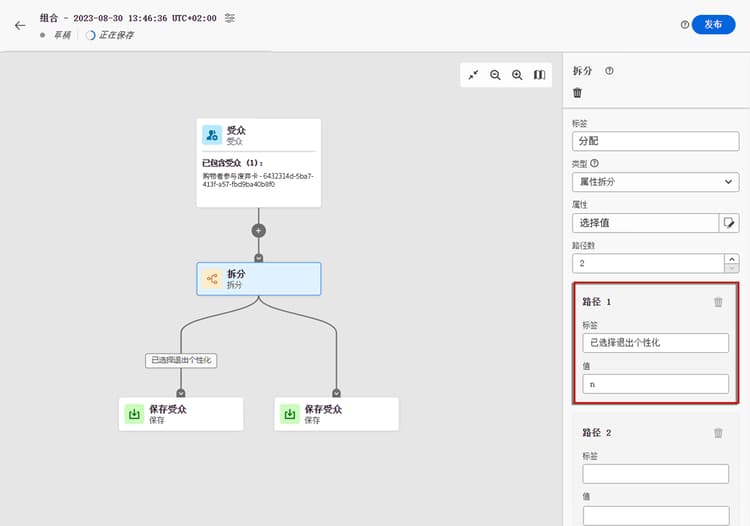
-
您可以为其他选项值创建单独的路径。 您还可以选择删除其余路径并打开其他轮廓,以包括没有
n选项值的所有其他轮廓。 -
完成后,在每个路径中单击保存受众,将工作流结果保存到新受众中。 对于每条路径,都会将一个受众保存到 Adobe Experience Platform 中。
-
完成后,发布组合工作流。
您现在可以使用此受众从营销活动中筛选出未同意个性化的轮廓。
This section contains structured knowledge intended to support interpretation, retrieval, and question answering related to this topic.
For complete understanding, this information should be combined with the documentation on this page. Neither source is intended to stand alone; the page describes the feature, while this section provides additional context that helps disambiguate terminology, intent, applicability, and constraints.
- TL;DR: This page explains how to manage recipient opt-out from communications and opt-out from personalization in Journey Optimizer so you can honor consent choices and meet your legal and brand-reputation obligations.
Intents:
- Manage unsubscriptions in journeys and campaigns
- Check a profile’s push opt-out status in Adobe Experience Platform
- Understand how consent is handled through the Experience Platform Consent schema
- Implement personalization consent in decision management and campaigns
- Use the segment rule builder or a split activity in a composition workflow to filter out profiles that have not consented to personalization
Glossary:
- Opt-out: recipient action to unsubscribe from communications; once unsubscribed, profiles are automatically removed from the audience of future marketing messages (product-specific)
- Suppression REST API: API used to control outgoing messages using suppression and allow lists (product-specific)
- Push token: token whose presence on a profile indicates implicit push consent, and which is removed when a user disables notifications at the device level (product-specific)
consents.marketing.push.val: attribute used for explicit push consent tracking, whereyindicates explicit opt-in andnindicates explicit opt-out (product-specific)- Consent schema: Experience Platform schema that handles consent; by default the value is empty and treated as consent to receive communications (product-specific)
- Consent policies: used to override the default consent logic (product-specific)
profile.consents.personalize.content.val: personalization consent attribute used in a split activity, wherensignifies that users do not consent to the use of their data for personalization (product-specific)
Guardrails:
- Providing recipients the capability to unsubscribe from communications is a legal requirement, as is ensuring this choice is honored
- Journey Optimizer provides ways of managing opt-out in email and mobile messages; push notifications do not require any action on your side, as recipients can unsubscribe through their devices
- By default, the value for the consent field is empty and treated as consent to receive communications; you can modify this default value while onboarding, or use consent policies to override the default logic
- In decision management, personalization preferences are not automatically implemented in decision scopes used from a decisioning API or edge decisioning API request; you must manually enforce personalization consent
- Decision scopes used in Journey Optimizer authored channels satisfy the personalization consent requirement from the journey or campaign they belong to
- Consent for having profile data used in data modeling is not supported yet in Journey Optimizer
- The personalization editor does not perform any consent checks or enforcement, as it is not involved in the delivery of messages
- The Journey Optimizer campaign object itself does not perform any additional consent policy enforcement checks at this time
- The use of right-based access control labels restricts which fields can be used for personalization; the message preview and email rendering service mask the fields identified with sensitive information
Terminology:
- Canonical name: Opt-out
- Do not confuse: “opt-out from communications” (unsubscribe from receiving messages) ≠ “opt-out from personalization” (excluding a profile’s data from being used for personalized content)
- Do not confuse: “
consents.marketing.push.val” (explicit push consent attribute) ≠ “presence of a push token” (indicator of implicit push consent) - Do not confuse: “Personalize Content = Yes (opt-in)” ≠ “Personalize Content = No (opt-out)”
FAQ:
- Q: What happens once a recipient unsubscribes? — The profile is automatically removed from the audience of future marketing messages.
- Q: Do push notifications require opt-out action in Journey Optimizer? — No, recipients can unsubscribe through their devices, and push opt-out is handled at the device level.
- Q: How do you check whether a profile has opted out of push? — In Adobe Experience Platform, open the profile, go to the Attributes tab, and look at the Push Notification Details field group; the presence of a push token indicates implicit consent, and no token indicates opt-out at the device level.
- Q: How is consent handled by default? — Through the Experience Platform Consent schema, where the default empty value is treated as consent; this can be changed at onboarding or overridden with consent policies.
- Q: Is consent for data modeling supported? — No, consent for having profile data used in data modeling is not supported yet in Journey Optimizer.
- Q: How do you manually enforce personalization consent in campaigns? — Use the segment rule builder, or add a split activity to a composition workflow, to create an audience that filters out profiles that have not given consent to personalization. The page also states that you can include consent policy definitions as part of the audience creation so the selected audience has already filtered out profiles that do not match the consent criteria.