在此页面上:设置文件路由和直邮渠道配置,以便将您的提取文件导出到正确的服务器以供直邮提供商检索。
Journey Optimizer允许您个性化并生成直邮提供商向客户发送邮件所需的文件。
在创建直邮消息时,您可以定义目标受众数据,包括选定的联系信息(例如邮政地址)。 然后,包含此数据的文件将自动生成并导出到服务器,您的直邮提供商将能够检索它并处理实际发送。
在生成此文件之前,您需要创建:
-
文件路由配置,用于指定导出文件的服务器并在必要时加密文件。
-
引用文件路由配置的直邮配置。 如果尚未配置任何文件路由选项,您将无法创建直邮配置。
-
要创建文件路由配置,您需要具有 Manage file routing 内置权限。 了解详情
-
直邮文件仅在导出时生成;系统不会无限期存储较旧的导出。 对于更长或永久的备份,请配置文件路由选项(SFTP或云存储)。
轮廓路由 file-routing-configuration
为了投放直邮消息,Journey Optimizer生成包含目标受众数据的文件并将其导出到服务器。
您需要指定服务器详细信息,以便直邮提供商能够访问并使用该文件传递邮件。
要配置文件路由,请执行以下步骤。
-
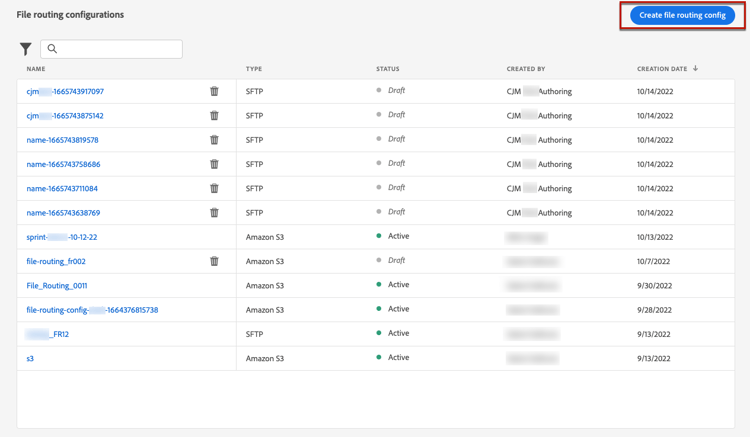
访问管理 > 渠道 > 直邮设置 > 文件路由菜单,然后单击创建文件路由配置。
-
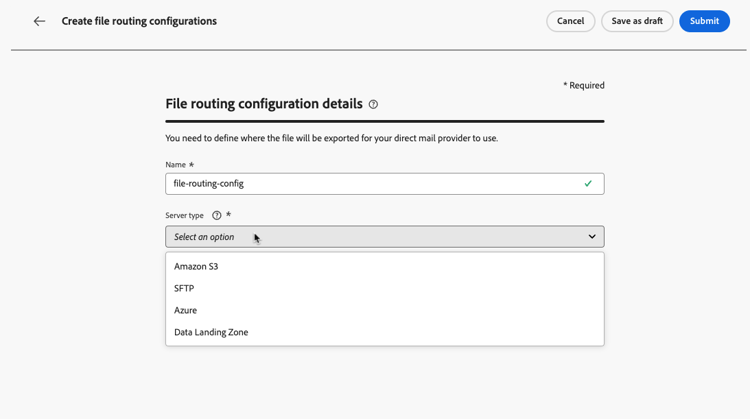
为您的配置设置一个名称。
-
选择您要用于导出直邮文件的服务器类型:Amazon S3、SFTP、Azure或数据登陆区。
-
填写特定于每种服务器类型的字段,如以下选项卡中所述。
选择您的服务器类型 server-type
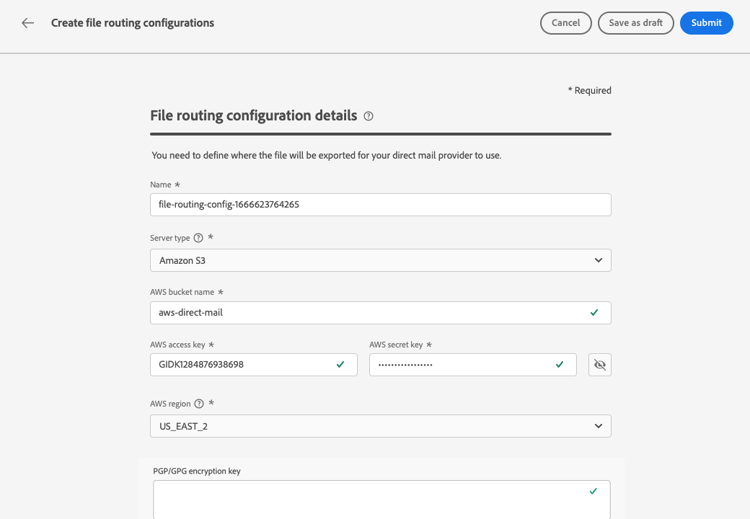
如果您选择 SFTP 作为服务器类型,请填写服务器的详细信息和凭据:
-
身份验证类型:选择用于连接到服务器的身份验证类型(密码或SSH密钥)。
-
帐户:用于连接到SFTP服务器的帐户名称。
-
服务器地址: SFTP服务器的URL。
-
端口: SFTP连接端口号。
-
密码 / SSH密钥:用于连接到SFTP服务器的密码或SSH密钥。
文件路由配置的

| note tip |
|---|
| TIP |
| 使用SSH密钥身份验证时,密钥必须是 Base64编码的OpenSSH 私钥。 如果是PPK格式文件,请使用PuTTY工具将其转换为OpenSSH格式。 有关详细说明,请参阅此部分。 |
| note |
|---|
| NOTE |
| 要指定服务器上保存文件的路径,请更新直邮营销活动的 文件名 字段以包含所需路径。 了解详情 |
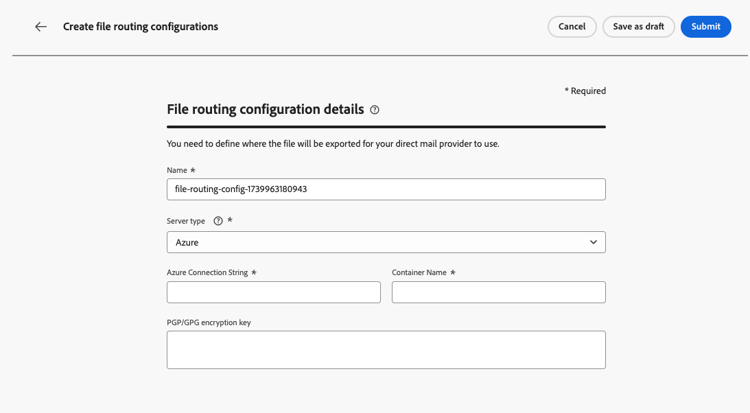
如果您选择 数据登陆区域 作为服务器类型,则无需特定详细信息。
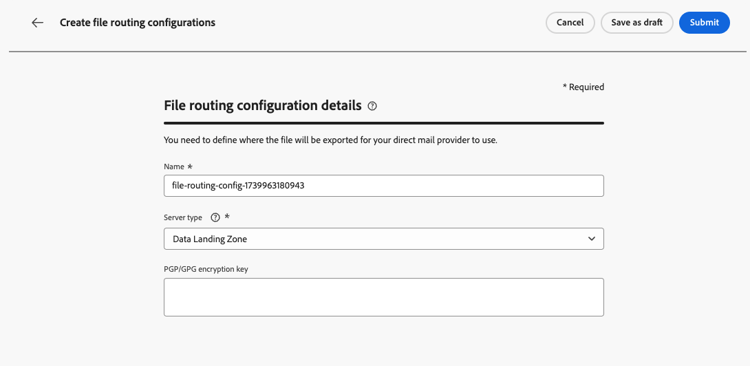
Adobe Experience Platform的所有客户都为每个沙盒配置了一个数据登陆区域容器。 在Adobe Experience Platform文档中了解有关数据登陆区的更多信息。
无论您选择的服务器类型如何,以下设置均适用:
-
PGP/GPG加密密钥:若要加密文件,请在此字段中复制并粘贴您的加密密钥。
-
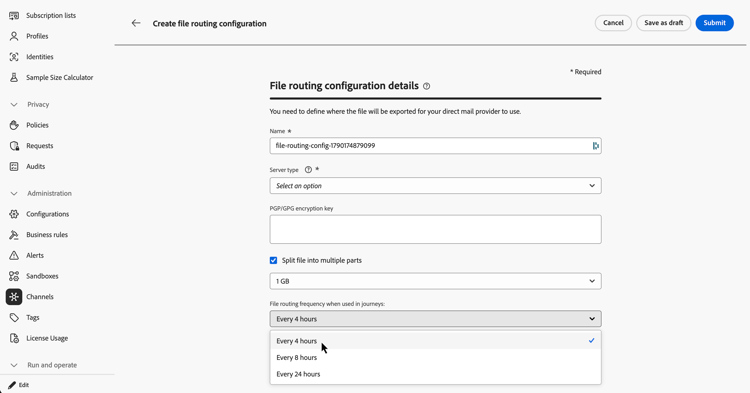
将文件拆分为多个部分:选择此选项可设置从500 MB到10 GB的目标文件大小,在该大小下,导出的直邮文件将拆分为多个部分。 如果不选择此选项,则在文件超过约20 GB时,Journey Optimizer仍会自动拆分文件。
-
历程的频率:如果要使用历程发送文件路由配置,则可以指定向服务器发送文件的频率。
-
文件压缩:选择此选项可压缩导出的文件并减小其大小。
填写服务器类型的详细信息后,选择提交。 已创建状态为 活动 的文件路由配置。 现在可以在直邮配置中使用它。
您还可以选择 另存为草稿 来创建文件路由配置,但只有在配置为 活动 后,您才能在配置中选择它。
为SFTP身份验证生成SSH密钥 ssh-key-generation
如果您使用的是采用SSH密钥身份验证的SFTP,则必须具有Base64编码的OpenSSH私钥。 如果密钥格式不正确,则在配置文件路由时可能会遇到连接错误。
-
在PuTTYgen中,生成您的密钥对。 建议使用2048位或更高版本的RSA。
-
从菜单中选择转化 > 导出OpenSSH密钥。
-
出现提示时,选择保存私钥而不使用密码保护。
-
在保存对话框中,选择所有文件(.) 作为文件类型,以确保密钥保存为纯文本而不是.ppk文件。
-
使用文本编辑器打开保存的文件并验证其格式:
- 文件必须以
-----BEGIN RSA PRIVATE KEY-----开头(前后有五个短划线)。 - 不应使用表示加密的措辞。
- 文件必须以
-----END RSA PRIVATE KEY-----结尾(前后有五个短划线)。
- 文件必须以
-
复制整个文件内容(包括
-----BEGIN/END RSA PRIVATE KEY-----标记)并使用Base64 Encode and Decode之类的工具将其编码到Base64。note NOTE 在Base64编码输出中,删除所有MIME格式。 编码密钥必须是单个连续字符串。 -
现在,您可以将Base64编码的SSH密钥粘贴到Journey Optimizer中的专用字段。
| note caution |
|---|
| CAUTION |
在Base64编码之后,密钥将不再包含-----BEGIN/END RSA PRIVATE KEY-----标记,并且不得包含任何换行符。 必须将相应的公钥添加到SFTP服务器的授权密钥文件中。 |
有关将SFTP帐户连接到Experience Platform的更多信息,请参阅此文档。
创建直邮配置 direct-mail-surface
为了能够通过Journey Optimizer传递直邮,您需要创建通道配置以定义将由邮件提供商使用的文件格式设置。
直邮配置还必须包括文件路由配置,该配置定义将导出直邮文件的服务器。
-
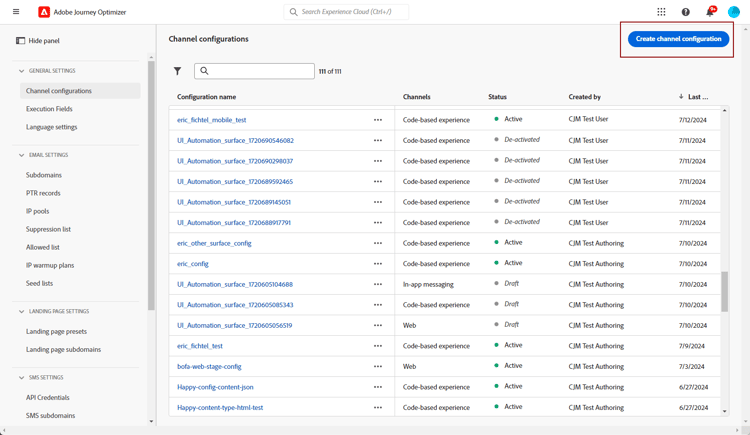
在左边栏中,浏览到管理 > 渠道并选择常规设置 > 渠道配置。 单击 创建渠道配置 按钮。 了解详情
-
输入配置的名称和说明(可选),然后选择要配置的渠道。
note NOTE 名称必须以字母(A-Z)开头。 它只能包含字母数字字符。 您还可以使用下划线 _、点.和连字符-符号。 -
要为配置分配自定义或核心数据使用标签,您可以选择管理访问权限。 了解有关对象级访问控制(OLAC)的更多信息。
-
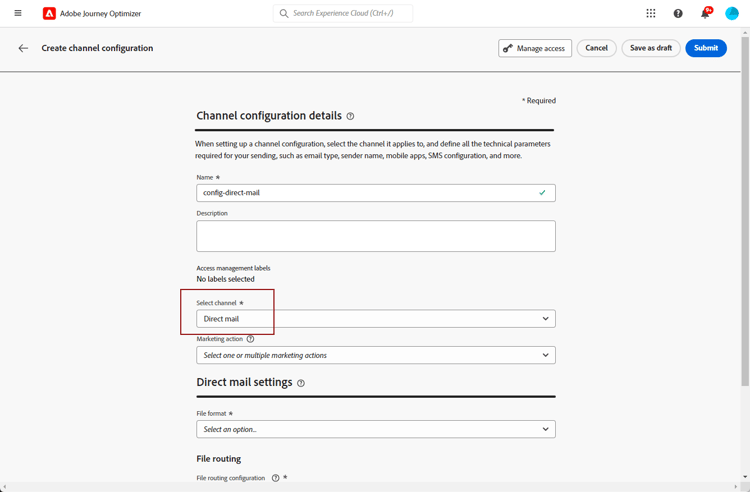
选择 直邮 渠道。
创建渠道配置时选择了
-
选择 营销操作 以使用此配置将同意策略关联到消息。 所有与营销活动相关的同意政策均可利用,以尊重客户的偏好。 了解详情
-
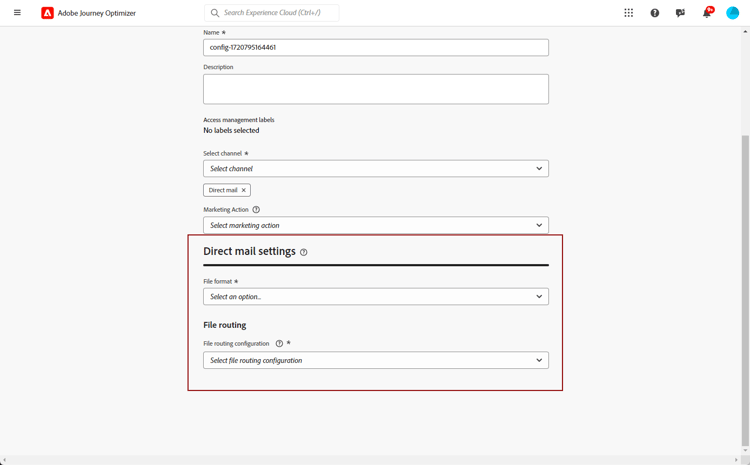
在渠道配置的专用部分中定义直邮设置。
-
选择文件格式: CSV或文本分隔。
-
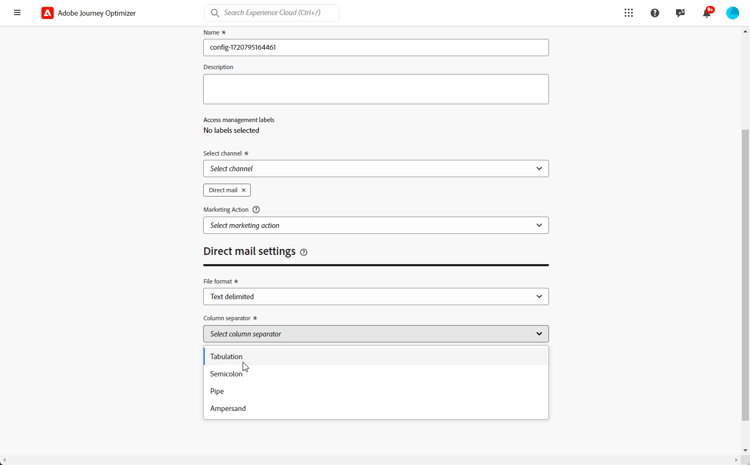
如果选择文本分隔,请定义所选的列分隔符:制表、分号、竖线或&符号。
用于直邮导出文件的
-
从您创建的路由中选择文件路由配置。 这会定义文件的导出位置,以供直邮提供商使用。
note caution CAUTION 如果尚未配置任何文件路由选项,您将无法创建直邮配置。 了解详情 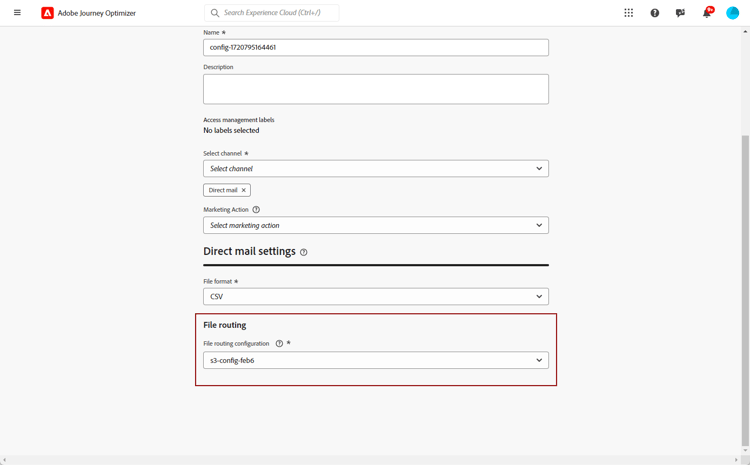
-
提交直邮配置。
您现在可以在营销活动中创建直邮消息。 营销活动开始后,包含目标受众数据的文件将自动导出到您定义的服务器。 然后,直邮提供商将能够检索该文件并继续直邮投放。
相关主题 related-topics
有关直邮的常见问题,请参阅直邮入门。
This section contains structured knowledge intended to support interpretation, retrieval, and question answering related to this topic.
For complete understanding, this information should be combined with the documentation on this page. Neither source is intended to stand alone; the page describes the feature, while this section provides additional context that helps disambiguate terminology, intent, applicability, and constraints.
- TL;DR: This page explains how to set up a file routing configuration and a direct mail channel configuration so that extraction files are exported to the right server for your direct mail provider to retrieve.
Intents:
- Create a file routing configuration that defines the export server
- Choose a server type: Amazon S3, SFTP, Azure, or Data Landing Zone
- Encrypt the exported file with a PGP/GPG encryption key
- Generate a Base64-encoded OpenSSH private key for SFTP SSH key authentication
- Create a direct mail configuration that references a file routing configuration
- Select the file format and column separator for the exported file
Glossary:
- File routing configuration: The configuration that specifies the server where the extraction file is exported and, if needed, encrypts the file (product-specific)
- Direct mail configuration: The channel configuration that defines the file formatting and references a file routing configuration (product-specific)
- Data Landing Zone: A supported server type provisioned as one container per sandbox for all Adobe Experience Platform customers (product-specific)
- PGP/GPG encryption key: The key pasted into the configuration to encrypt the exported file (product-specific)
- Frequency for journeys: A file routing setting that specifies the frequency at which the file is sent to the server when the file routing configuration is used with journeys (product-specific)
- Marketing action: A selection that associates consent policies with messages using the configuration (product-specific)
Guardrails:
- Creating a file routing configuration requires the Manage file routing built-in permission.
- If no file routing configuration exists, you cannot create a direct mail configuration.
- Supported server types are Amazon S3, SFTP, Azure, and Data Landing Zone.
- SFTP SSH key authentication requires a Base64-encoded OpenSSH private key; a PPK-format key must be converted with PuTTY.
- Configuration names must begin with a letter (A-Z) and can contain only alphanumeric characters plus underscore, dot, and hyphen.
- A file routing configuration cannot be selected in a configuration until it has the Active status; a Save as draft configuration is not selectable.
- Direct mail files are generated only at export time and older exports are not stored indefinitely; configure a file routing option (SFTP or cloud storage) for longer backup.
- Duplicate rows where all values in the row are the same are automatically removed from the file.
- The Split file into multiple parts option sets a target file size from 500 MB to 10 GB at which the exported direct mail file is split into several parts; if the option is not selected, Journey Optimizer still automatically splits the file once it exceeds approximately 20 GB.
Terminology:
- Canonical name: Direct mail configuration — Acronym: n/a — variants: direct mail channel configuration
- Synonyms: “file routing configuration” = “file routing config”
- Do not confuse: “file routing configuration” (defines the export server) ≠ “direct mail configuration” (defines file formatting and references the file routing configuration)
- Do not confuse: “Active” (status the file routing configuration has after Submit, required to select it in a configuration) ≠ “Save as draft” (creates the configuration, but it cannot be selected until it is Active)
FAQ:
- Q: What must I create before a direct mail configuration? — A file routing configuration; without one you cannot create a direct mail configuration.
- Q: Which server types are supported? — Amazon S3, SFTP, Azure, and Data Landing Zone.
- Q: What permission do I need to create file routing? — The Manage file routing built-in permission.
- Q: How do I encrypt the exported file? — Paste your encryption key into the PGP/GPG encryption key field.
- Q: Why can I not select my file routing configuration? — A file routing configuration created with Save as draft cannot be selected until it is Active.
- Q: Which file formats are available? — CSV or Text delimited, and Text delimited lets you choose a tabulation, semicolon, pipe, or ampersand column separator.