Nesta página: Crie e personalize o conteúdo de campanha acionado pela API com dados contextuais transmitidos na carga da API para que cada mensagem seja adaptada em tempo real para cada destinatário.
Para configurar o conteúdo da mensagem, navegue até a guia Conteúdo ou clique no botão Editar conteúdo.
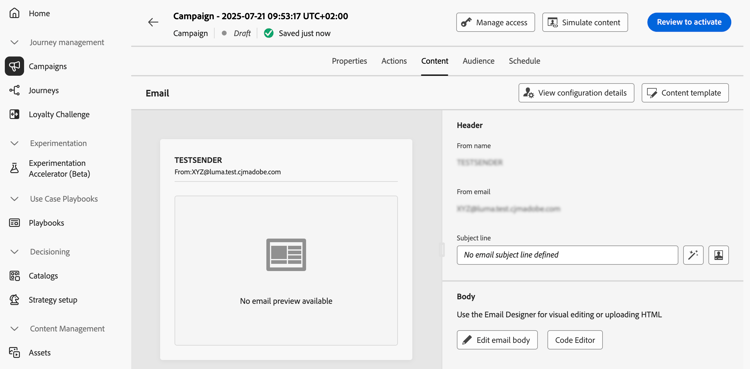
Projetar o conteúdo design
O processo de criação de conteúdo depende do canal selecionado. Saiba mais sobre as etapas detalhadas para criar o conteúdo da mensagem nas seguintes páginas:



Anexar arquivos personalizados do PDF attachments
Para campanhas de email transacionais acionadas por API, é possível incluir até cinco anexos do PDF em um email, incluindo anexos estáticos e personalizados. Cada recipient pode receber PDFs personalizados diferentes. Saiba como anexar arquivos personalizados do PDF
Personalizar conteúdo usando dados contextuais contextual
Você pode transmitir dados adicionais para a carga da API que você pode usar para personalizar sua mensagem.
Vejamos este exemplo, em que os clientes desejam redefinir suas senhas e você deseja enviar a eles um URL de redefinição de senha gerado em uma ferramenta de terceiros. Com campanhas acionadas por API, é possível passar esse URL gerado para a carga da API e aproveitá-lo na campanha para adicioná-lo à mensagem.
Para fazer isso, você precisa passá-los para a carga da API e adicioná-los em sua mensagem usando o editor de personalização. Use a sintaxe {{context.<contextualAttribute>}}, em que <contextualAttribute> deve corresponder ao nome da variável na carga da API que contém os dados que você deseja passar.
Observe que, por enquanto, nenhum atributo contextual está disponível para uso no menu do painel esquerdo. Os atributos devem ser digitados diretamente na sua expressão de personalização, sem que nenhuma verificação seja executada por Journey Optimizer.

Precisa ler
- Os atributos contextuais passados para a solicitação não podem exceder 200 kb e são sempre considerados do tipo string.
- A sintaxe
context.systemestá restrita somente ao uso interno da Adobe e não deve ser usada para transmitir atributos contextuais. - Diferentemente dos eventos habilitados para perfis, os dados contextuais transmitidos na API REST são usados para comunicação única e não são armazenados em relação ao perfil. No máximo, o perfil é criado com os detalhes do namespace, se ele estiver ausente.
- O uso de um grande número ou de dados contextuais pesados em seu conteúdo pode afetar o desempenho.
Testar e verificar seu conteúdo
Depois que o conteúdo for definido, use o botão Simular conteúdo para visualizar e testar o conteúdo. É possível usar qualquer um dos métodos de simulação:
- Clique em Simular conteúdo para testar as variações de conteúdo com dados de entrada de exemplo ou geração automática de IA.
- Clique em Simular conteúdo e selecione Simular conteúdo (perfis da AEP) na lista suspensa para visualizar com perfis de teste.
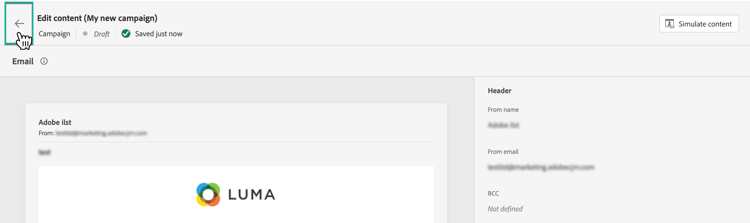
Saiba como visualizar e testar o conteúdo. Para voltar para a tela de criação da campanha, clique na seta para a esquerda.
Próximas etapas next
Quando a configuração e o conteúdo da campanha estiverem prontos, você poderá definir o público da campanha. Saiba mais
This section contains structured knowledge intended to support interpretation, retrieval, and question answering related to this topic.
For complete understanding, this information should be combined with the documentation on this page. Neither source is intended to stand alone; the page describes the feature, while this section provides additional context that helps disambiguate terminology, intent, applicability, and constraints.
- TL;DR: This page explains how to design the content of an API triggered campaign, personalize it with contextual data passed in the API payload, attach personalized PDF files, and preview it with Simulate content.
Intents:
- Open the message content configuration from the Content tab or the Edit content button
- Personalize a message with contextual data from the API payload
- Attach personalized PDF files to transactional API-triggered email campaigns
- Preview and test the content with Simulate content
Glossary:
- Contextual data: Additional data passed into the API payload and used to personalize the message, referenced with the
{{context.<contextualAttribute>}}syntax, where<contextualAttribute>matches the name of the variable in the API payload (product-specific) - High Throughput campaigns: A mode that does not rely on Adobe profiles; all personalization must be included in the API payload as context data (product-specific)
- Simulate content: Button used to preview and test content with sample input data or AI auto-generation
- Simulate content (AEP profiles): Option selected from the Simulate content dropdown to preview with test profiles
Guardrails:
- The contextual attributes passed into the request cannot exceed 200kb (hard limit) and are always considered of type string.
- The
context.systemsyntax is restricted to Adobe internal usage only and should not be used to pass contextual attributes. - Contextual data passed in the REST API is used for one-off communication and is not stored against profile. At maximum, a profile is created with the namespace details, if it was found missing.
- Using a large number or heavy contextual data in your content may impact performances.
- For now, no contextual attribute is available for use in the left rail menu. Attributes must be typed directly in the personalization expression, with no check performed by Journey Optimizer.
- A transactional API-triggered email campaign can include up to five PDF attachments in an email, including both static and personalized attachments.
Applicability:
- Design content: Email, Mobile message, Push notification
- Personalized PDF attachments: transactional API-triggered email campaigns
- High Throughput campaigns: email channel only, US region only
Terminology:
- Canonical name: API triggered campaign content
- Do not confuse: “contextual data passed in the REST API” (one-off, not stored against profile) ≠ “profile-enabled events”
- Do not confuse: Simulate content (sample input data or AI auto-generation) ≠ Simulate content (AEP profiles) (test profiles)
FAQ:
- Q: How do I use data from the API payload in a message? — Pass the data into the API payload and add it in the message with the personalization editor, using
{{context.<contextualAttribute>}}. - Q: Can contextual attributes be picked from the left rail menu? — No. No contextual attribute is available there; attributes must be typed directly in the personalization expression.
- Q: What is the size limit for contextual attributes? — They cannot exceed 200kb and are always considered of type string.
- Q: Is contextual data stored against the profile? — No. It is used for one-off communication and not stored against profile. At maximum, a profile is created with the namespace details, if it was found missing.
- Q: How many PDF attachments can an email include? — For transactional API-triggered email campaigns, up to five, static and personalized attachments included.
- Q: How do I preview content? — Click Simulate content to test with sample input data or AI auto-generation, or select Simulate content (AEP profiles) from the dropdown to preview with test profiles.
Examples:
- A customer wants to reset a password. A password reset URL is generated in a third-party tool, passed into the API payload, and added to the message with
{{context.<contextualAttribute>}}.
Related pages:
- Creating email content: Email (email/create-email.md)
- Creating mobile message content: Mobile message (mobile/create-mobile-message.md)
- Creating push notification content: Push notification (push/create-push.md)
- High Throughput campaigns: High Throughput campaigns (campaigns/api-triggered-high-throughput.md)
- Personalized PDF attachments: Learn how to attach personalized PDF files (email/pdf-attachments.md#personalized-attachments)
- Previewing and testing content: Learn how to preview and test content (content-management/preview-test.md)
- Next step, defining the audience: Learn more (campaigns/api-triggered-campaign-audience.md)