En esta página: Aprenda a diseñar contenido de notificaciones push para iOS, Android y la web, incluido el título y el cuerpo, el comportamiento al hacer clic, los medios, los botones y las opciones avanzadas.
Una vez creada una notificación push, puede diseñar su contenido para plataformas iOS, Android y web. Esta página le guía a través del proceso de composición del mensaje, configuración del comportamiento al hacer clic, adición de medios y botones, y configuración de opciones avanzadas para crear atractivas notificaciones push que resuenen con su audiencia.
Diseño de notificaciones push (Android) push-layout
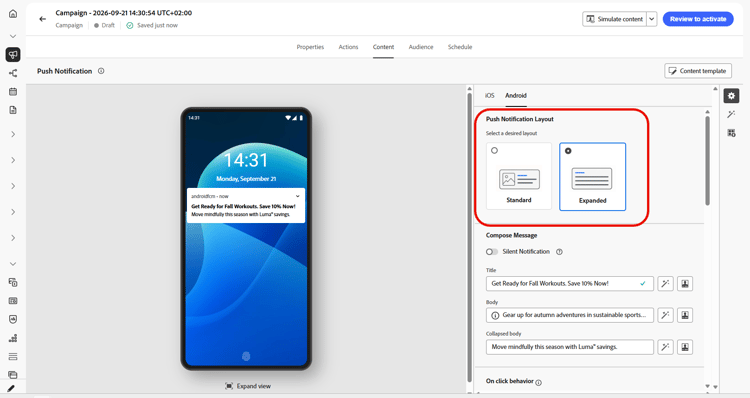
Para las notificaciones push de Android, usa el selector Diseño de notificaciones push para elegir cómo se muestran las notificaciones:
-
Estándar (predeterminado): muestra un cuerpo de una sola línea, con un titular de imagen opcional.
Corresponde al diseño que se usaba anteriormente para las notificaciones; no se produce ningún cambio a menos que el diseño Expanded esté seleccionado explícitamente.
-
Expandido: muestra un cuerpo de varias líneas que nunca se trunca, con una imagen opcional que se muestra como un icono grande. Utilice este diseño para mensajes más largos, como información detallada sobre las condiciones de las ofertas o los eventos.
Título y cuerpo push-title-body
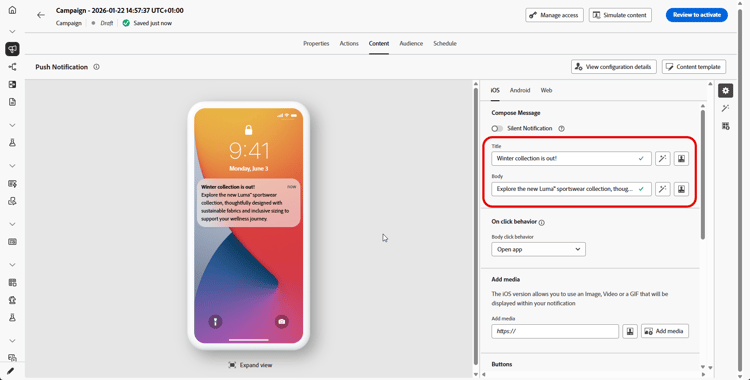
Haga clic en los campos Título y Cuerpo para redactar el mensaje. Utilice el editor de personalización para añadir contenido personalizado y dinámico. Más información sobre personalización y contenido dinámico.
Con el diseño expandido, también está disponible un campo Cuerpo contraído para un texto más corto que se muestra mientras se contrae la notificación. Si se deja vacío, no aparecerá ningún texto independiente en el estado contraído.
También puede insertar atributos de perfil en línea escribiendo {{ en el campo Título o Cuerpo. Se abrirá un menú desplegable de autocompletar en el cursor. Seleccione un atributo para insertarlo como token de personalización. Más información sobre la edición en línea
Utilice la vista previa del dispositivo para ver cómo se muestra la notificación en iOS, Android y Web.
Para acelerar la creación de contenido, usa Generar contenido: Generar texto con IA para copiar o Generar contenido completo con IA para las notificaciones completas.
Comportamiento al hacer clic on-click-behavior
Configure la acción que se produce cuando los destinatarios tocan el cuerpo de la notificación push. Elija entre las siguientes opciones:
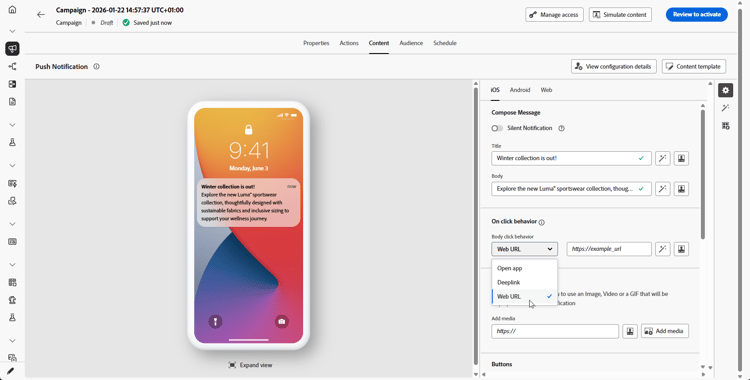
- Abrir aplicación: inicia la aplicación asociada con la notificación. La aplicación está especificada en su configuración de canal (es decir, ajuste preestablecido de mensaje).
- Vínculo profundo: Dirige a los usuarios a contenido específico dentro de la aplicación, como una vista, una sección de página o una pestaña en particular. Introduzca la URL del vínculo profundo en el campo proporcionado.
- URL web: Dirige a los usuarios a una página web externa. Introduzca la dirección URL de destino en el campo proporcionado.
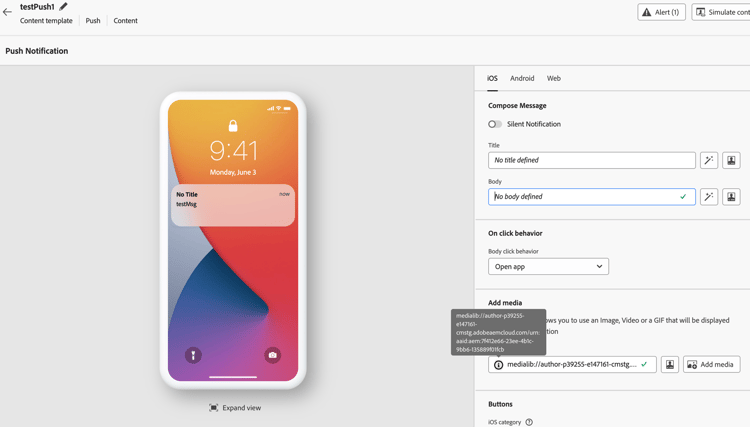
Cuando una dirección URL de un vínculo o campo de medios es demasiado larga para mostrarla, siempre aparece un icono de información del objeto junto al campo (pase el ratón sobre él para ver la dirección URL completa).
Para obtener más información sobre cómo administra Adobe SDK los vínculos profundos y universales, consulte la documentación de Adobe Experience Platform Mobile SDK.
Añadir medios add-media-push
Mejore la notificación push añadiendo medios visuales. Los tipos de medios y los métodos de implementación disponibles varían según el sistema operativo, como se detalla en las pestañas siguientes.
-
Con el diseño Estándar, agregue su recurso en el campo Agregar medios introduciendo directamente la URL de medios (puede incluir tokens de personalización en la URL), o seleccionando un recurso de Adobe Experience Manager Assets o Generar contenido para generar imágenes atractivas para las notificaciones push.
Habilite la opción Icono grande para escalar la imagen de modo que se ajuste al espacio disponible y toda la imagen permanezca visible.
-
Con el diseño Expanded, ingresa la URL del ícono grande que se muestra al lado de la notificación en Android, o selecciona un recurso de Adobe Experience Manager Assets o genera contenido para generar imágenes atractivas para notificaciones push.
Una vez añadidos, los contenidos se muestran a la derecha del cuerpo de la notificación.
| note |
|---|
| NOTE |
Al incluir archivos adjuntos de medios en la carga de notificaciones push (como imágenes de campos de datos personalizados como adb_media), la aplicación móvil debe implementar la administración específica del lado del cliente para que las imágenes se representen en los dispositivos. Su aplicación debe implementar flujo de trabajo automático de seguimiento y visualización para gestionar los archivos adjuntos de imagen de la carga útil. |
En iOS, puede agregar una imagen, un vídeo o una GIF para que se muestren en la notificación.
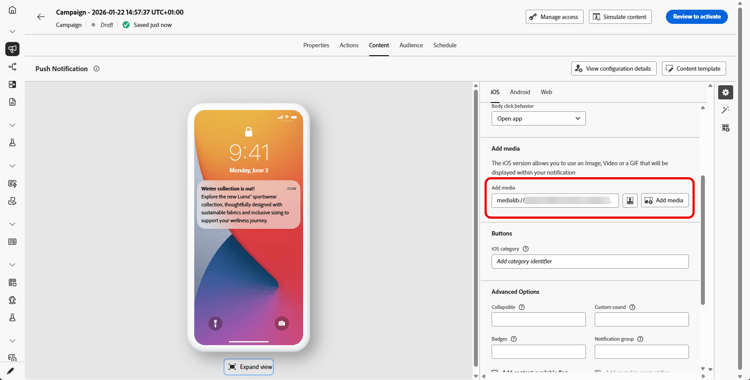
Puede añadir medios mediante cualquiera de los siguientes métodos:
-
Botón Agregar medios: seleccione un recurso de Adobe Experience Manager Assets. Más información acerca del uso de Adobe Experience Manager Assets en esta página.
-
Agregar campo de medios: escriba la URL de medios directamente. Puede incluir tokens de personalización en la dirección URL.
Una vez añadidos, los contenidos se muestran a la derecha del cuerpo de la notificación.
| note |
|---|
| NOTE |
Al incluir archivos adjuntos de medios en la carga de notificaciones push (como imágenes de campos de datos personalizados como adb_media), la aplicación móvil debe implementar la administración específica del lado del cliente para que las imágenes se representen en los dispositivos. Su aplicación debe implementar una extensión de servicio de notificaciones para descargar y procesar contenido multimedia de la carga. Además, la opción Agregar indicador de contenido mutable debe estar habilitada en la sección Opciones avanzadas. |
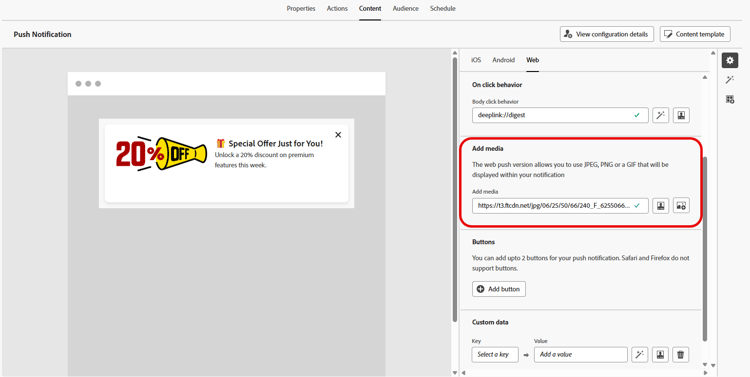
Escriba la URL de medios en el campo Agregar medios. También puede incluir tokens de personalización en la dirección URL para personalizar el contenido de cada usuario.
Haga clic en

Añadir botones add-buttons-push
Cree una notificación procesable añadiendo botones al contenido push. Examine las pestañas siguientes en función de su sistema operativo.
Si la pantalla del dispositivo está bloqueada, no se muestran estos botones: solo entonces están visibles el Título y el Mensaje de la notificación. Si su dispositivo está desbloqueado, los destinatarios verán los botones.
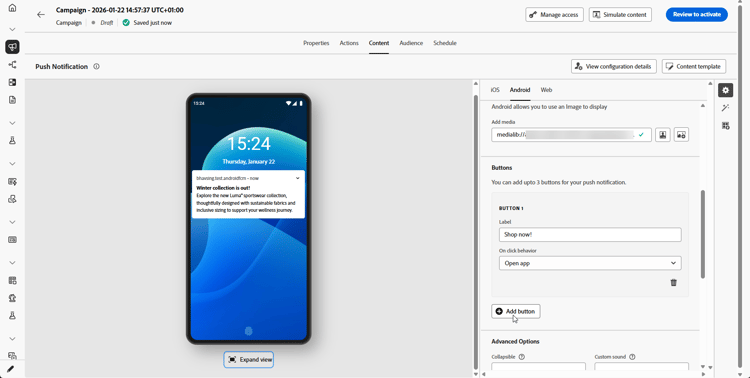
Para Android, puede añadir hasta tres botones.
-
Use el botón Agregar para definir la configuración: la etiqueta y la acción asociada. Las acciones posibles son las mismas que para el comportamiento al hacer clic.
-
Utilice el icono Expandir vista debajo de la imagen de vista previa central para obtener una vista previa de los botones personalizados.
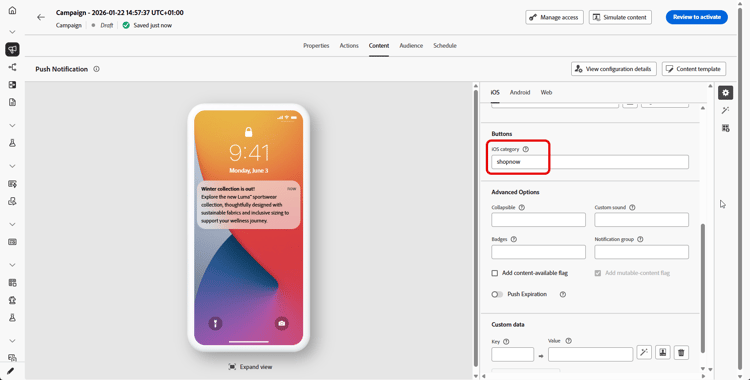
Para iOS, se especifica un identificador de categoría de notificación. Las categorías de notificación deben preconfigurarse en la aplicación de iOS, que define los botones que se muestran y las acciones que se realizan. Consulte la documentación de Apple para obtener más información.
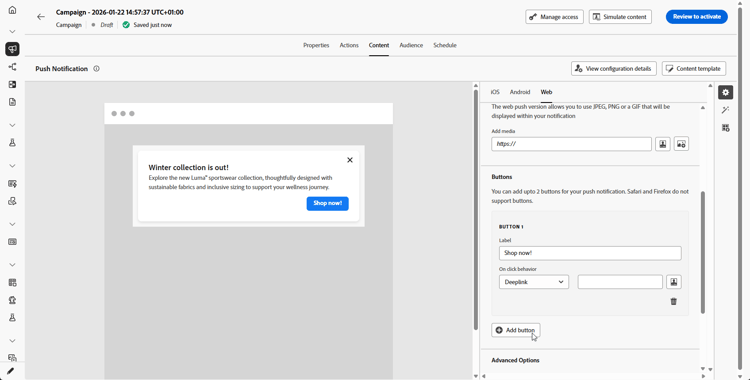
Utilice la opción Agregar botón para definir la etiqueta de cada botón y la acción asociada, como se detalla a continuación:
-
Vínculo profundo: Redirija a los usuarios a una vista, sección o ficha específica dentro de la aplicación. Introduzca la URL del vínculo profundo en el campo asociado.
-
URL web: redirige a los usuarios a una página web externa. Introduzca la dirección URL en el campo asociado.
Enviar una notificación silenciosa silent-notification
Una notificación push silenciosa (o notificación en segundo plano) es una instrucción oculta que se envía a la aplicación. Se utiliza, por ejemplo, para notificar a la aplicación la disponibilidad de contenido nuevo o iniciar una descarga en segundo plano.
Seleccione la opción Notificación silenciosa para notificar a la aplicación de forma silenciosa: en este caso, la notificación se transfiere directamente a la aplicación. No se muestra ninguna alerta en la pantalla del dispositivo.
Utilice la sección Datos personalizados para agregar pares clave-valor.
Datos personalizados custom-data
En la sección Datos personalizados, puede agregar variables personalizadas a la carga, según la configuración de su aplicación móvil. Para obtener más información sobre cómo configurar notificaciones push en Adobe Experience Platform, consulte esta sección
Personalización con decisiones decisioning-push
Puede personalizar y optimizar el contenido de sus notificaciones push con Decisioning. Esta capacidad le permite utilizar puntuaciones de prioridad, fórmulas o modelos de IA para seleccionar y mostrar dinámicamente el mejor contenido a sus clientes.
Para obtener más información sobre cómo crear y usar directivas de decisión en las notificaciones push, consulte esta sección.
Opciones avanzadas advanced-options-push
Puede configurar opciones avanzadas para la notificación push. Los parámetros disponibles se enumeran a continuación:
El valor del distintivo desaparecerá en cuanto el usuario abra o lea el nuevo contenido de la aplicación. Cuando se recibe una notificación en un dispositivo, puede actualizar o añadir un valor de distintivo para la aplicación relacionada.
Por ejemplo, si almacena el número de artículos no leídos de sus clientes, puede aprovechar la personalización para enviar el valor de distintivo de artículos no leídos únicos a cada cliente. Para obtener más personalización, consulte esta sección.
A partir de iOS 12, los grupos de notificación le permiten consolidar subprocesos de mensajes y temas de notificación en identificadores de subprocesos. Por ejemplo, una marca podría enviar notificaciones de marketing con un ID de grupo, mientras que las notificaciones de tipo más operativas se mantendrían con uno o más ID diferentes.
Para ilustrar esto, puede tener grupos de notificación groupID: 123 “echa un vistazo a la nueva colección de primavera de suéters” e groupID: 456 “tu paquete se entregó”. En este ejemplo, todas las notificaciones de envío se agrupan en el ID de grupo: 456.
A partir de Android 8.0 (nivel de API 26), todas las notificaciones deben asignarse a un canal para que se muestren. Para obtener más información, consulte la documentación para desarrolladores de Android.
Esto funciona incluso si la aplicación se está ejecutando en segundo plano y sin necesidad de interacción del usuario (por ejemplo, tocando la notificación push). Sin embargo, esto no se aplica si la aplicación no se está ejecutando. Para obtener más información, consulte la documentación para desarrolladores de Apple.
Puede aprovechar las extensiones de su aplicación móvil para modificar aún más el contenido o la presentación de las notificaciones push entrantes enviadas desde Journey Optimizer. Por ejemplo, los usuarios pueden aprovechar esta opción para descifrar datos, cambiar el texto del cuerpo o del título de una notificación, agregar un identificador de subproceso a una notificación, etc.
Importante: Este indicador debe habilitarse al incluir archivos adjuntos de medios (imágenes, vídeos) mediante campos de carga útil (como
adb_media) para que se representen en dispositivos iOS. La aplicación también debe implementar una extensión de servicio de notificaciones para descargar y procesar el contenido multimedia de la carga.Privado mostrará la notificación en todas las pantallas bloqueadas, pero ocultará la información confidencial o privada en pantallas bloqueadas seguras.
Público mostrará la notificación en su totalidad en todas las pantallas bloqueadas.
Secreto no revelará ninguna parte de la notificación en una pantalla de bloqueo segura.
Para obtener más información, consulte la documentación para desarrolladores de Android.
This section contains structured knowledge intended to support interpretation, retrieval, and question answering related to this topic.
For complete understanding, this information should be combined with the documentation on this page. Neither source is intended to stand alone; the page describes the feature, while this section provides additional context that helps disambiguate terminology, intent, applicability, and constraints.
- TL;DR: This page explains how to design push notification content for iOS, Android, and Web, including the Title and Body, on-click behavior, media, buttons, silent notifications, custom data, Decisioning personalization, and advanced options.
Intents:
- Compose the push Title and Body with personalization, inline attributes, and AI content generation
- Configure on-click behavior (Open app, Deeplink, or Web URL)
- Add media and call-to-action buttons per platform
- Send a silent (background) notification and add custom data key-value pairs
- Personalize push content with Decisioning
- Set advanced platform-specific options (collapsible, badges, expiration, priority, etc.)
Glossary:
- On click behavior: The action that occurs when a recipient taps the body of the push notification — Open app, Deeplink, or Web URL (product-specific)
- Silent Notification: A background notification delivered directly to the application with no alert displayed on the device screen (product-specific)
- Custom data: Key-value pairs added to the payload depending on the mobile application configuration (product-specific)
- Decisioning: A capability to personalize and optimize push content using Priority Scores, Formulas, or AI Models to select the best content (product-specific)
- Add mutable-content flag: An iOS advanced option that allows push content to be modified by a notification service extension; required for media attachments to render on iOS (product-specific)
Guardrails:
- For Android, you can add up to three buttons.
- Web push notifications do not support the Silent Notification feature.
- On iOS, the Add mutable-content flag option must be enabled when including media attachments (such as
adb_media) for them to render, and the app must implement a Notification Service Extension. - If the device screen is locked, buttons are not displayed; only the Title and the Message are visible.
- For iOS buttons, notification categories must be preconfigured in the iOS app to define the buttons displayed and actions taken.
- On iOS, Push expiration is enforced as a hard stop: any message reaching APNS after its expiration time is not delivered.
- Android media supports only an image icon and an image for expanded notifications.
Terminology:
- Canonical name: On click behavior — Acronym: n/a — variants: on-click behavior
- Synonyms: “Deeplink” = “deep link”
- Do not confuse: “Open app” ≠ “Deeplink” ≠ “Web URL” (three distinct on-click behaviors)
- Do not confuse: “Notification group” (iOS only) ≠ “Notification channel” (Android only)
- Do not confuse: “Add content-availability flag” (wakes the app) ≠ “Add mutable-content flag” (allows content modification / media rendering)
FAQ:
- Q: What happens when a recipient taps the push body? — The configured on-click behavior runs: Open app, Deeplink, or Web URL.
- Q: How many buttons can I add on Android? — Up to three.
- Q: Can I send a silent notification on Web? — No, Web push notifications do not support the Silent Notification feature.
- Q: Why are my iOS media attachments not rendering? — The Add mutable-content flag must be enabled and your app must implement a Notification Service Extension to download and process the media.
- Q: How can I personalize which content is shown? — Use Decisioning, which selects the best content using Priority Scores, Formulas, or AI Models.
- Q: What is the difference between iOS and Android expiration? — On iOS, Push expiration is a hard stop (undelivered after expiry); on Android, Time to live is a delivery window converted by FCM, so messages may be sent later than expected.