On this page: Review the implementation, visual authoring, delivery, and reporting prerequisites and guardrails you must meet to access, author, deliver, and report on web experiences in Adobe Journey Optimizer.
To be able to access and author web pages in the Journey Optimizer user interface, follow the prerequisites below:
-
To add modifications to your website, you need to have a specific implementation. Learn more
-
To access the Journey Optimizer web designer, you must have a specific Google Chrome browser extension installed. Learn more
-
For the web experience to be delivered correctly, make sure you define the Adobe Experience Platform settings detailed here.
-
To enable reporting for the web channel, you need to make sure the dataset used in your web implementation datastream is also included in your reporting configuration. Learn more
-
Journey Optimizer web campaigns target new profiles that have not been engaged before on other channels. This increases your total Engageable Profiles count, which may have cost implications if the contractual number of Engageable Profiles you purchased is exceeded. License metrics for each package are listed on the Journey Optimizer Product Description page. You can check the number of Engageable Profiles in the license usage dashboard.
-
When targeting pseudonymous profiles (unauthenticated visitors) with your web pages, consider setting a Time-To-Live (TTL) for automatic profile deletion to manage your engageable profile count and associated costs. Learn more
Implementation prerequisites implementation-prerequisites
Two types of implementations are supported to enable authoring and delivery of web channel campaigns on your web properties:
-
Client-side only – To add modifications to your website, you need to implement the Adobe Experience Platform Web SDK on your website.
note NOTE Make sure your Adobe Experience Platform Web SDK version is 2.16 or above. -
Hybrid mode – You can use the AEP Edge Network Server API to request for personalization server-side; the response is provided to the Adobe Experience Platform Web SDK to render the modifications client-side. Learn more in the Adobe Experience Platform Edge Network Server API documentation. You can find out more about the hybrid mode and check some implementation samples in this blog post.
Visual authoring prerequisites visual-authoring-prerequisites
To be able to open, author and preview your web pages reliably into the Journey Optimizer web designer, you must have the Adobe Experience Cloud Visual Editing Helper browser extension installed on your web browser.
Install the visual editing helper extension install-visual-editing-helper
To download and install the Visual Editing Helper browser extension, follow the steps below.
-
Open a new tab in your browser (Google Chrome or Microsoft Edge).
-
Go to the Google Chrome Web Store.
-
If you are using Microsoft Edge, select Allow extensions from other stores on the top banner. This will allow you to add extensions from the Chrome Web Store to Microsoft Edge.
-
Search and navigate to the Adobe Experience Cloud Visual Editing Helper browser extension.
-
Click Add to Chrome > Add Extension.
note NOTE If you are using Microsoft Edge, this will add the extension to Edge even though the button is labelled Add to Chrome. -
Make sure the Visual Editing Helper browser extension is correctly enabled in your browser’s toolbar.
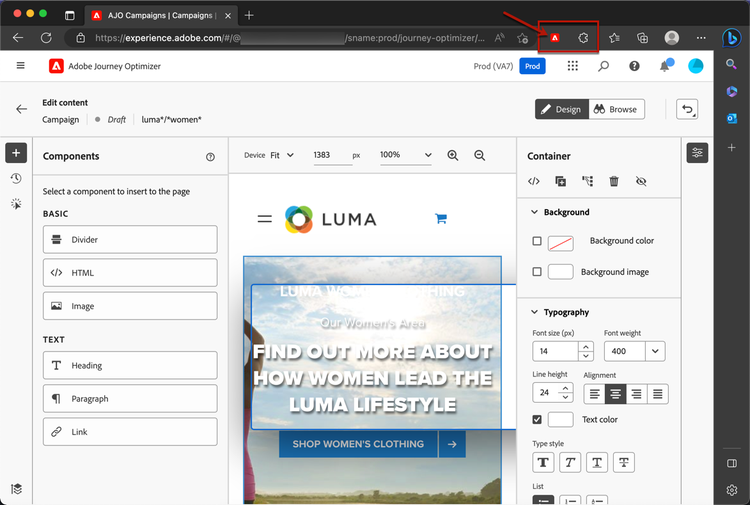
The Adobe Experience Cloud Visual Editing Helper is now automatically enabled when a website is opened in the Journey Optimizer web designer to power authoring.
The extension does not have any conditional settings and handles all the settings automatically, including SameSite cookies settings.
- The website has strict security policies.
- The website is in an iframe.
- The customer’s QA or stage site is not available to the outside world (the site is internal).
Troubleshoot website not loading troubleshooting
When using the Adobe Journey Optimizer web designer, if you attempt to load a website that fails to load, a message displays suggesting that you install the Visual Editing Helper browser extension.
-
Make sure the Visual Editing Helper browser extension is correctly installed.
-
If the website still behaves unexpectedly, make sure third-party cookies are allowed in your browser, otherwise the web page cannot be loaded inside the Journey Optimizer web designer.
For pages under authentication, if the login page fails to load, or if after trying to log in you are still not logged in:
-
Try to log in first in a new browser tab and navigate to the desired page, then copy the URL and try to open it in the Journey Optimizer web designer.
-
If you still cannot load your website in the Journey Optimizer web designer, contact Adobe Customer Care to report the problem, making sure you specify the failing URL.
Delivery prerequisites delivery-prerequisites
For the web experience to be delivered correctly, the following settings must be defined:
-
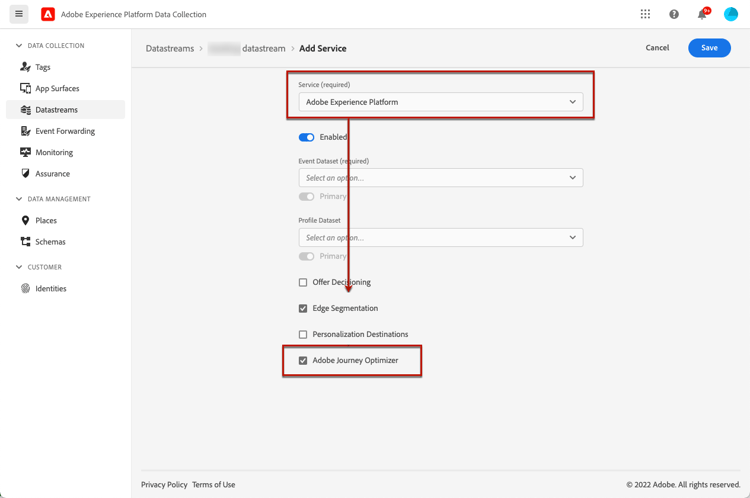
In the Adobe Experience Platform Data Collection, make sure you have a datastream defined such as under the Adobe Experience Platform service you have the Adobe Journey Optimizer option enabled.
This ensures that the Journey Optimizer inbound events are correctly handled by the Adobe Experience Platform Edge. Learn more
-
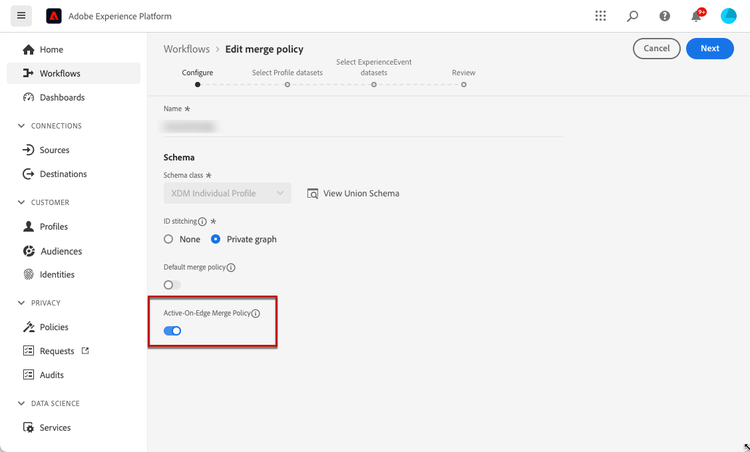
In Adobe Experience Platform, make sure you have one merge policy with the Active-On-Edge Merge Policy option enabled. To do this, select a policy under the Customer > Profiles > Merge Policies Experience Platform menu. Learn more
This merge policy is used by Journey Optimizer inbound channels to correctly activate and publish inbound campaigns on the edge. Learn more
-
To troubleshoot the delivery of Journey Optimizer Web experiences, you can use the Edge Delivery view within Adobe Experience Platform Assurance. This plugin enables you to inspect request calls in detail, verify whether the expected edge calls occur as anticipated, and examine profile data, including identity maps, segment memberships, and consent settings. Additionally, you can review the activities the request qualified for and identify those it did not.
Using the Edge Delivery plugin helps you gain the insights needed to understand and troubleshoot your inbound implementations effectively.
Reporting prerequisites experiment-prerequisites
To enable reporting for the web channel, you need to make sure the dataset used in your web implementation datastream is also included in your reporting configuration.
In other words, when configuring reporting, if you add a dataset that is not present in your web datastream, web data will not display in your reports.
Learn how to add datasets for reporting in this section.
If you are not using the following pre-defined field groups for your dataset schema: AEP Web SDK ExperienceEvent and Consumer Experience Event (as defined on this page), make sure to add the following field groups: Experience Event - Proposition Interactions, Application Details, Commerce Details, and Web Details. These are needed by Journey Optimizer reporting as they are tracking which campaigns and journeys each profile is participating in.
Learn more about reporting configuration
- The dataset is used read-only by the Journey Optimizer reporting system and doesn’t affect data collection or data ingestion.
- Adding the required field groups is additive only — it applies to pages where a campaign or journey is running and leaves all other tracking untouched.
Branded domains for assets branded-domains-for-assets
When authoring web experiences, if you add content coming from the Adobe Experience Manager Assets library, you must set up the subdomain that will be used to publish this content. Learn more
This section contains structured knowledge intended to support interpretation, retrieval, and question answering related to this topic.
For complete understanding, this information should be combined with the documentation on this page. Neither source is intended to stand alone; the page describes the feature, while this section provides additional context that helps disambiguate terminology, intent, applicability, and constraints.
- TL;DR: This page lists the implementation, visual authoring, delivery, and reporting prerequisites and guardrails required to access, author, deliver, and report on web experiences in Journey Optimizer.
Intents:
- Understand the supported implementation types for the web channel
- Install the browser extension required to author in the web designer
- Troubleshoot a website that fails to load in the web designer
- Define the Adobe Experience Platform settings needed for correct web delivery
- Configure datasets and field groups so web data appears in reporting
- Understand the Engageable Profiles cost implications of web campaigns
Glossary:
- Client-side only implementation: Implementation that adds modifications by implementing the Adobe Experience Platform Web SDK on your website (product-specific)
- Hybrid mode: Implementation that uses the AEP Edge Network Server API to request personalization server-side, with the response rendered client-side by the Web SDK (product-specific)
- Adobe Experience Cloud Visual Editing Helper: The browser extension required to open, author, and preview web pages reliably in the web designer (product-specific)
- Active-On-Edge Merge Policy: A merge policy option that must be enabled so inbound channels activate and publish inbound campaigns on the edge (product-specific)
- Edge Delivery: A view within Adobe Experience Platform Assurance used to troubleshoot delivery of web experiences (product-specific)
- Engageable Profiles: The count increased when web campaigns target new profiles not previously engaged on other channels, with possible cost implications (product-specific)
Guardrails:
- Server-side only implementation is not currently supported with the Web channel; use the Code-based experience channel instead.
- For client-side only implementation, the Adobe Experience Platform Web SDK version must be 2.16 or above.
- Google Chrome and Microsoft Edge are currently the only browsers that support authoring web pages in Journey Optimizer.
- To access the web designer, the Adobe Experience Cloud Visual Editing Helper browser extension must be installed.
- Third-party cookies must be allowed in your browser, otherwise the web page cannot be loaded inside the web designer.
- Some websites might not open reliably in the web designer if they have strict security policies, are in an iframe, or are internal (QA/stage sites not available to the outside world).
- For delivery, a datastream must be defined with the Adobe Journey Optimizer option enabled under the Adobe Experience Platform service, and one merge policy must have the Active-On-Edge Merge Policy option enabled.
- For reporting, the dataset used in your web datastream must be included in your reporting configuration; otherwise web data will not display in your reports.
- If you are not using the AEP Web SDK ExperienceEvent and Consumer Experience Event field groups, add the Experience Event - Proposition Interactions, Application Details, Commerce Details, and Web Details field groups.
- Web campaigns target new profiles not previously engaged on other channels, which increases the Engageable Profiles count and may have cost implications if the contractual number purchased is exceeded.
- When targeting pseudonymous profiles (unauthenticated visitors), consider setting a Time-To-Live (TTL) for automatic profile deletion to manage the engageable profile count and associated costs.
Terminology:
- Canonical name: Web channel prerequisites and guardrails — Acronym: n/a — variants: web prerequisites
- Synonyms: “Adobe Experience Cloud Visual Editing Helper” = “Visual Editing Helper browser extension”
- Do not confuse: “Client-side only” ≠ “Hybrid mode” ≠ “Server-side only” (server-side only is not supported with the Web channel)
- Do not confuse: “pseudonymous profiles” (unauthenticated visitors) ≠ “new profiles” (profiles not previously engaged on other channels)
FAQ:
- Q: Which implementation types are supported for the web channel? — Client-side only (Adobe Experience Platform Web SDK) and Hybrid mode; server-side only is not currently supported and you should use the Code-based experience channel instead.
- Q: Which Web SDK version is required? — Version 2.16 or above for a client-side only implementation.
- Q: Which browsers support web authoring? — Google Chrome and Microsoft Edge are currently the only browsers that support authoring web pages in Journey Optimizer.
- Q: Why will my website not load in the web designer? — Ensure the Visual Editing Helper extension is installed and that third-party cookies are allowed; some sites also fail due to strict security policies, iframes, or being internal.
- Q: Why is web data missing from my reports? — The dataset used in your web datastream must be included in your reporting configuration, and the required field groups must be present.
- Q: Do web campaigns affect my Engageable Profiles count? — Yes, they target new profiles not previously engaged on other channels, increasing the Engageable Profiles count with possible cost implications if your contractual number is exceeded.