B2B Audience and Profile Activation
Use Real-Time Customer Data Platform B2B Edition to bring together account, opportunity, and person data into unified B2B profiles, then activate both people audiences and account audiences across destinations such as LinkedIn, Marketo Engage, and cloud storage. This blueprint describes how to design B2B schemas, build multi-entity audiences, and export them for activation across multiple channels and destinations, as well as for orchestration and analytics in applications like Journey Optimizer B2B Edition and Customer Journey Analytics B2B Edition.
Use cases
- Create audiences of people for targeting and personalization across channels based on B2B data including accounts, opportunities, and leads.
- Create multi-entity audiences that combine account- and opportunity-level attributes with person-level behavior by using a segment-of-segments approach (for example, “People who visited the pricing page in the last 3 days and are decision makers in opportunities at stage X for accounts in industry Y”).
- Activate people and account audiences to Experience Platform and cloud storage destinations—such as Marketo Engage, LinkedIn Matched Audiences, Google Customer Match, DV360, The Trade Desk, Amazon Ads, Bombora, and Demandbase—for targeting, personalization, sales outreach, and analytics.
Applications
- Real-Time Customer Data Platform B2B Edition
- (Optional) Customer Journey Analytics B2B Edition
- (Optional) Journey Optimizer B2B Edition
Integration patterns
Typical B2B integration patterns for this blueprint include:
-
B2B engagement and CRM sources → RTCDP B2B → destinations
B2B engagement and CRM systems such as Marketo Engage, Salesforce, and Microsoft Dynamics send leads/contacts, accounts, and opportunities into Real-Time CDP B2B Edition using the standard B2B schemas. From there, audiences of people and accounts are activated to destinations including:
- Marketo Engage
- LinkedIn / LinkedIn Matched Audiences
- Google Customer Match & DV360
- The Trade Desk
- Amazon Ads
- Trade Desk CRM, Criteo, Bing, and other advertising platforms
- Cloud storage destinations such as Amazon S3, ADLS, and Snowflake for downstream use
-
B2B intent and event sources → RTCDP B2B → audiences → destinations
B2B intent and event sources such as Bombora Intent, Demandbase Intent, PathFactory, and RainFocus stream intent and engagement events into RTCDP B2B. These events are mapped to standard B2B schemas and used to build people and account audiences that can be activated to advertising and marketing destinations.
Various B2B data sources can be used to map account, lead, opportunity, and person data to the B2B Edition of Real-Time Customer Data Platform using the standard B2B schemas and relationships.
Architecture
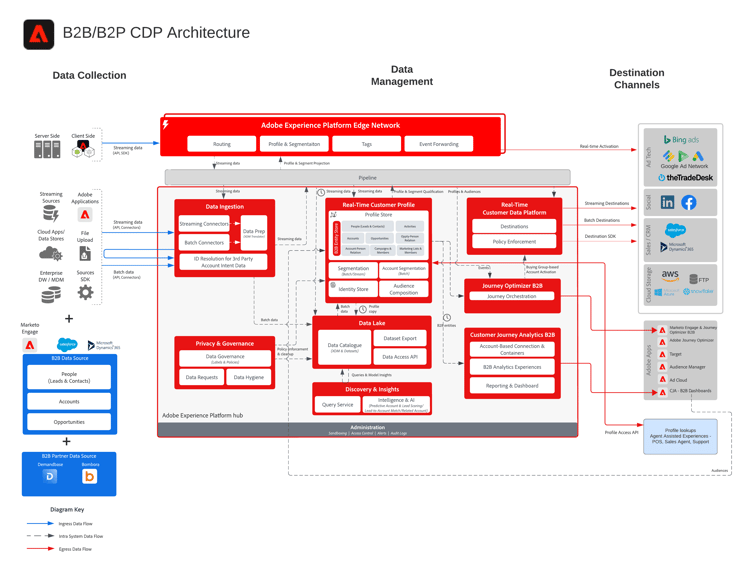
Guardrails
Refer to the following guardrails and eligibility documentation when designing B2B audiences and profiles:
Multiple Instance and IMS Org Support
The following outlines the supported patterns of mapping Experience Platform and Marketo Engage instances.
Marketo as a data source to Experience Platform
- Multiple Marketo Engage instances to one Experience Platform instance is supported.
- One Marketo Engage instance to many Experience Platform instances is not supported.
- One Marketo Engage instance to one Experience Platform instance and multiple sandboxes is supported.
Marketo as a destination to Experience Platform
- Experience Platform to many Marketo Engage instances is supported.
- Many Experience Platform instances to one Marketo Engage instance is supported.
Experience Platform Profile and Segmentation Guardrails
See the Experience Platform profile and segmentation guardrails here: Profile and Segmentation Guardrails.
Segments that include B2B entities such as accounts, leads, or opportunities rely on multi-entity relationships and are evaluated in batch. By contrast, streaming segmentation is supported for audiences limited to people and events that do not incorporate B2B entities. For near-real-time B2B activation scenarios, consider using batch-evaluated B2B audiences as inputs to streaming or edge audiences where supported.
Experience Platform – Marketo Engage Source Connector
- Refer documentation here.
Experience Platform – Marketo Destination Connector
- Refer documentation here.
Destination Guardrails
- Please refer to the destination documentation for specific guidance on each destination: Destination Guardrails.
- For advertising destinations such as Facebook, Google Customer Match & DV360, Microsoft Bing, The Trade Desk, Amazon Ads, Bombora, Demandbase, and others, ensure that the identifiers you choose in your schema and identity strategy (email, mobile advertising IDs, address fields, account IDs) align with the mapping capabilities and supported identities for those destinations.
Implementation steps
For guidance on how to implement and configure the B2B Edition of the Real-Time Customer Data Platform, see the Real-Time CDP B2B Edition documentation: B2B Edition of Real-Time Customer Data Platform.
Two implementation patterns are common:
- Ingest B2B data and profiles from Marketo Engage (and its connected CRM) into RTCDP B2B Edition.
- Ingest B2B data directly from CRM or other B2B systems into RTCDP B2B Edition using the relevant source connectors.
As part of the RTCDP B2B architecture upgrades, some previously used patterns are now deprecated for B2B entities. For more in-depth details refer detailed documentation here.
Implementation considerations
Guidance on key considerations and configurations of the blueprint.
-
CRM Integration with and without Marketo
- If the implementation uses Marketo Engage as a source and Marketo Engage is connected to the CRM, then CRM data that is synchronized into Marketo (for example, leads/contacts, accounts, opportunities) will flow into RTCDP B2B Edition via the Marketo source connector.
- If there are additional CRM tables or attributes that are not passed through Marketo (for example, custom objects or additional fields), connect the CRM source directly to Experience Platform using the CRM source connectors and map those tables to the standard B2B schemas and relationships.
- Design CRM + Marketo ingestion together to avoid duplicate or conflicting representations of B2B entities in RTCDP B2B and ensure that all B2B entities conform to the standard schemas.
Related documentation
- B2B Edition of Real-Time Customer Data Platform
- Getting Started with Real-Time Customer Data Platform B2B Edition
- Guardrails for Real-Time Customer Data Platform B2B Edition
- Schemas in Real-Time Customer Data Platform B2B Edition
- Architecture upgrades to Real-Time CDP B2B Edition
- Adobe Experience Platform
- Marketo Engage
- Adobe Experience Platform – Marketo Source Connector
- Adobe Experience Platform – Marketo Destination Connector
- Destination Guardrails