在此页面上:了解如何为iOS、Android和Web设计推送通知内容,包括标题和正文、点击行为、媒体、按钮和高级选项。
创建推送通知后,即可针对iOS、Android和Web平台设计其内容。 此页面将指导您撰写消息、配置单击行为、添加媒体和按钮,并设置高级选项以创建可与受众引起共鸣的引人入胜的推送通知。
推送通知布局(Android) push-layout
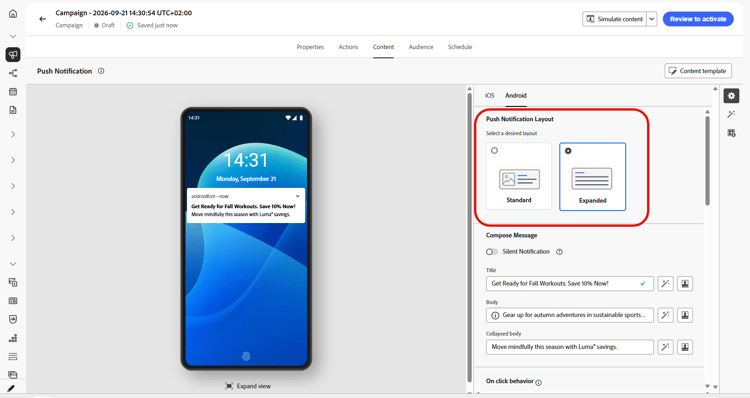
对于Android推送通知,请使用 推送通知布局 选取器来选择通知的显示方式:
-
Standard(默认):显示单行正文,带有可选的图像横幅。
这与以前用于通知的布局相对应,除非明确选择 展开 布局,否则不会发生任何更改。
-
已展开:显示从未截断的多行正文,可选图像显示为大图标。 此布局用于较长的消息,如详细的选件条款或事件信息。
标题和正文 push-title-body
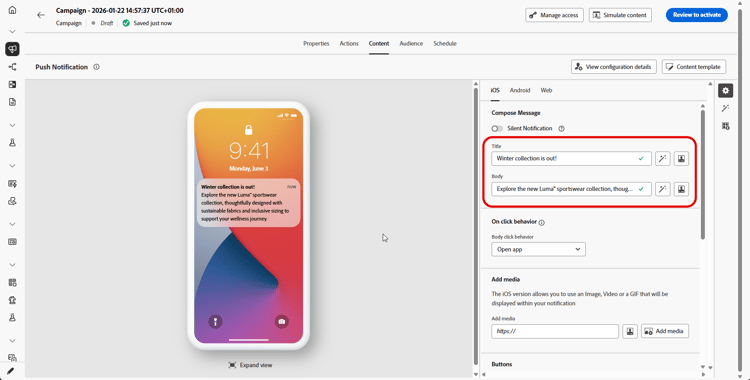
单击 标题 和 正文 字段以撰写消息。 使用个性化编辑器添加个性化和动态内容。 详细了解个性化和动态内容。
使用扩展布局时,折叠的正文字段也可用于折叠通知时显示的较短文本。 如果留空,则以折叠状态不显示正文文本。
您还可以通过在 标题 或 正文 字段中键入{{来插入内联配置文件属性。 在光标处打开自动完成下拉列表,选择属性以将其作为个性化令牌插入。 了解有关内联编辑的更多信息
使用设备预览功能可查看通知在iOS、Android和Web上的显示方式。
要加快内容创建速度,请使用“生成内容”:使用AI生成文本进行复制,或使用AI生成完整内容进行完整通知。
单击行为 on-click-behavior
配置当收件人点按推送通知正文时发生的操作。 从以下选项中进行选择:
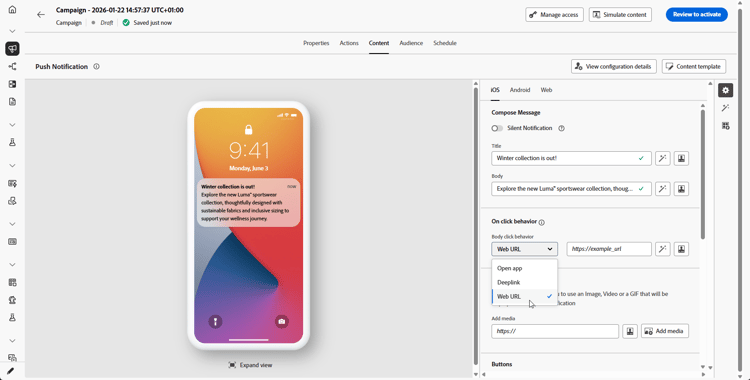
- 打开应用程序:启动与通知关联的应用程序。 已在渠道配置中指定该应用(即消息预设)。
- 深层链接:将用户定向到您应用程序内的特定内容,如特定视图、页面分区或选项卡。 在提供的字段中输入深层链接URL。
- Web URL:将用户定向到外部网页。 在提供的字段中输入目标URL。
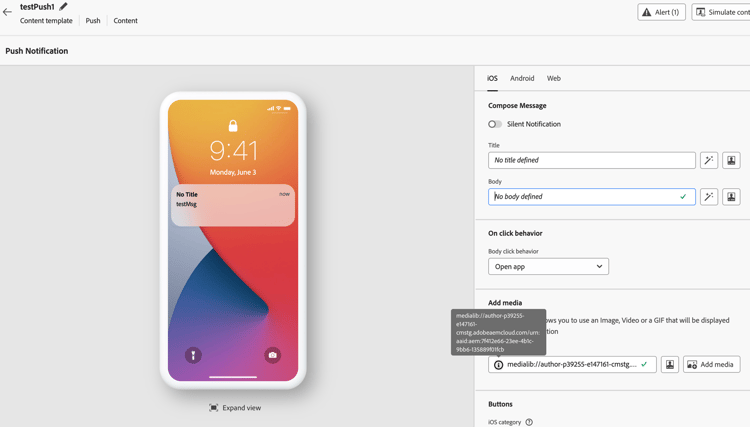
当任何链接或媒体字段中的URL太长而无法显示时,该字段旁边始终会显示工具提示图标 — 将鼠标悬停在该字段上可查看完整的URL。
有关Adobe SDK如何处理深层链接和通用链接的更多信息,请参阅Adobe Experience Platform Mobile SDK文档。
添加媒体 add-media-push
通过添加可视媒体增强推送通知。 可用的介质类型和实施方法因操作系统而异,具体如下面的标签中所述。
-
使用 Standard 布局,通过直接输入媒体URL (可在URL中包含个性化令牌)或从Adobe Experience Manager Assets中选择资源或生成内容以生成参与推送通知的图像,在 添加媒体 字段中添加资源。
启用 大图标 选项以缩放图像以适合可用空间,从而使整个图像保持可见。
-
使用 展开 布局,输入Android上通知一侧显示的大图标的URL,或从Adobe Experience Manager Assets或生成内容中选择资源以生成用于推送通知的参与图像。
添加后,介质会显示在通知正文的右侧。
| note |
|---|
| NOTE |
在推送通知有效负荷中包括媒体附件时(例如自定义数据字段(如adb_media)中的图像),移动设备应用程序必须实施特定的客户端处理才能在设备上呈现图像。 您的应用程序必须实施自动显示和跟踪工作流,以处理有效负载中的图像附件。 |
对于iOS,您可以添加要在通知中显示的图像、视频或GIF。
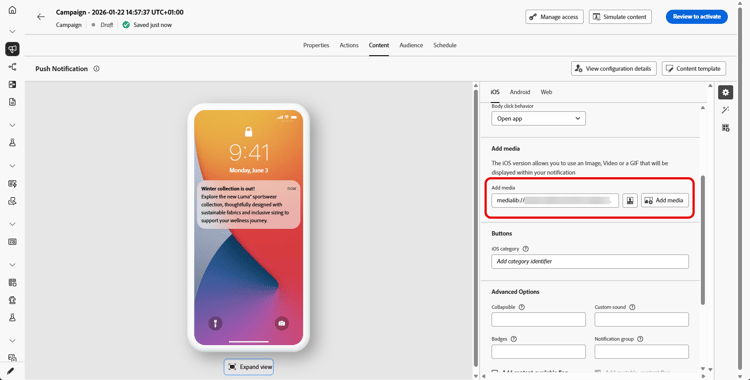
您可以使用以下任一方法添加介质:
-
添加媒体按钮:从 Adobe Experience Manager Assets 中选择资源。 在此页面中了解有关使用 Adobe Experience Manager Assets 的更多信息。
-
添加媒体字段:直接输入媒体URL。 您可以在URL中包含个性化令牌。
添加后,介质会显示在通知正文的右侧。
| note |
|---|
| NOTE |
在推送通知有效负荷中包括媒体附件时(例如自定义数据字段(如adb_media)中的图像),移动设备应用程序必须实施特定的客户端处理才能在设备上呈现图像。 您的应用程序必须实施通知服务扩展,才能从有效负载下载和处理媒体内容。 此外,必须在高级选项部分中启用 添加可变内容标志 选项。 |
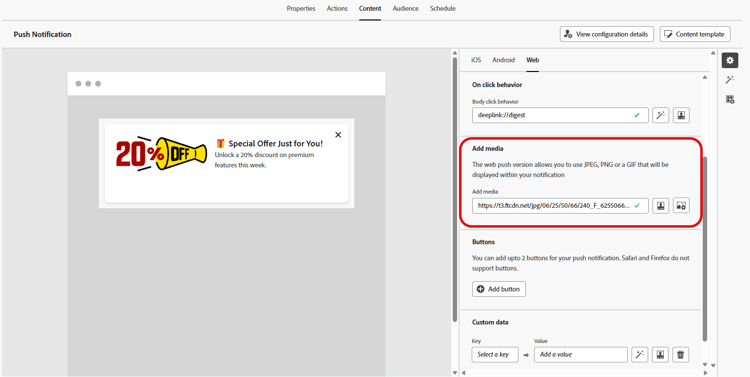
在 添加媒体 字段中输入媒体URL。 您还可以在URL中包含个性化令牌,以自定义每个用户的内容。
单击

添加按钮 add-buttons-push
通过向推送内容添加按钮来创建可操作通知。 根据您的操作系统浏览下面的选项卡。
如果设备屏幕已锁定,则不会显示这些按钮:只有通知的 标题 和 消息 可见。 如果解锁了收件人的设备,收件人将看到相应的按钮。
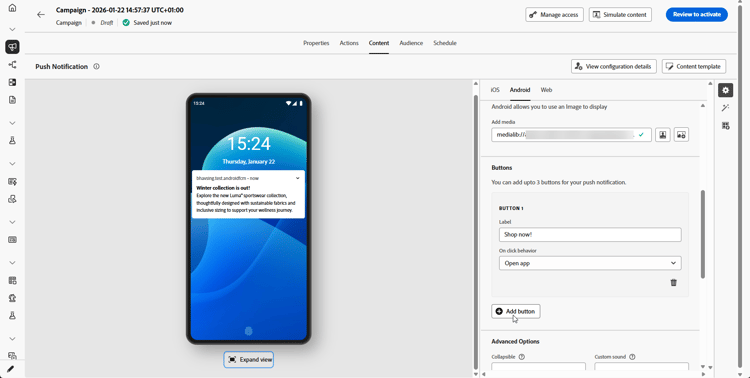
对于Android,您最多可以添加三个按钮。
-
使用 添加按钮 定义设置:标签和相关操作。 可能的操作与点击行为的操作相同。
-
使用中央预览图像下的 展开视图 图标预览您的个性化按钮。
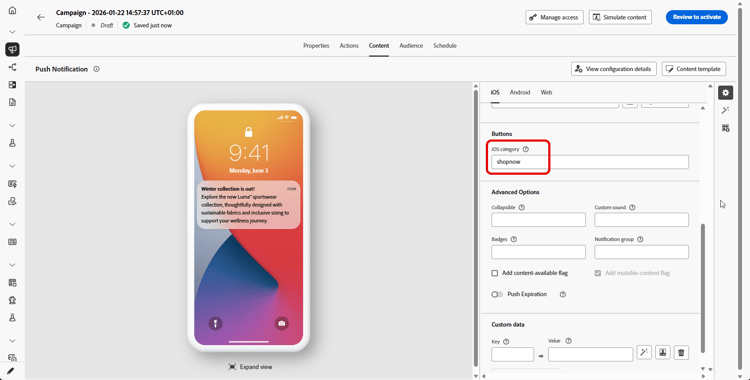
对于iOS,会指定通知类别标识符。 需要在iOS应用程序中预配置通知类别,以便定义要显示的按钮和要采取的操作。 有关更多详细信息,请参阅Apple文档。
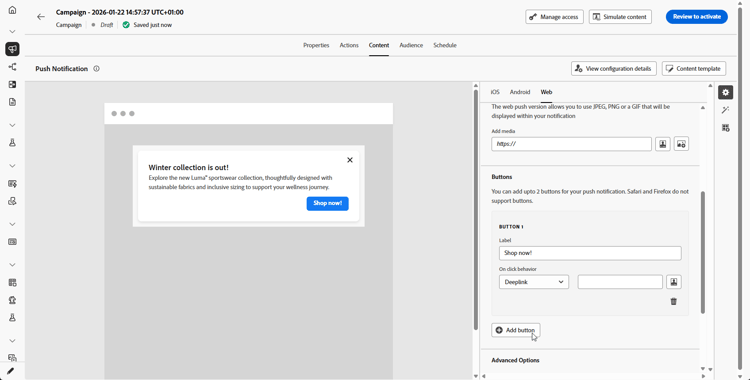
使用 添加按钮 选项定义每个按钮的标签和相关操作,如下所述:
-
深层链接:将用户重定向到您应用程序内的特定视图、区域或选项卡。 在关联字段中输入深层链接URL。
-
Web URL:将用户重定向到外部网页。 在相关字段中输入URL。
发送静默通知 silent-notification
静默推送通知(或后台通知)是交付给应用程序的隐藏指令。 例如,用于通知应用程序有新内容可用,或在后台启动下载。
选择 静默通知 选项以静默通知应用程序:在这种情况下,通知将直接传输到应用程序。 设备屏幕上不显示任何警报。
使用 自定义数据 部分添加键值对。
自定义数据 custom-data
在 自定义数据 部分中,您可以将自定义变量添加到有效负载中,具体取决于您的移动应用程序配置。 有关如何在Adobe Experience Platform中设置推送通知的更多信息,请参阅此部分
使用Decisioning实现个性化 decisioning-push
您可以使用 Decisioning 个性化并优化推送通知的内容。 此功能允许您使用优先级得分、公式或AI模型来动态选择并向客户显示最佳内容。
有关如何创建和使用推送通知中的决策政策的详细信息,请参阅此部分。
高级选项 advanced-options-push
您可以为推送通知配置高级选项。 可用参数如下所示:
当用户打开或从应用程序中读取新内容时,标记值将消失。 在设备上收到通知时,可能会刷新或增加相关应用程序的标记值。
例如,如果您存储的是客户的未读文章数,则可利用个性化为每个客户发送唯一的未读文章标记值。 有关更多个性化,请参阅此章节。
从iOS 12开始,通知组允许您将消息线程和通知主题合并到线程ID中。 例如,一个品牌可能会在一个组ID下发送营销通知,而在一个或多个不同的ID下保留更多操作类型通知。
举例来说,您可以让groupID: 123“查看新春的毛衣系列”和groupID: 456“您的包已投放”通知组。 在此示例中,所有投放通知都捆绑在组ID:456下。
从Android 8.0(API级别26)开始,必须将所有通知分配给一个渠道才能显示。 有关详细信息,请参阅Android开发人员文档。
即使应用程序在后台运行且不需要任何用户交互(例如点击推送通知),此功能也可以正常工作。 但是,如果应用程序未运行,则不适用。 有关更多信息,请参阅 Apple 开发人员文档。
然后,您可以利用移动应用扩展进一步修改从Journey Optimizer发送的推送通知的内容或演示。 例如,用户可以利用此选项解密数据、更改通知的正文或标题文本、向通知添加线程标识符等。
重要信息:在通过有效负荷字段(如
adb_media)包含媒体附件(图像、视频)时,必须启用此标记才能在iOS设备上呈现。 您的应用程序还必须实施Notification Service扩展,才能从有效负载下载和处理媒体内容。Private将在所有锁屏界面上显示通知,但在安全锁屏界面上隐藏敏感或私人信息。
Public将在所有锁屏界面上完整显示通知。
密码不会在安全的锁定屏幕上显示通知的任何部分。
有关详细信息,请参阅Android开发人员文档。
This section contains structured knowledge intended to support interpretation, retrieval, and question answering related to this topic.
For complete understanding, this information should be combined with the documentation on this page. Neither source is intended to stand alone; the page describes the feature, while this section provides additional context that helps disambiguate terminology, intent, applicability, and constraints.
- TL;DR: This page explains how to design push notification content for iOS, Android, and Web, including the Title and Body, on-click behavior, media, buttons, silent notifications, custom data, Decisioning personalization, and advanced options.
Intents:
- Compose the push Title and Body with personalization, inline attributes, and AI content generation
- Configure on-click behavior (Open app, Deeplink, or Web URL)
- Add media and call-to-action buttons per platform
- Send a silent (background) notification and add custom data key-value pairs
- Personalize push content with Decisioning
- Set advanced platform-specific options (collapsible, badges, expiration, priority, etc.)
Glossary:
- On click behavior: The action that occurs when a recipient taps the body of the push notification — Open app, Deeplink, or Web URL (product-specific)
- Silent Notification: A background notification delivered directly to the application with no alert displayed on the device screen (product-specific)
- Custom data: Key-value pairs added to the payload depending on the mobile application configuration (product-specific)
- Decisioning: A capability to personalize and optimize push content using Priority Scores, Formulas, or AI Models to select the best content (product-specific)
- Add mutable-content flag: An iOS advanced option that allows push content to be modified by a notification service extension; required for media attachments to render on iOS (product-specific)
Guardrails:
- For Android, you can add up to three buttons.
- Web push notifications do not support the Silent Notification feature.
- On iOS, the Add mutable-content flag option must be enabled when including media attachments (such as
adb_media) for them to render, and the app must implement a Notification Service Extension. - If the device screen is locked, buttons are not displayed; only the Title and the Message are visible.
- For iOS buttons, notification categories must be preconfigured in the iOS app to define the buttons displayed and actions taken.
- On iOS, Push expiration is enforced as a hard stop: any message reaching APNS after its expiration time is not delivered.
- Android media supports only an image icon and an image for expanded notifications.
Terminology:
- Canonical name: On click behavior — Acronym: n/a — variants: on-click behavior
- Synonyms: “Deeplink” = “deep link”
- Do not confuse: “Open app” ≠ “Deeplink” ≠ “Web URL” (three distinct on-click behaviors)
- Do not confuse: “Notification group” (iOS only) ≠ “Notification channel” (Android only)
- Do not confuse: “Add content-availability flag” (wakes the app) ≠ “Add mutable-content flag” (allows content modification / media rendering)
FAQ:
- Q: What happens when a recipient taps the push body? — The configured on-click behavior runs: Open app, Deeplink, or Web URL.
- Q: How many buttons can I add on Android? — Up to three.
- Q: Can I send a silent notification on Web? — No, Web push notifications do not support the Silent Notification feature.
- Q: Why are my iOS media attachments not rendering? — The Add mutable-content flag must be enabled and your app must implement a Notification Service Extension to download and process the media.
- Q: How can I personalize which content is shown? — Use Decisioning, which selects the best content using Priority Scores, Formulas, or AI Models.
- Q: What is the difference between iOS and Android expiration? — On iOS, Push expiration is a hard stop (undelivered after expiry); on Android, Time to live is a delivery window converted by FCM, so messages may be sent later than expected.