On this page: Learn how profile entrance and reentrance work for each type of journey so you can control when and how often profiles enter your journeys.
Profile entrance management depends on the type of journey.
Types of journeys types-of-journeys
With Adobe Journey Optimizer, you can create the following types of journeys:
-
Unitary event journeys: These journeys start with a Unitary event. When the event is received, the associated profile enters the journey. Read more
-
Business event journeys: These journeys start with a Business event immediately followed by a Read audience activity. When the event is received, profiles belonging to the targeted audience enter the journey. One instance of this journey is created for each profile. Read more
-
Read audience journeys: These journeys start with a Read audiece activity. When the journey is executed, profiles belonging to the targeted audience enter the journey. One instance of this journey is created for each profile. These journeys can be recurring or “one-shot”. Read more
-
Audience qualification journeys: these journeys start with an Audience qualification event. These journeys listen to the entrances and exits of profiles in audiences. When this happens, the associated profile enters the journey. Read more
Compare all journey types with use cases →
In all journey types, a profile cannot be present multiple times in the same journey, at the same time, for all active versions of the journey. To check that a person is in a journey, the profile identity is used as a key. The system does not allow the same key, for example the key CRMID=3224, to be at different places in the same journey.
Journey processing rate journey-processing-rate
Journey processing rate is impacted by multiple factors that determine how profiles flow through a journey:
Profile entrance rate profile-entrance-rate
How profiles enter journeys and their expected rate depends on the first activity being used:
-
Read audience journeys (batch scenario, where you target an audience of profiles and trigger a journey for that full audience): the maximum is 20,000 TPS (transactions per second). This is the quota available at a sandbox level. If multiple journeys run at the same time in that sandbox, 20,000 TPS may not be achievable. Consider this maximum a best-case scenario.
-
Audience qualification journeys (unitary scenario, where you want to trigger a journey when a profile qualifies or disqualifies for a streaming audience): the maximum is 5,000 TPS. Note that this is a shared limit with journeys starting with events and is also shared across journeys at an organization level.
-
Unitary event journeys (unitary scenario, where you want to trigger a journey when an event is emitted from a profile): same as above, both sharing the same 5,000 TPS limit. More information regarding journey event throughput is available in this section.
-
Business event journeys (a unitary-to-batch scenario because a business event is always followed by a Read audience): business events count toward the 5,000 TPS quota. The Read audience activity that follows has the same limit as journeys starting with a Read audience (20,000 TPS).
Events and audience qualifications inside journeys events-inside-journeys
After entrance, you can use Unitary event or Audience qualification activities inside the journey. A profile can enter in any of the 4 types of journeys described above and wait for an event to be emitted or wait for this profile to qualify for an audience. Those Unitary events and Audience qualifications will count in the quota described above. For example: if you start a journey with a Read audience (with a maximum of 20,000 TPS) and have an event right after, this event will be at maximum 5,000 TPS.
Wait activities impact wait-activities-impact
Wait activities in journeys can also have an impact on how many profiles are flowing through a journey at a specific time. Usually a Wait activity is based on a relative time (for example: exit 2 hours after entering the wait, so all profiles will not exit at the same time). However, if a fixed time is defined on that Wait activity, multiple profiles may exit that journey at the exact same time. This is not a recommended practice. Massive volumes could then be seen and the TPS from this point onwards can exceed 20,000 TPS.
Action activities action-activities-impact
Finally, action activities can be impacted by the profile load coming from journeys and can also affect processing rate. These include native channels like Email, SMS, and Push, plus custom actions, jumps to other journeys, and update profile activities. For example, a custom action targeting an external endpoint with a high response time will slow the journey processing rate.
For custom actions, the default capping is 300,000 calls per minute, which can be changed with a custom capping policy. Learn more about custom action capping in this section.
Unitary event and Audience qualification journeys entry-unitary
In Unitary event and Audience qualification journeys, you can enable or disable reentrance:
-
If reentrance is enabled, a profile can enter a journey several times, but cannot do it until he fully exited the previous instance of the journey.
-
If reentrance is disabled, a profile cannot enter multiple times the same journey, within the global journey timeout period. See this section.
By default, journeys allow reentrance. When the Allow reentrance option is activated, the Reentrance wait period field is displayed. It allows you to define the time to wait before allowing a profile to enter the journey again. This prevents journeys from being erroneously triggered multiple times for the same event. By default the field is set to 5 minutes. The maximum duration is 91 days (global timeout).
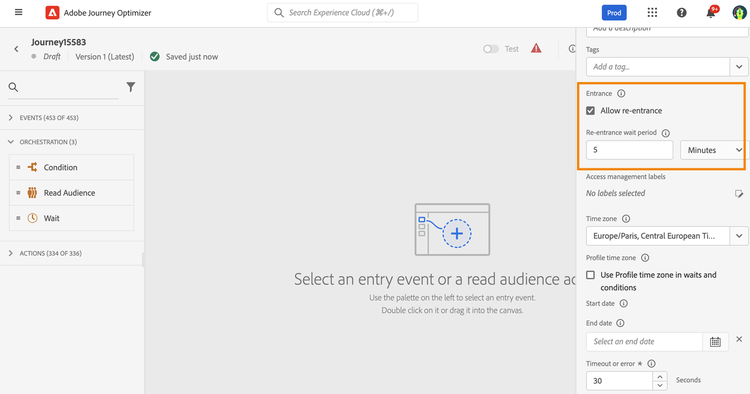
After the reentrance period, profiles can reenter the journey. To avoid this, and fully disable reentrance for those profiles, you can add a condition to test if the profile entered already or not, using profile or audience data.
Business journeys entry-business
In Business journeys, to allow multiple business event executions, activate the corresponding option in the Execution section of the journey properties.
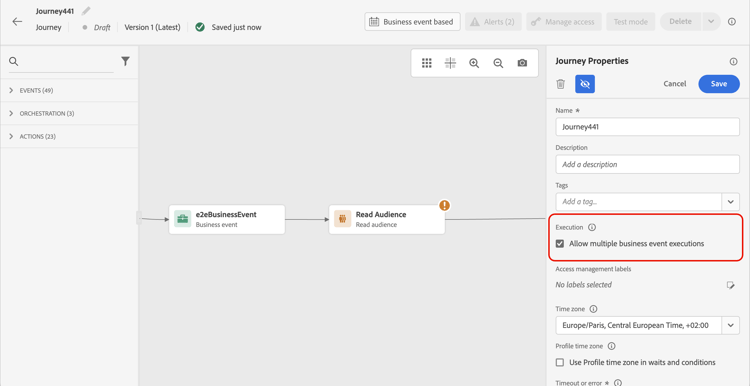
In the case of business events, for a given journey, audience data retrieved at first execution is reused during a 1-hour time window.
A profile can be present multiple times in the same journey, at the same time, but in the context of different business events.
For more information, refer to this section
Read audience journeys entry-read-audience
Read audience journeys can be recurring or non-recurring:
-
For non-recurring journeys: the profile enters once and only once in the journey.
-
For recurring journeys: by default, all the profiles belonging to the audience enter the journey on each recurrence. They must finish the journey before they can reenter in another occurrence.
Several options are available for recurring Read audience journeys. For more information, refer to the Use an audience in a journey section.
Related topics
- Journey entry and exit criteria guide - Complete guide with real-world examples and best practices
- Configure exit criteria - Define when profiles should leave your journey
- End a journey - Understand how journeys close and finish
- Journey use cases - See complete examples with entry and exit configurations
This section contains structured knowledge intended to support interpretation, retrieval, and question answering related to this topic.
For complete understanding, this information should be combined with the documentation on this page. Neither source is intended to stand alone; the page describes the feature, while this section provides additional context that helps disambiguate terminology, intent, applicability, and constraints.
- TL;DR: This page explains how profile entry management works across the four journey types in Adobe Journey Optimizer, including throughput limits, reentrance settings, and the behavior of Wait and action activities on processing rate.
Intents:
- Understand the entry behavior and throughput limits for each journey type (Unitary event, Business event, Read audience, Audience qualification)
- Enable or disable profile reentrance and configure the reentrance wait period
- Allow multiple business event executions for a Business journey
- Identify how Wait activities and action activities affect journey processing rate
- Ensure a profile is not present in the same journey at the same time
Glossary:
- Reentrance: The ability for a profile to enter the same journey again after previously exiting it; configurable with a wait period (product-specific)
- Reentrance wait period: The minimum time that must pass before a profile can re-enter a journey; default is 5 minutes, maximum is 90 days in journey properties (product-specific)
- TPS (Transactions Per Second): The throughput rate at which profiles can enter or be processed in a journey (product-specific)
- Unitary event journey: A journey triggered by a single event associated with one profile (product-specific)
- Read audience journey: A journey that processes a batch of profiles belonging to a defined audience, either once or on a recurring schedule (product-specific)
- Business event journey: A journey triggered by a business event that targets an audience, creating one journey instance per profile (product-specific)
- Audience qualification journey: A journey triggered when a profile enters or exits a streaming audience in real-time (product-specific)
Guardrails:
- A profile cannot be present multiple times in the same journey at the same time across all active versions.
- Read audience journeys: maximum 20,000 TPS (sandbox-level quota; shared across all concurrent Read Audience journeys in the same sandbox)
- Audience qualification and Unitary event journeys: maximum 5,000 TPS (org-level quota; shared with each other across all sandboxes in the org)
- Business events count toward the 5,000 TPS org-level quota; the subsequent Read audience activity shares the 20,000 TPS sandbox-level quota
- Default reentrance wait period is 5 minutes; maximum configurable value is 90 days in journey properties
- Fixed-time Wait activities can cause profile surges exceeding 20,000 TPS and are not recommended.
- Custom action default capping is 300,000 calls per minute.
- For Business journeys, audience data from the first execution is reused for 1 hour.
Terminology:
- Canonical name: Profile entrance management — Acronym: n/a — variants: profile entry management, journey entry
- Synonyms: “reentrance” = “re-entry”
- Do not confuse: “Unitary event journey” ≠ “Audience qualification journey” — both are unitary scenarios but triggered differently (event emission vs. audience membership change)
FAQ:
- Q: Can a profile enter the same journey twice simultaneously? — No, the system uses the profile identity as a key and prevents the same profile from being at different places in the same journey at the same time.
- Q: What is the default reentrance wait period? — 5 minutes, configurable up to a maximum of 90 days in journey properties.
- Q: How many profiles per second can a Read audience journey process? — Up to 20,000 TPS at sandbox level, though this maximum may not be achievable if multiple journeys run simultaneously in the same sandbox.
- Q: What happens to throughput after a Wait activity with a fixed time? — Multiple profiles may exit the wait simultaneously, potentially exceeding 20,000 TPS; relative-time Wait activities are recommended to avoid this.
- Q: Can a profile appear in a Business journey multiple times at the same time? — Yes, but only in the context of different business events.