このページ:コンテンツ決定アクティビティを使用して、パーソナライズされたオファーをジャーニーに含めて、実施要件を満たすプロファイルに配信する方法について説明します。
Journey Optimizer を使用すると、ジャーニーキャンバスの専用の コンテンツ決定 アクティビティを通じて、ジャーニーにオファーを含めることができます。 次に、他のアクティビティ(カスタムアクションなど)をジャーニーに追加して、パーソナライズされたオファーでオーディエンスをターゲットにすることができます。
この機能を活用するには、コンテンツ決定アクティビティを追加して、実施要件を満たすプロファイルに提示するオファーを定義するジャーニーを作成します。
次に、コンテンツ決定アクティビティの出力は、以下の用途で使用できます。
-
条件を含む最適化アクティビティ:取得したオファーに基づいてプロファイルを特定のパスに移動します。
-
カスタムアクション:これらのオファーを外部システムに送信できます。
コンテンツ決定アクティビティの設定 add-content-decision-activity
コンテンツ決定アクティビティを使用すると、Journey Optimizer 決定から最適な項目を選択し、適切なオーディエンスに配信できるようにする決定ポリシーを定義できます。
コンテンツ決定アクティビティを設定するには、次の手順に従います。
-
オーケストレーションカテゴリを展開し、コンテンツ決定アクティビティをキャンバスにドロップします。

-
オプションで、アクティビティにラベルと説明を追加します。
-
「決定ポリシーを追加」をクリックします。 決定ルールの詳細情報
note NOTE 決定ポリシーを作成するには、決定権限が必要です。 詳細情報 -
返される項目の数を選択します。 例えば、「2」を選択した場合、最適な 2 つの実施要件を満たすオファーが表示されます。 「次へ」をクリックします。
-
「戦略シーケンス」セクションでは、決定ポリシーと共に提示する決定項目や選択戦略を選択します。 詳細情報
-
必要に応じて、評価順序を並べ替えます。
複数の決定項目や戦略を追加すると、順番に評価され、各オブジェクトまたはオブジェクトのグループの左側に数字で示されます。 デフォルトのシーケンスを変更するには、オブジェクトやグループをドラッグ&ドロップして、任意の順序に並べ替えることができます。 詳細情報
-
(オプション)フォールバックオファーを追加します。 詳細情報
-
決定ポリシーをレビューして保存します。
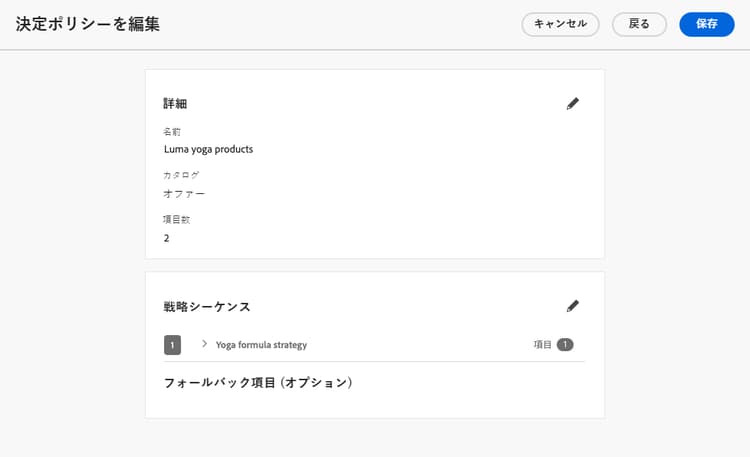
これで、このコンテンツ決定アクティビティの出力をジャーニーで活用する準備が整いました。
ガードレールと制限 guardrails
同意ポリシー
-
同意ポリシーの更新が有効になるまで最大 48 時間かかります。 決定ポリシーが、最近更新された同意ポリシーに関連付けられた属性を参照している場合、変更は直ちに適用されません。
-
同様に、同意ポリシーの対象となる新しいプロファイル属性が決定ポリシーに追加された場合、その属性は使用可能になりますが、関連付けられた同意ポリシーは、遅延が経過するまで適用されません。
-
同意ポリシーは、Adobe Healthcare Shield または Privacy and Security Shield アドオンを導入している組織でのみ使用できます。
コンテンツ決定アクティビティの出力の使用 use-content-decision-output
コンテンツ決定の出力は、複数のジャーニーアクティビティで使用できます。 例えば、条件を含む最適化アクティビティを使用すると、取得したオファーの数に基づいて、プロファイルをジャーニーの特定の分岐に移動できます。
また、コンテンツ決定アクティビティからのオファーを外部システムと共有することを目的に、カスタムアクションをジャーニーに追加することもできます。
最適化アクティビティの場合(条件メソッド)の場合 add-condition-activity
コンテンツ決定アクティビティの出力を活用するには、最適化アクティビティを追加して、条件メソッドを選択し、オファーのデータを使用してプロファイルを特定のパスに移動する式を定義します。 次の手順に従います。 その他の条件タイプとオプションについて詳しくは、条件を参照してください。
-
オーケストレーションカテゴリから、最適化アクティビティをキャンバスにドロップします。 詳細情報
-
(オプション)定義する最初の式に対応する Path1 の名前を、より関連性の高いラベルに変更します。
-
この最初のパスでは、「式」フィールド内をクリックするか、編集アイコンを使用して式を追加します。
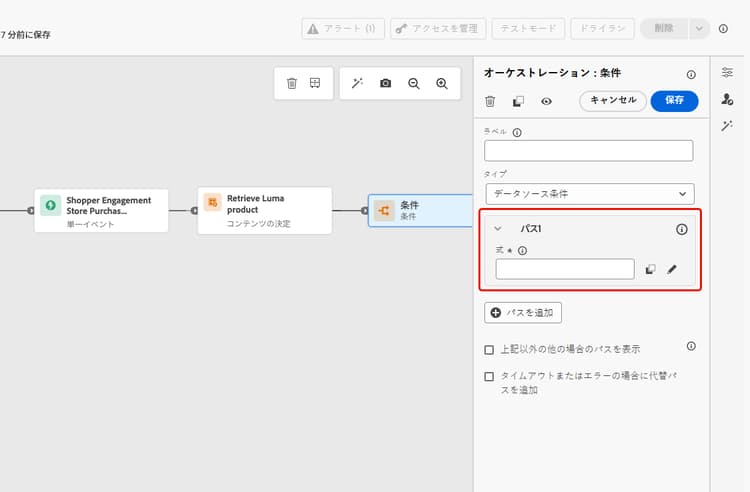
-
開いたポップアップウィンドウで、詳細設定モードに切り替えて、高度な式エディターを使用します。
note caution CAUTION コンテンツ決定ノードの出力は、詳細設定モードでのみ使用できます。 -
コンテキストノードを展開し、決定ポリシーに移動して、オファーカタログスキーマで使用可能なすべての属性を表示します。
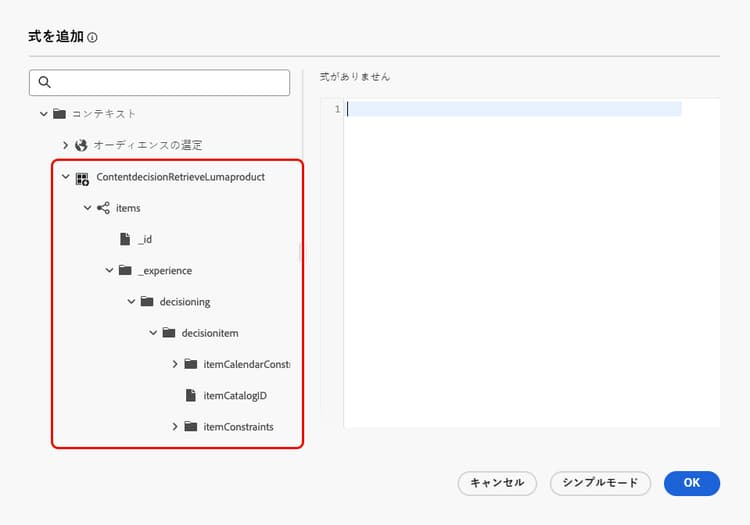
note NOTE 属性に定義された制限ラベルは、DULE または同意のポリシー違反につながる場合があります。 これは、決定ルールで使用されるジャーニーエクスペリエンスイベントおよびオファースキーマに適用されます。 データガバナンスポリシーについて詳しくは、この節を参照してください。 -
ジャーニーにエントリするプロファイルに対してオファーが返されたかどうかを確認するには、構文
listSize(@decision{ContentdecisionName.items})>0で listSize 関数を使用しますnote NOTE この例では、 Nameはジャーニーに追加したコンテンツ決定のラベルです。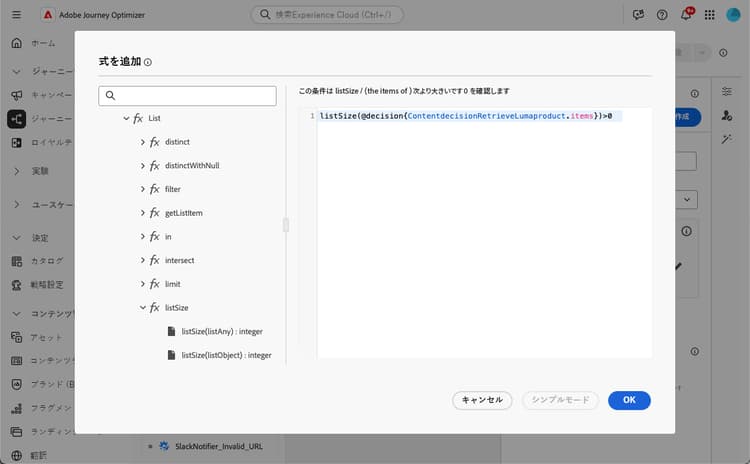
-
「OK」をクリックします。
-
必要に応じて、他の条件を定義するパスを追加します。
また、「上記以外の事例のパスを表示」をオンにして、最初の条件を満たさないプロファイルの別のパスを作成することもできます。
-
条件アクティビティを保存します。
カスタムアクションの場合 add-custom-action
コンテンツ決定アクティビティの出力を活用するには、定義したオファーを外部システムと共有するカスタムアクションをジャーニーに追加します。 次の手順に従います。
-
カスタムアクションをジャーニーに追加します。 詳細情報
-
アクションのラベルを入力します。
-
「リクエストパラメーター」セクションで、取得したオファーの属性にマッピングするパラメーターを選択します。
編集可能なテキストフィールド内をクリックし、取得したオファーの属性にマッピングするパラメーターを選択します。
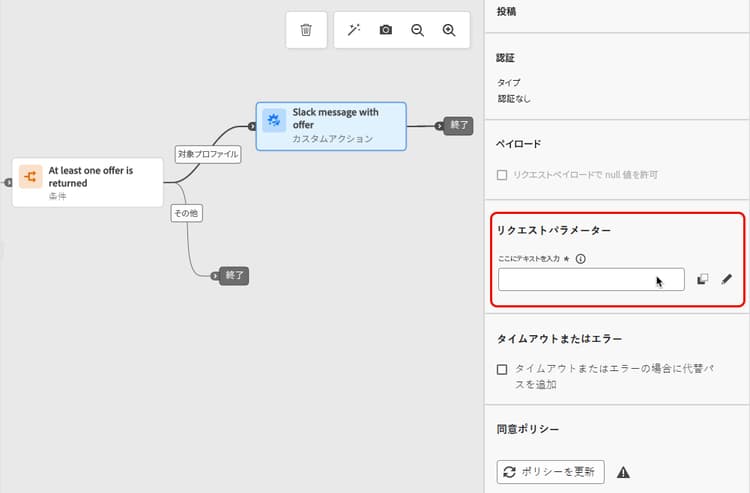
-
開いたポップアップウィンドウで、詳細設定モードに切り替えます。 高度な式エディターで、コンテキストノードを展開して、すべての決定ポリシー項目を表示します。
note caution CAUTION コンテンツ決定ノードの出力は、詳細設定モードでのみ使用できます。 -
items配列を使用してオファーカタログスキーマを参照します。 例えば、最初に取得したオファーのitemNameと、2 番目に取得したオファーのitemNameを使用します。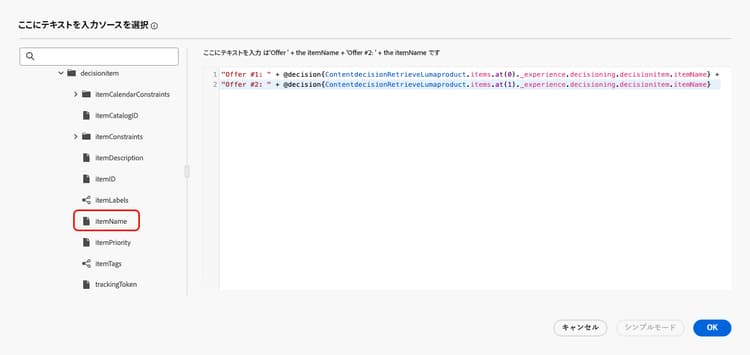
-
「OK」をクリックして式を保存します。
-
カスタムアクション設定を 保存 します。
エンドツーエンドの例 use-case
上記で説明したように、条件アクティビティとカスタムアクションを組み合わせたコンテンツ決定アクティビティを使用するジャーニーの完全な例を以下に示します。

ジャーニーをアクティブ化すると、次の操作が行われます。
-
プロファイルがそのオーディエンスを選定するたびに、そのプロファイルはジャーニーにエントリします。
-
コンテンツ決定アクティビティを通じて、Journey Optimizer は各プロファイルに関連するオファーを取得します。
-
1 つ以上のオファーを取得したプロファイルのみが、ジャーニーを続行します(「実施要件を満たすプロファイル」パス経由)。
-
条件が満たされると、対応するオファーがカスタムアクションを通じて外部システムに送信されます。
ステップイベントの決定データ decisioning-step-events
ジャーニーでコンテンツ決定アクティビティが実行されると、決定データがジャーニーステップイベントで使用可能になります。 このデータは、取得された項目と決定方法に関する詳細な情報を提供します。
各コンテンツ決定アクティビティでは、ステップイベントに、上位レベルの決定データ(exdRequestID および propositionEventType など)と、提案の配列が含まれます。 各提案には、id、scopeDetails(決定プロバイダー、相関 ID、決定ポリシーを含む)および items 配列が含まれます。 各項目には、次が含まれます。
-
id:項目の一意の ID
-
name:項目の名前
-
score:項目に割り当てられたスコア
-
itemSelection:決定方法と項目の取得方法に関するデータ。次が含まれます。
- selectionDetail:使用される選択戦略に関する情報
- rankingDetail:ランキングプロセスに関する情報(戦略、アルゴリズム、ステップ、トラフィックタイプ)
ステップイベントの決定データの例:
"decisioning": {
  "exdRequestID": "8079d2bb-a8b2-4ecf-b9e7-32923dd6ad4e",
  "propositions": [
    {
      "id": "f475cb21-0842-44da-b0eb-70766ba53464",
      "scopeDetails": {
        "decisionProvider": "EXD",
        "correlationID": "6940d1c46208f3c00dae2ab94f3cd31c601461b47bf6d29ff8af0d0806a9c204",
        "decisionPolicy": {
          "id": "b913f724-3747-447b-a51e-8a2f9178f0db"
        }
      },
      "items": [
        {
          "id": "dps:14c7468e7f6271ff8023748a1146d11f05f77b7fc1368081:1bebbf0b7e0f1374",
          "name": "My item name",
          "score": 0.93,
          "itemSelection": {
            "selectionDetail": {
              "strategyID": "dps:selection-strategy:1bebbfc9245cb35e",
              "strategyName": "My selection strategy",
              "selectionType": "selectionStrategy",
              "version": "latest"
            },
            "rankingDetail": {
              "strategyID": "4FyRZTmpjrbzuL7rX7gvmu",
              "algorithmID": "RANDOM",
              "step": "aiModel",
              "trafficType": "random"
            }
          }
        }
      ]
    }
  ],
  "propositionEventType": {
    "decision": 1
  }
}
This section contains structured knowledge intended to support interpretation, retrieval, and question answering related to this topic.
For complete understanding, this information should be combined with the documentation on this page. Neither source is intended to stand alone; the page describes the feature, while this section provides additional context that helps disambiguate terminology, intent, applicability, and constraints.
- TL;DR: This page explains how to configure and use the Content Decision activity in Journey Optimizer journeys to retrieve personalized offers via a decision policy and route or forward them using conditions and custom actions.
Intents:
- Add a Content Decision activity to a journey and configure a decision policy
- Select and sequence decision items and selection strategies within a decision policy
- Use the content decision output in an Optimize activity condition to branch profiles based on retrieved offers
- Forward retrieved offers to an external system using a custom action
- Inspect decisioning data in journey step events for audit and troubleshooting purposes
Glossary:
- Content decision activity: A journey orchestration activity that evaluates a decision policy and retrieves the best eligible offers for each profile (product-specific)
- Decision policy: A configuration that specifies which decision items and selection strategies to evaluate, and how many items to return (product-specific)
- Selection strategy: A ranked evaluation method used within a decision policy to determine which offers are eligible and how they are scored (product-specific)
- Proposition: The output unit of a decision policy execution, containing the selected items and associated scope and ranking metadata (product-specific)
- listSize function: An expression editor function used to count the number of items returned by a content decision, e.g.
listSize(@decision{Name.items})>0(product-specific) - Offers catalog schema: The schema that defines the attributes available on decision items; accessible via the Context node in advanced expression editor mode (product-specific)
Guardrails:
- The output of a Content Decision activity cannot be used in native channel activities (email, push, Mobile message, etc.)
- The content decision output is only accessible in Advanced mode of the expression editor; it is not available in simple mode
- Decisioning permissions are required to author a decision policy
- Consent policy updates take up to 48 hours to take effect for attributes referenced in a decision policy
- Consent policies are only available to organizations with the Adobe Healthcare Shield or Privacy and Security Shield add-on
- Restricted data usage labels (DULE) on offer schema attributes can result in governance policy violations
Terminology:
- Canonical name: Content decision activity — Acronym: none — variants: content decision node, decisioning activity
- Synonyms: “decision policy” = “offer selection policy” ; “proposition” = “decision output”
- Do not confuse: “Content decision activity” ≠ “native channel action” (content decision retrieves offers but does not deliver them directly; a custom action or condition is needed to act on the output)
FAQ:
- Q: Can I use the offers returned by a Content Decision activity directly in an email? — No, the output of a content decision activity cannot be used in native channel activities; you must pass the offers to a custom action to send them to an external system.
- Q: How do I check whether any offers were returned for a profile? — Use the listSize function in the advanced expression editor:
listSize(@decision{ContentdecisionName.items})>0. - Q: Where do I access content decision output in the expression editor? — Switch to Advanced mode, unfold the Context node, and navigate to your decision policy to see all available offer catalog schema attributes.
- Q: How long does it take for a consent policy update to apply to a decision policy? — Up to 48 hours after the consent policy is updated.
- Q: What decisioning data is available in journey step events? — Each step event includes exdRequestID, propositionEventType, and an array of propositions — each containing an id, scopeDetails (decision provider, correlationID, decision policy), and an items array with id, name, score, and itemSelection details.