[AEM Assets]{class="badge positive" title="Applies to AEM Assets)."}
Share assets in Content Hub search-assets-as-a-link
Content Hub enables authorized users to share one or more selected assets by generating a shareable link. As an authorized Content Hub user, you select the assets you want to distribute, generate a link, and send that link to both private users (internal, authenticated collaborators) and public users (external recipients).
Sharing via a link is one of the most efficient ways to distribute digital assets. This eliminates the need to download and re-upload files, ensuring recipients access the exact assets stored in your Content Hub environment.
How to share assets as a link
To share selected assets with others, follow these steps:
- Sign in as an authorized Content Hub user with access to your Content Hub environment.
- Select one or more assets available in your Content Hub environment that you want to share.
- Generate a link for the selected assets.
- Send the generated link to other private or public users so they can access the shared assets.
Practical uses of link-based sharing
Sharing assets as a link supports common collaboration and distribution needs, including:
- Distributing assets to external partners or clients without granting them full access to your Content Hub environment.
- Sharing with internal team members who need quick access to specific approved assets.
- Sending a single, self-contained link rather than transferring large files by email or other means.
Because the shared assets remain hosted within your Content Hub environment, recipients always receive the current, authorized version of each asset through the generated link.
Prerequisites prerequisites
Content Hub users — that is, individuals who have been onboarded to Content Hub — can create a shareable link to specific assets selected from the Content Hub library and distribute it to other users. See Content Hub users for details on onboarding.
Link-based sharing is the standard mechanism for distributing assets, because it allows recipients to access the selected content directly without needing to locate the assets themselves. This streamlines collaboration and asset distribution across teams and with external stakeholders, ensuring the right people can reach the right assets efficiently.
Share assets share-assets
To share one or more assets with private or public users, execute the following steps:
-
Navigate to your Content Hub homepage, select one or more assets and click

You can also select and share assets available in

-
View an asset or review the list of assets available in Share assets dialog box. Click

-
Specify a title and an optional description that defines the set of selected assets. A clear title and description help recipients identify the shared set at a glance.
-
Select Period of expiration. This setting determines how long the shared link remains valid before access expires.
-
Under Who can access drop down, select the access options and click Get Link to generate a link to share with the selected users. This action produces the shareable link based on the access level you choose. The two access levels differ as follows:
- Private users must sign in to their Content Hub environment to access the shared assets page.
- Public users access the shared assets page as guests, without signing in to Content Hub.
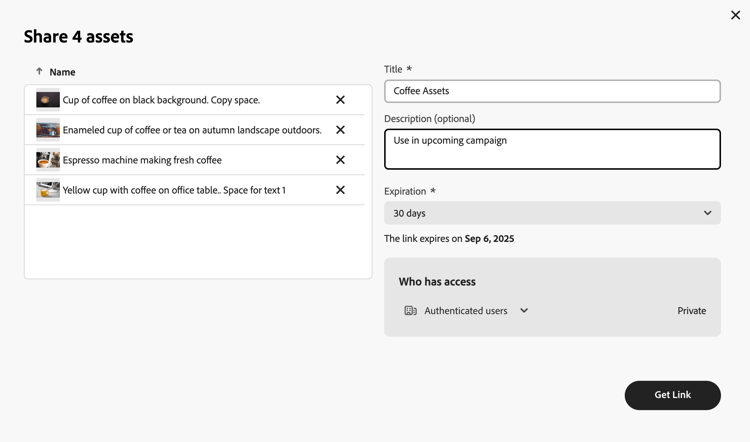
note NOTE Enable public link sharing from the configuration page so that the Public Link toggle appears on the Share assets dialog box. Without enabling this configuration, the Public Link toggle does not display.
Share an asset from its preview page share-asset-from-preview-page
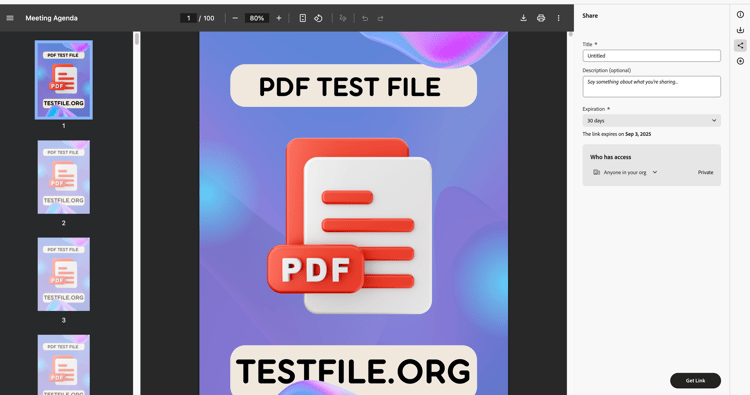
You can share an asset directly from its preview page in Content Hub, generating either a private or public link without leaving the preview view. Execute the following steps to share the asset while previewing the asset:
-
Navigate to the Content Hub homepage and click the asset thumbnail to preview the asset. This displays the menu options on the right pane of the dialog box.
-
Select
-
Complete Steps 3 to 5 in the Share assets section to generate and share the asset link—Private or public—directly from this Share panel. A Private link restricts access to authorized users, while a public link allows anyone with the URL to view the asset.
Access the shared assets access-shared-assets
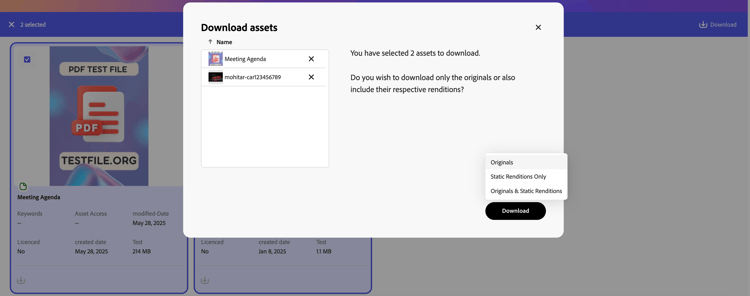
Access the shared assets page through the provided link, then complete any of the following actions:
-
Select one or more assets and click

-
Click the asset thumbnail to view that asset’s metadata, which provides identifying details such as file information and asset properties before you download.
-
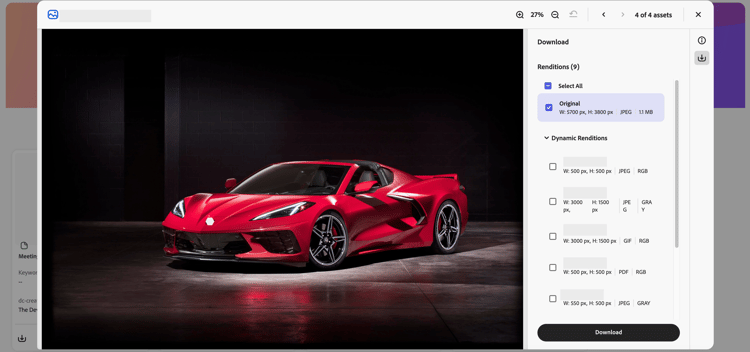
On the shared assets page (accessed through a private link), click an asset thumbnail and select
Frequently asked questions faqs-share-assets-content-hub
What does sharing assets in AEM Assets Content Hub mean?
Sharing assets in Adobe Experience Manager (AEM) Assets Content Hub enables authorized users to share one or more assets, or entire collections, by generating a shareable link. This link grants recipients direct access to view and download the selected assets, streamlining distribution without requiring recipients to navigate the full Content Hub environment. Because access is delivered through a single link, teams can quickly circulate approved brand assets, marketing materials, and creative files to internal and external stakeholders alike.
Recipient types for a shared link include:
- Private users — recipients who must sign in to access the shared assets, ensuring controlled, authenticated access.
- Public users — recipients who can access the assets as guests without signing in.
This dual-recipient approach makes link-based sharing flexible for a range of collaboration needs: private sharing supports secure, permission-controlled workflows, while public sharing supports broad, frictionless distribution to audiences outside the organization. As a result, authorized users can tailor how each set of assets is shared, distributed, and consumed.
How do I share assets or collections with others using AEM Assets Content Hub?
Sharing assets or collections in Adobe Experience Manager (AEM) Assets Content Hub generates a shareable link that you can distribute to team members or stakeholders. The process uses the built-in Share feature, which lets you control exactly what is shared, who can access it, and for how long.
Steps to Share Assets or Collections
- Open the Content Hub homepage.
- Select one or more assets. To share a collection instead, go to the Collections tab and select the collection.
- Click the Share icon to open the Share dialog.
- In the dialog, preview the selected assets and remove any that should not be included.
- Add a title and description to give recipients context about the shared content.
- Choose who can access the link by setting it to private or public.
- Set an expiration period for the link.
- Click Get Link to generate the shareable URL, which is automatically copied for you to distribute.
Sharing Options Explained
- Access control (private or public): Selecting private or public determines who can open the link, allowing you to restrict access to intended recipients or make the assets openly accessible.
- Expiration period: Setting an expiration period creates a time-limited link, which helps ensure shared assets are no longer accessible after they are no longer needed.
- Title and description: Adding a title and description helps recipients quickly understand what the shared assets or collection contain.
Once generated with Get Link, the shareable URL can be sent directly to team members or stakeholders for review, collaboration, or distribution.
What access options are available when sharing assets in AEM Assets Content Hub, and how do they differ?
Adobe Experience Manager (AEM) Assets Content Hub provides two access options for shared links: private links and public links. This lets users and administrators choose the appropriate level of control each time an asset is shared, balancing security against ease of distribution. The two options differ primarily in whether recipients must sign in and in how their link expiration is configured.
Private Links: Secure, Sign-In Required
Private links require recipients to sign in to their Content Hub environment before they can view and download assets. This provides added security, because access is restricted to authenticated members of the Content Hub environment rather than anyone who happens to obtain the link. Private links use custom expiration dates, allowing the person sharing the asset to define exactly how long access remains valid.
Private links are best suited for sharing sensitive, unreleased, or internal assets where controlling exactly who can access the content is essential.
Public Links: Open Access via Link
Public links can be accessed by anyone who has the link, without requiring sign-in. This makes public links the faster, more convenient option for broad distribution to external recipients or collaborators who do not have Content Hub access. Public links carry their own expiration settings, typically ranging from 24 hours to one week, ensuring that open access is time-limited rather than permanent.
Public links are ideal for quickly distributing approved, non-sensitive assets to a wide audience.
Private vs Public Links: Key Differences
The two access options contrast across three dimensions:
- Authentication: Unlike public links, private links require recipients to sign in to their Content Hub environment, while public links are accessible to anyone with the link and require no sign-in.
- Security: Private links offer added security by limiting access to authenticated users; public links prioritize convenience and open reach.
- Expiration: Private links use custom expiration dates set by the sharer, whereas public links use preset windows such as 24 hours to one week.
Choosing between private and public links depends on the balance a user needs between security and ease of access for each shared asset.
Is there any configuration managed by administrator to be able to generate public links for assets in AEM Assets Content Hub?
Yes. Administrators control the generation of public links for assets in Adobe Experience Manager (AEM) Assets Content Hub through the Enable Public Link toggle, located in the Collections and Sharing tab of the Configuration UI. Enabling or disabling this toggle determines whether public links can be generated for assets.
To locate and set this control:
- Open the Configuration UI in AEM Assets Content Hub.
- Navigate to the Collections and Sharing tab.
- Enable or disable the Enable Public Link toggle.
Enable Public Link is an administrator-managed setting, which means the ability to create public links is governed centrally rather than left to individual users. When the toggle is enabled, users can generate public links to share assets. When it is disabled, public link generation is turned off across the Content Hub.
This centralized control allows administrators to align public link sharing with organizational governance and security requirements, ensuring that assets are only shared publicly when explicitly permitted.
Can I set expiration dates for shared asset links in AEM Assets Content Hub, and why is this important?
Yes — you can set expiration dates for both private and public shared asset links in Adobe Experience Manager (AEM) Assets Content Hub. This feature gives content owners direct control over how long a shared link remains active, ensuring assets are accessible only for the intended window.
Expiration Options for Public vs. Private Links
Content Hub applies different expiration controls depending on the link type:
- Public links: Choose from preset durations ranging from 24 hours up to one week.
- Private links: Select from the available presets, or define a custom expiration date for more precise control over the sharing window.
Unlike public links, which are limited to fixed presets, private links add the flexibility of a fully custom expiration date, giving you finer control over exactly when access ends.
Why Setting Expiration Dates Matters
Expiration dates are important because they enforce automatic access control. Once a link expires, it can no longer be used to access or download the assets. As a result, expired links cannot be forwarded, reused, or exploited after the intended sharing period ends. This directly helps maintain the security and control of your content, reducing the risk of unauthorized distribution and limiting the exposure of sensitive or brand-restricted assets over time.
By pairing preset and custom expiration windows with public and private sharing, AEM Assets Content Hub allows teams to distribute assets externally while ensuring access does not persist longer than necessary.
What can recipients do with the shared asset link created using AEM Assets Content Hub, and are there options for downloading different renditions?
Recipients of a shared asset link can preview, select, and download assets directly in their web browser, with no application installation or account login required. Adobe Experience Manager (AEM) Assets Content Hub generates the link so that anyone who receives it can access the shared content immediately.
Recipients who receive a shared asset link can:
- Open the link in a browser to preview the shared assets.
- Select the specific assets they need from the shared collection.
- Download the selected assets, delivered together as a single zip file.
- View asset metadata by clicking the asset thumbnail.
Downloading different renditions: If asset renditions are enabled in AEM Assets Content Hub, recipients choose which renditions they want to download. A rendition is an alternate version of the same source asset, such as the Original (the full, unmodified file) or a Static rendition. This lets recipients retrieve the exact format that fits their intended use rather than being limited to a single output. The assets and their selected renditions are packaged and downloaded together as a zip file, and recipients view metadata by clicking the asset thumbnail.
The link remains functional until its set expiration date, after which access is automatically revoked. This time-limited access ensures that shared content is available only for the intended window, giving asset owners controlled, secure distribution of their files.
See also
- Translate Assets
- Assets HTTP API
- Assets supported file formats
- Search assets
- Connected assets
- Asset reports
- Metadata schemas
- Download assets
- Manage metadata
- Manage Dynamic Media templates
- Manage reports in Assets view
- Search facets
- Manage collections
- Bulk metadata import
- Publish Assets to AEM and Dynamic Media