在此頁面上:定義電子郵件、行動裝置、推播、WhatsApp和自訂管道的時間型排除專案,以避免在錯誤的時間傳送訊息給客戶,並尊重其偏好設定和合規性要求。
什麼是無訊息時數
無訊息時數可讓您定義電子郵件、行動訊息、推播、WhatsApp和自訂管道的時間排除專案。 此功能可確保在特定時段內不會傳送任何訊息,協助您遵守客戶偏好設定和合規性要求。
您可以透過 規則集 套用勿打擾時間,這些規則集可指派給行銷活動或歷程中的個別動作,以進行精確控制。
透過簡化這些程式,您可以改善客戶體驗、節省時間,並確保遵守通訊規則:
- 不要喚醒您的客戶 - 正確的客戶、正確的頻道、正確的時間是許多行銷人員的信條,因此時機是客戶歷程的關鍵部分是很合理的。 透過設定「無訊息時數」規則,品牌更能掌控連絡人何時收到訊息,確保他們在更有可能對您的訊息採取行動時收到訊息。
- 便利性 — 當您需要防止對象收到訊息而不需要停止整個歷程或行銷活動時,可以輕鬆地攔截跨行銷活動和歷程的通訊。
- 省時 — 透過建立 以時間為基礎的規則 在一個位置管理排除專案,而不是透過自訂運算式新增多個條件節點。\
➡️ 在影片中探索此功能
護欄與限制
- 支援的頻道 — 電子郵件、行動訊息、推播、WhatsApp和自訂頻道。
- 傳輸延遲 — 無訊息時數規則的更新可能需要最多12小時才能套用至已使用該規則的管道動作。
- 大量延遲 — 若是大量通訊,系統可能需要額外的時間,才能開始成功強制實施無訊息小時抑制。
建立無訊息小時規則
若要設定無訊息時數,請在自訂規則集中建立規則。 瞭解如何建立規則集。 請依照下列步驟操作:
-
導覽至 商業規則 以存取規則集詳細目錄。
-
選擇現有的自訂規則集或建立新的自訂規則集:
accordion 在現有規則集中建立無訊息時數規則 從詳細目錄選取規則集。 安靜時間規則只能新增到具有「管道」網域的規則集。 您可以在 網域 資料行中檢查此資訊。
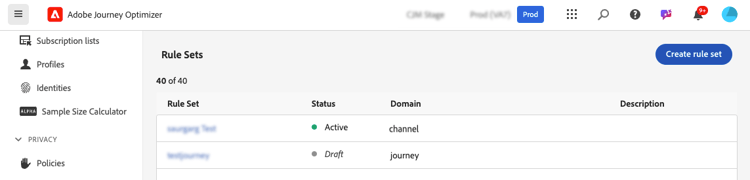
accordion 在新規則集中建立無訊息小時規則 按一下建立規則集,輸入唯一的名稱,然後從 規則集網域 下拉式清單中選取「管道」。

note NOTE 安靜時間只能在 自訂規則集 中定義。 全域規則集不支援無訊息時間設定。 -
在規則集畫面中,按一下新增規則,並為規則提供唯一名稱。
-
類別欄位指定規則套用的訊息類別。 目前此欄位為唯讀,預設為行銷。
-
在 規則型別 下拉式清單中,選取無訊息時數。
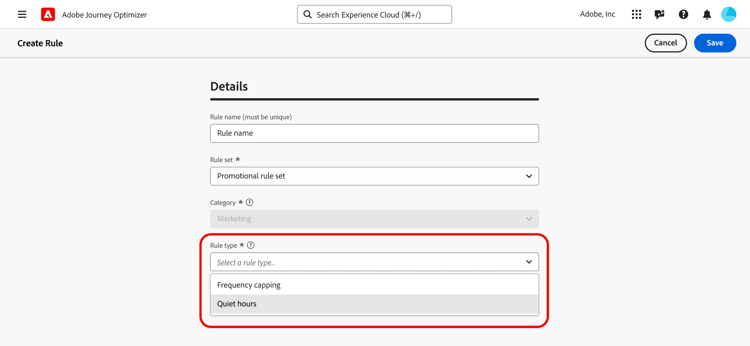
-
在 日期與時間 區段中,定義何時套用無訊息時數:
-
在 時區 下拉式清單中,將標準時區套用至對象中的所有收件者,無論其個別時區為何。
若要使用每個設定檔的時區欄位,請選取使用收件者當地時區 。 進一步瞭解歷程中的時區管理
note important IMPORTANT 如果設定檔沒有時區值,則不會強制該設定檔使用無訊息小時,而且也不會遞補為預設時區。 設定檔上缺少時區資料是最常見的原因,收件者型無訊息時間未如預期套用。 -
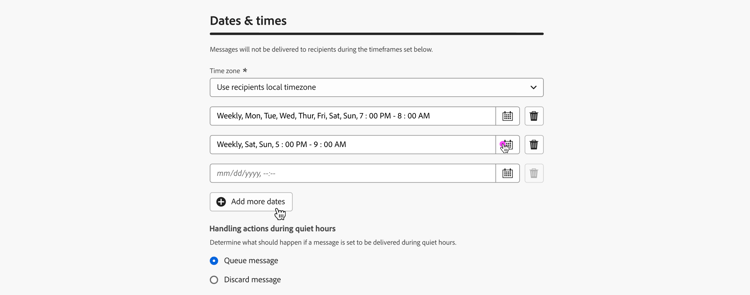
指定應套用免打擾時間的時段。
-
每週 — 選擇一週中的特定日期和時段。 您也可以強制執行規則全天。
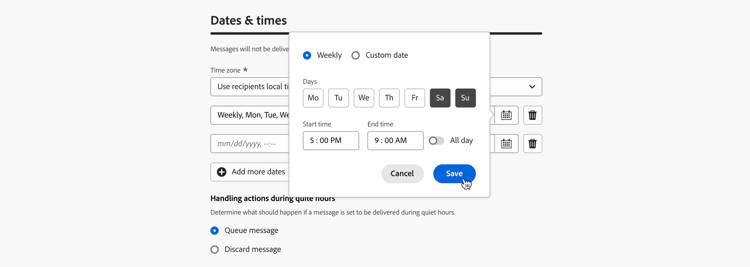
當每週時段越過午夜時,選取的日期就是該時段開始的日期。 例如,星期一9:00 PM至9:00 AM期間涵蓋星期一9:00 PM至星期二9:00 AM;這不會涵蓋星期一12:00 AM至9:00 AM。
一起檢閱每週期間,以確保它們持續涵蓋預定日期,尤其是在午夜、一週的開始或結束時。 例如,星期六和星期日的全天期間,加上星期一至星期五的9:00 PM至9:00 AM期間,會取消涵蓋星期一的12:00 AM至9:00 AM。 若要將無訊息工作時間延長至星期一上午9:00,請將星期日納入晚上9:00至上午9:00期間。
-
自訂日期 — 選擇行事曆和時程表中的特定日期。 您也可以強制執行規則全天。
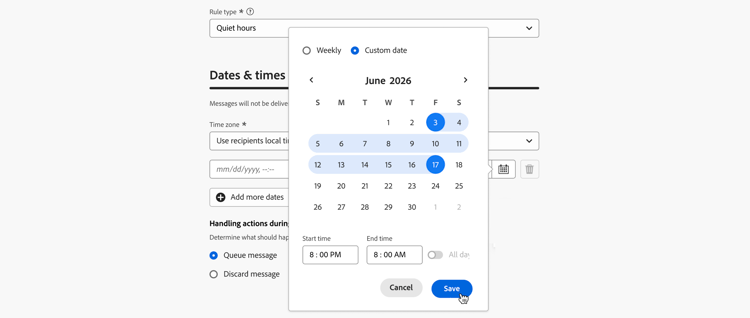
-
-
按一下「新增更多日期」按鈕,最多可新增5個不同的句號。
-
-
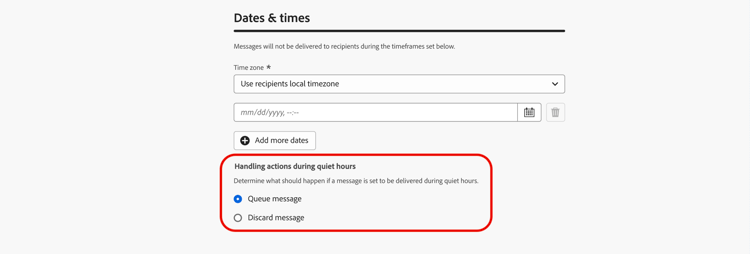
在 安靜時數期間的處理動作 區段中,選擇在選取的時段內如何處理訊息:
-
佇列訊息 — 訊息會在無訊息時段的完成時傳送,除非處於暫停狀態。
note NOTE 如果訊息在設定檔中維持佇列狀態超過7天,將會捨棄該訊息。 -
捨棄訊息 — 永不傳送訊息。
note NOTE 如果您選取「捨棄」並將此規則套用至歷程動作,則會從訊息傳遞中移除設定檔並從歷程中退出。
-
規則現在會顯示在規則集中。 您可以選取它以在屬性窗格中顯示其詳細資訊。
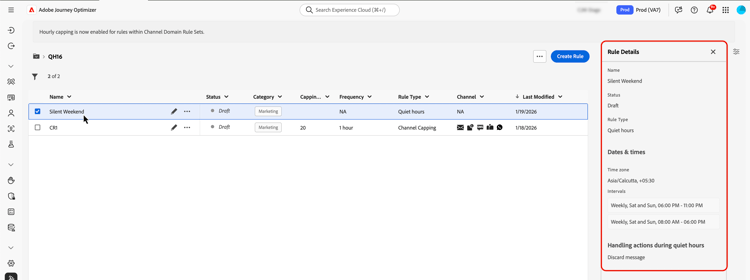
如果您的規則已就緒,請啟動該規則並完成規則集的設定。 瞭解如何建立和啟用規則集
最佳實務 best-practices
使用下列指南來決定如何為一組指定的歷程或行銷活動設定無訊息時數規則。
選擇時區模式 choose-time-zone
- 當您的對象集中在單一區域並共用相同的營業時間時,請套用標準時區。 然後,相同的視窗會統一套用至每個收件者。
- 選取當您的對象跨越數個區域時,使用收件者當地時區,讓晚上10:00到上午7:00等視窗使用每個收件者的當地時間,而非單一參考時間。 當您使用此模式時,請確定設定檔包含時區值,因為對於未包含的設定檔,不會強制執行無訊息時數。
選擇處理動作 choose-handling-action
正確的處理動作取決於靜音視窗結束後,訊息是否仍有意義:
- 對於稍後仍保持相關性的訊息,例如,忠誠度更新、獎勵摘要或次日早上仍然有效的優惠方案,請使用佇列訊息。 訊息會在無訊息時段結束時保留並傳送。 已針對設定檔保留佇列超過7天的訊息會被捨棄。
- 對於在安靜視窗期間失去值的時間敏感訊息,例如,隔夜結束的快閃特賣,或是不再及時的放棄購物車提醒,請使用捨棄訊息。 訊息絕不會傳送。 當規則套用至歷程動作時,設定檔也會退出歷程。
如需將此指引套用至實際歷程的端對端範例,請參閱社群文章Adobe Journey Optimizer中的安靜時間:計時是Personalization的最後一哩。
套用無訊息時間至歷程與行銷活動 apply
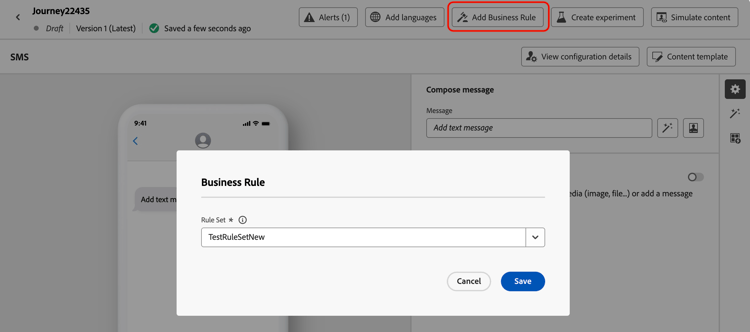
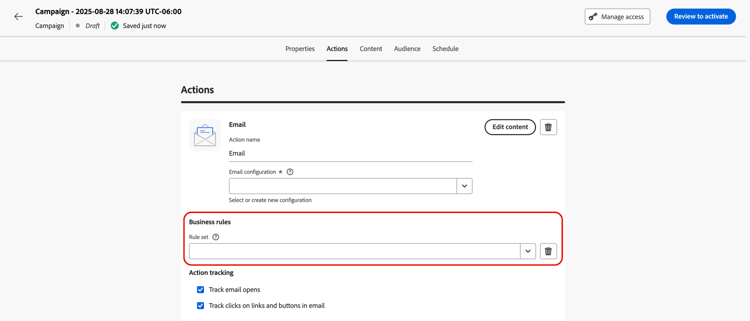
儲存規則並啟用規則集後,您就可以將其套用至歷程和行銷活動中的動作。 支援的頻道: 電子郵件、行動訊息、推播、WhatsApp、自訂頻道。 瀏覽以下標籤以取得更多詳細資訊。
後續步驟
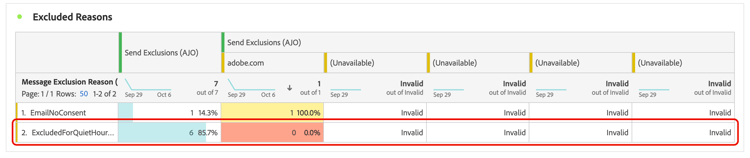
一旦您的歷程或行銷活動啟動並執行,您就可以在Customer Journey Analytics報告和即時報告中檢視從通訊排除的設定檔數目,其中安靜時數規則將會列為使用者被排除傳送的可能原因。
作法影片 video
瞭解如何使用Adobe Journey Optimizer的安靜時間功能。
This section contains structured knowledge intended to support interpretation, retrieval, and question answering related to this topic.
For complete understanding, this information should be combined with the documentation on this page. Neither source is intended to stand alone; the page describes the feature, while this section provides additional context that helps disambiguate terminology, intent, applicability, and constraints.
- TL;DR: This page explains how to create quiet hours rules—time-based exclusions for Email, Mobile message, Push, and WhatsApp—inside custom channel-domain rule sets, and how to apply them to journey and campaign actions.
Intents:
- Create a quiet hours rule in a custom channel-domain rule set
- Define the exclusion period using Weekly or Custom date with a time zone
- Review weekly periods together to identify gaps at midnight and at the start or end of the week
- Choose how messages are handled during quiet hours (Queue message or Discard message)
- Choose between a standard time zone and Use recipients local time zone, and between Queue message and Discard message, based on audience and message shelf life
- Apply an activated quiet hours rule set to journey and campaign actions
- View the number of profiles excluded by quiet hours in reporting
Glossary:
- Quiet hours: Time-based exclusions for Email, Mobile message, Push, and WhatsApp that ensure no messages are sent during specific periods (product-specific)
- Queue message: Handling option where messages are sent at the completion of the quiet hours period unless in Paused state (product-specific)
- Discard message: Handling option where messages are never sent (product-specific)
- Use recipients local time zone: Option that applies each profile’s own time zone field instead of one standard time zone (product-specific)
- Custom rule set: A rule set in which quiet hours can be defined (product-specific)
Guardrails:
- Supported channels: Email, Mobile message, Push, and WhatsApp.
- Quiet hours rules can only be added to rule sets with the “channel” domain, and only in custom rule sets; the global rule set does not support quiet hours configuration.
- The Category field is currently read-only and defaults to Marketing.
- If a profile has no time zone value, quiet hours are not enforced for that profile, and there is no fallback to a default time zone.
- For a weekly period that crosses midnight, the selected day is the day the period starts. A Monday 9:00 PM–9:00 AM period covers Monday 9:00 PM through Tuesday 9:00 AM, not Monday 12:00 AM–9:00 AM.
- Review weekly periods together for continuous coverage. A Saturday and Sunday all-day period combined with Monday–Friday 9:00 PM–9:00 AM periods leaves Monday 12:00 AM–9:00 AM uncovered; include Sunday in the 9:00 PM–9:00 AM period to cover through Monday 9:00 AM.
- You can add up to 5 separate periods with the Add more dates button.
- Updates to a quiet hours rule may take up to 12 hours to be applied to channel actions that already use that rule.
- In cases of high-volume communications, the system may take additional time to begin enforcing quiet hour suppressions.
- If a message remains in a queued state for a profile for more than 7 days, the message is discarded.
- If you select Discard and apply this rule to a journey action, the profile is removed from message delivery and exited from the journey.
Terminology:
- Canonical name: quiet hours — variants: quiet hours rule
- Synonyms: none
- Do not confuse: “Queue message” (sent after the quiet period unless Paused) ≠ “Discard message” (never sent)
- Do not confuse: standard “Time zone” (one time zone for all recipients) ≠ “Use recipients local time zone” (each profile’s own time zone)
FAQ:
- Q: Which channels support quiet hours? — Email, Mobile message, Push, and WhatsApp.
- Q: Can I set quiet hours in the global rule set? — No, quiet hours can only be defined in custom rule sets with the “channel” domain.
- Q: What happens to a message that hits quiet hours? — With Queue message it is sent when the quiet period ends unless it is Paused; with Discard message it is never sent.
- Q: When should I use Queue message or Discard message? — Use Queue message for messages that stay relevant after the quiet period (for example loyalty updates), keeping in mind the 7-day queue limit. Use Discard message for time-sensitive messages that lose their value during the quiet window (for example a flash sale that ends overnight).
- Q: When should I use a standard time zone or recipients’ local time zone? — Use a standard time zone when the audience is concentrated in a single region. Use Use recipients local time zone when the audience spans several regions, and make sure profiles have a time zone value.
- Q: How can I avoid queued messages being released all at once? — Combine quiet hours with frequency capping by channel.
- Q: What if a profile has no time zone value? — Quiet hours are not enforced for that profile, and there is no fallback to a default time zone. This is the most common reason recipient-based quiet hours do not apply as expected.
- Q: Which day does a weekly period that crosses midnight apply to? — The selected day is the day the period starts. A Monday 9:00 PM–9:00 AM period covers Monday evening through Tuesday morning.
- Q: How can I cover Monday through 9:00 AM? — Include Sunday in the 9:00 PM–9:00 AM period; a Saturday and Sunday all-day period combined with Monday–Friday overnight periods leaves Monday 12:00 AM–9:00 AM uncovered.
- Q: How long can a message stay queued? — If it remains queued for a profile for more than 7 days, it is discarded.
- Q: How long do rule updates take to apply? — Up to 12 hours for channel actions that already use that rule.
Personas:
- marketer: Can create a quiet hours rule in a custom rule set, choosing Weekly or Custom date periods and a time zone. Can add up to 5 periods with Add more dates, and choose Queue message or Discard message to handle messages. The page states that quiet hours are not enforced for a profile with no time zone value. Where: “Create Quiet hours rules”.
Onboarding:
- Level: Intermediate
- First minimal step: Navigate to Business rules to access the rule sets inventory.
- Success check: The rule displays in the rule set, and you can select it to view its details in the properties pane.
- Previous: Learn how to create rule sets before adding a quiet hours rule: Work with rule sets (conflict-prioritization/rule-sets.md); Review custom channels supported by quiet hours: Get started with custom channels (custom-channel/get-started-custom-channel.md)
- Next: View profiles excluded by quiet hours in the Customer Journey Analytics report: Updated reporting experience (reports/report-gs-cja.md); Check the Live report for quiet hours listed as an exclusion reason: Live report (reports/live-report.md)