이 페이지에서: 여정이 Campaign 트랜잭션 메시지를 통해 이메일, 푸시 알림 및 모바일 메시지를 보낼 수 있도록 Journey Optimizer을 Adobe Campaign v7 또는 v8에 연결합니다.
Adobe Campaign Classic v7 또는 Campaign v8이 있는 경우 여정에서 Adobe Journey Optimizer과 Adobe Campaign을 통합하는 특정 사용자 지정 작업을 사용할 수 있습니다. 이 통합을 통해 Adobe Campaign 트랜잭션 메시지 기능을 사용하여 이메일, 푸시 알림 및 모바일 메시지를 전송할 수 있습니다. 이 전체 사용 사례에서 자세히 알아보세요.
구성된 각 작업에 대해 여정 디자이너 팔레트에서 캠페인 작업 활동을 사용할 수 있습니다.
활성화 access
요청되면, Journey Optimizer과 Adobe Campaign 환경 간의 연결은 프로비저닝 시 Adobe에 의해 설정됩니다. 프로비저닝 시 연결을 요청하지 않은 경우 Adobe Journey Optimizer 지원에 문의하여 활성화를 요청하십시오. 다음 세부 정보를 제공해야 합니다.
- 조직 ID (Adobe OrgID)
- 샌드박스 이름
- Campaign 서버 URL
- 실시간 서버 URL
- Adobe Campaign 버전
가드레일 및 제한 사항 important-notes
-
메시지 제한이 없습니다. 시스템은 현재 Campaign SLA을 기준으로 5분당 4,000개 이상으로 보낼 수 있는 메시지 수를 제한합니다. 이러한 이유로 Journey Optimizer은 단일 사용 사례(대상이 아닌 개별 이벤트)에서만 사용해야 합니다.
-
사용할 템플릿당 캔버스에 대해 하나의 작업을 구성해야 합니다. Adobe Campaign에서 사용하려는 각 템플릿에 대해 Journey Optimizer에서 하나의 작업을 구성해야 합니다.
-
진행 중인 다른 Campaign 작업에 영향을 주지 않도록 이 통합을 위해 호스팅된 전용 메시지 센터 또는 Managed Services 인스턴스를 사용하는 것이 좋습니다. 마케팅 서버는 호스팅되거나 온-프레미스일 수 있습니다.
-
페이로드 또는 캠페인 메시지가 올바른지 확인할 수 없습니다.
-
대상자 자격 이벤트에는 Campaign 작업을 사용할 수 없습니다.
전제 조건 prerequisites
Adobe Campaign에서는 트랜잭션 메시지와 관련 이벤트를 만들고 게시해야 합니다. Adobe Campaign 설명서를 참조하세요.
아래 패턴에 따라 각 메시지에 해당하는 JSON 페이로드를 빌드할 수 있습니다. 그런 다음 Journey Optimizer에서 작업을 구성할 때 이 페이로드를 붙여 넣습니다(아래 참조).
| code language-json |
|---|
|
- 채널: 캠페인 트랜잭션 템플릿에 대해 정의된 채널
- eventType: Campaign 이벤트의 내부 이름
- ctx: 메시지에 있는 개인화를 기반으로 하는 변수입니다.
작업 구성 configure-action
Journey Optimizer에서는 트랜잭션 메시지당 하나의 작업을 구성해야 합니다.
Campaign 작업을 만들려면 다음 단계를 수행합니다.
- 새 작업을 만듭니다. 사용자 지정 작업을 만드는 방법을 알아봅니다.
- 이름과 설명을 입력합니다.
- 작업 유형 필드에서 Adobe Campaign Classic을(를) 선택합니다.
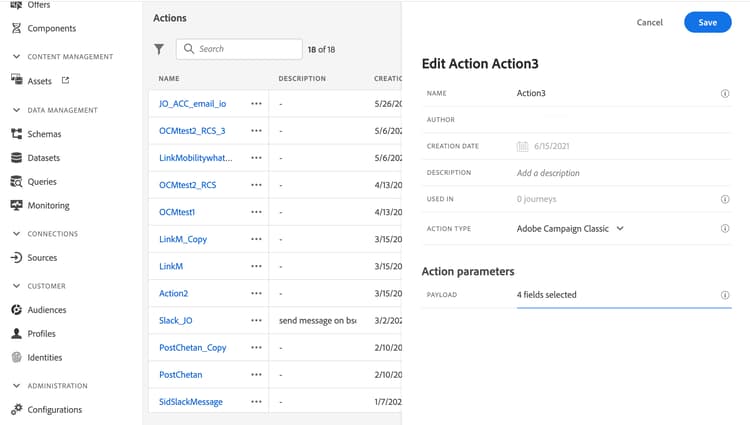
- 페이로드 필드를 클릭하고 캠페인 메시지에 해당하는 JSON 페이로드의 예제를 붙여 넣습니다. 이 페이로드를 가져오려면 Adobe에 문의하십시오.
- 여정 캔버스에서 매핑할지 여부를 기준으로 각 필드를 정적 또는 변수로 설정합니다. 예를 들어 전자 메일 채널 매개 변수 및 개인화 필드(
ctx)와 같은 필드는 일반적으로 여정 내에서 동적으로 조정할 수 있도록 변수로 설정해야 합니다. - 저장을 클릭합니다.
기존 작업 업데이트 update-action
초기 설정 후 실시간(RT) 끝점이 변경되는 경우와 같이 기존 Campaign v7/v8 사용자 지정 작업을 업데이트해야 하는 경우 다음 단계를 수행합니다.
- 관리 메뉴에서 구성을 선택한 다음 작업(으)로 이동합니다.
- 작업 목록에서 업데이트할 Campaign 작업을 찾아 선택합니다.
- 작업 구성을 열려면 편집을 클릭하세요.
- URL 필드를 새 RT 끝점 URL로 업데이트합니다. 끝점 형식이 올바르고 연결 가능한지 확인하십시오.
- 필요한 경우 페이로드 구성을 Campaign 트랜잭션 메시지 구조의 변경 사항과 일치하도록 업데이트하십시오.
- 테스트를 클릭하여 새 끝점에 대한 연결의 유효성을 검사합니다. 계속하기 전에 테스트가 성공적인 응답을 반환하는지 확인하십시오.
- 유효성을 검사했으면 저장을 클릭하여 변경 내용을 적용합니다.
This section contains structured knowledge intended to support interpretation, retrieval, and question answering related to this topic.
For complete understanding, this information should be combined with the documentation on this page. Neither source is intended to stand alone; the page describes the feature, while this section provides additional context that helps disambiguate terminology, intent, applicability, and constraints.
- TL;DR: This page explains how to integrate Journey Optimizer with Adobe Campaign v7 or v8 so journeys can send emails, push notifications, and mobile messages through Adobe Campaign Transactional Messaging.
Intents:
- Request activation of the connection between Journey Optimizer and Adobe Campaign environments
- Prepare the transactional message, its associated event, and the JSON payload in Adobe Campaign
- Configure a Campaign action of type Adobe Campaign Classic in Journey Optimizer
- Set payload fields as static or variable for mapping on the journey canvas
- Update an existing Campaign action when the Real-Time endpoint changes
Glossary:
- Campaign action: The action available in the journey designer palette for each configured Adobe Campaign v7/v8 action (product-specific)
- Transactional Messaging: The Adobe Campaign capability used to send emails, push notifications, and mobile messages triggered from Journey Optimizer (product-specific)
- eventType: The internal name of the Adobe Campaign event referenced in the JSON payload (product-specific)
- ctx: The payload object holding variables based on the personalization present in the Campaign message (product-specific)
Guardrails:
- There is no throttling of messages; the system caps the number of messages that can be sent to 4,000 per 5 minutes, based on the current Campaign SLA.
- Because of that cap, Journey Optimizer should only be used in unitary use cases (individual events, not audiences).
- You must configure one action on the canvas per template, meaning one action in Journey Optimizer for each Adobe Campaign template you wish to use.
- There is no validation that the payload or Campaign message is correct.
- You cannot use a Campaign action with an audience qualification event.
- Adobe recommends using a dedicated Message Center hosted or Managed Services instance to avoid impacting other Campaign operations.
Terminology:
- Canonical name: Adobe Campaign v7/v8 integration — Acronym: ACC (Adobe Campaign Classic v7/v8) — variants: Campaign action, Campaign v7/v8 custom action
- Do not confuse: “Campaign action” (Adobe Campaign v7/v8 integration) ≠ other custom actions (created through the generic action creation procedure that the page links to)
FAQ:
- Q: How is the connection between Journey Optimizer and Adobe Campaign established? — It is set up by Adobe at provisioning time; if it was not requested then, contact Adobe Journey Optimizer support and provide the Org ID, Sandbox Name, Campaign Server URL, Real-Time Server URL, and Campaign version.
- Q: What is the message sending cap for this integration? — There is no throttling, but the system caps messages to 4,000 per 5 minutes based on the current Campaign SLA.
- Q: Why should this integration be used only for unitary use cases? — Because there is no throttling and messages are capped to 4,000 per 5 minutes, it suits individual events rather than audiences.
- Q: Can a Campaign action be used with an audience qualification event? — No, you cannot use a Campaign action with an audience qualification event.
- Q: How do I update a Campaign action when the Real-Time endpoint changes? — Edit the action, update the URL field with the new RT endpoint, adjust the Payload if needed, click Test to validate the connection, then Save.