이 페이지에서: API 페이로드에서 전달된 컨텍스트 데이터를 사용하여 API에서 트리거된 캠페인 콘텐츠를 디자인하고 개인화하여 모든 받는 사람에 대해 각 메시지를 실시간으로 맞춤화할 수 있습니다.
메시지 콘텐츠를 구성하려면 콘텐츠 탭으로 이동하거나 콘텐츠 편집 단추를 클릭합니다.
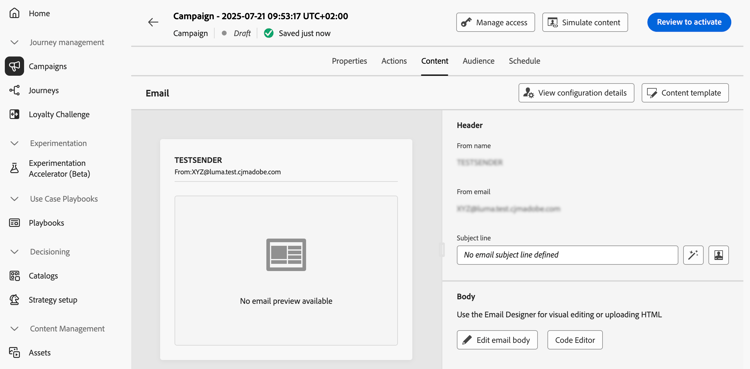
콘텐츠 디자인 design
콘텐츠 만들기 프로세스는 선택한 채널에 따라 다릅니다. 다음 페이지에서 메시지 콘텐츠를 만드는 자세한 단계를 배웁니다.



개인화된 PDF 파일 첨부 attachments
트랜잭션 API가 트리거되는 이메일 캠페인의 경우 정적 및 개인화된 첨부 파일을 모두 포함하여 이메일에 최대 5개의 PDF 첨부 파일을 포함할 수 있습니다. 각 수신자는 서로 다른 개인화된 PDF를 받을 수 있습니다. 개인화된 PDF 파일을 첨부하는 방법을 알아봅니다
컨텍스트 기반 데이터를 사용하여 콘텐츠 개인화 contextual
메시지를 개인화하는 데 활용할 수 있는 API 페이로드에 추가 데이터를 전달할 수 있습니다.
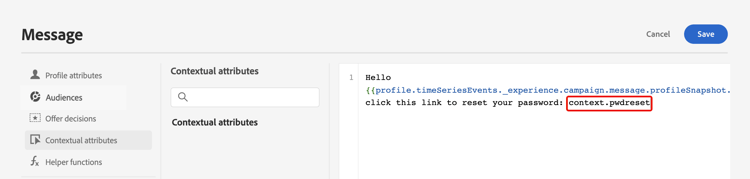
고객이 암호를 재설정하고자 하고 서드파티 도구에서 생성된 암호 재설정 URL을 전송하고자 하는 이 예를 살펴보겠습니다. API가 트리거된 캠페인을 사용하면 이 생성된 URL을 API 페이로드에 전달하고 이를 캠페인에 활용하여 메시지에 추가할 수 있습니다.
이렇게 하려면 API 페이로드에 전달하고 개인화 편집기를 사용하여 메시지에 추가해야 합니다. {{context.<contextualAttribute>}} 구문을 사용하십시오. 여기서 <contextualAttribute>은(는) 전달할 데이터를 포함하는 API 페이로드의 변수 이름과 일치해야 합니다.
지금은 왼쪽 레일 메뉴에서 사용할 수 있는 컨텍스트 속성이 없습니다. Journey Optimizer에서 검사를 수행하지 않고 개인화 식에서 직접 특성을 입력해야 합니다.
읽어야 함
- 요청에 전달된 컨텍스트 속성은 200kb를 초과할 수 없으며 항상 유형 문자열로 간주됩니다.
context.system구문은 Adobe 내부 사용으로만 제한되며 컨텍스트 특성을 전달하는 데 사용해서는 안 됩니다.- 프로필 활성화 이벤트와 달리 REST API에서 전달된 컨텍스트 데이터는 일회성 통신에 사용되며 프로필에 대해 저장되지 않습니다. 네임스페이스가 누락된 경우 최대 네임스페이스 세부 정보로 프로필이 만들어집니다.
- 콘텐츠에 수많은 상황별 데이터 또는 방대한 컨텍스트 데이터를 사용하면 성능에 영향을 줄 수 있습니다.
- 검사가 수행되지 않으므로 표현식에 수동으로 입력한 컨텍스트 특성 경로가 중첩 및 키 이름을 포함한 페이로드 구조와 정확히 일치하는지 확인하십시오.
콘텐츠 테스트 및 확인
콘텐츠가 정의되면 콘텐츠 시뮬레이션 버튼을 사용하여 콘텐츠를 미리 보고 테스트하십시오. 다음 중 하나의 시뮬레이션 방법을 사용할 수 있습니다.
- 샘플 입력 데이터 또는 AI 자동 생성을 사용하여 콘텐츠 변형을 테스트하려면 콘텐츠 시뮬레이션을 클릭하십시오.
- 콘텐츠 시뮬레이션을 클릭한 후 드롭다운에서 콘텐츠 시뮬레이션(AEP 프로필)을 선택하여 테스트 프로필로 미리 봅니다.
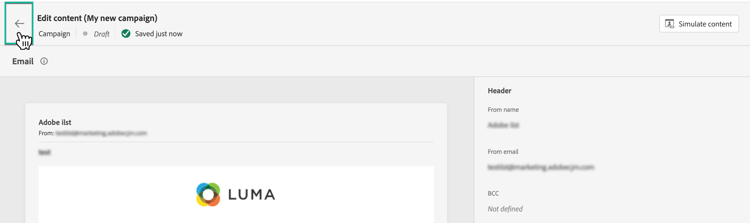
콘텐츠를 미리 보고 테스트하는 방법에 대해 알아보세요. 캠페인 생성 화면으로 돌아가려면 왼쪽 화살표를 클릭합니다.
다음 단계 next
캠페인 구성 및 콘텐츠가 준비되면 캠페인 대상자를 정의할 수 있습니다. 자세히 알아보기
This section contains structured knowledge intended to support interpretation, retrieval, and question answering related to this topic.
For complete understanding, this information should be combined with the documentation on this page. Neither source is intended to stand alone; the page describes the feature, while this section provides additional context that helps disambiguate terminology, intent, applicability, and constraints.
- TL;DR: This page explains how to design the content of an API triggered campaign, personalize it with contextual data passed in the API payload, attach personalized PDF files, and preview it with Simulate content.
Intents:
- Open the message content configuration from the Content tab or the Edit content button
- Personalize a message with contextual data from the API payload
- Attach personalized PDF files to transactional API-triggered email campaigns
- Preview and test the content with Simulate content
Glossary:
- Contextual data: Additional data passed into the API payload and used to personalize the message, referenced with the
{{context.<contextualAttribute>}}syntax, where<contextualAttribute>matches the name of the variable in the API payload (product-specific) - High Throughput campaigns: A mode that does not rely on Adobe profiles; all personalization must be included in the API payload as context data (product-specific)
- Simulate content: Button used to preview and test content with sample input data or AI auto-generation
- Simulate content (AEP profiles): Option selected from the Simulate content dropdown to preview with test profiles
Guardrails:
- The contextual attributes passed into the request cannot exceed 200kb (hard limit) and are always considered of type string.
- The
context.systemsyntax is restricted to Adobe internal usage only and should not be used to pass contextual attributes. - Contextual data passed in the REST API is used for one-off communication and is not stored against profile. At maximum, a profile is created with the namespace details, if it was found missing.
- Using a large number or heavy contextual data in your content may impact performances.
- For now, no contextual attribute is available for use in the left rail menu. Attributes must be typed directly in the personalization expression, with no check performed by Journey Optimizer.
- A transactional API-triggered email campaign can include up to five PDF attachments in an email, including both static and personalized attachments.
Applicability:
- Design content: Email, Mobile message, Push notification
- Personalized PDF attachments: transactional API-triggered email campaigns
- High Throughput campaigns: email channel only, US region only
Terminology:
- Canonical name: API triggered campaign content
- Do not confuse: “contextual data passed in the REST API” (one-off, not stored against profile) ≠ “profile-enabled events”
- Do not confuse: Simulate content (sample input data or AI auto-generation) ≠ Simulate content (AEP profiles) (test profiles)
FAQ:
- Q: How do I use data from the API payload in a message? — Pass the data into the API payload and add it in the message with the personalization editor, using
{{context.<contextualAttribute>}}. - Q: Can contextual attributes be picked from the left rail menu? — No. No contextual attribute is available there; attributes must be typed directly in the personalization expression.
- Q: What is the size limit for contextual attributes? — They cannot exceed 200kb and are always considered of type string.
- Q: Is contextual data stored against the profile? — No. It is used for one-off communication and not stored against profile. At maximum, a profile is created with the namespace details, if it was found missing.
- Q: How many PDF attachments can an email include? — For transactional API-triggered email campaigns, up to five, static and personalized attachments included.
- Q: How do I preview content? — Click Simulate content to test with sample input data or AI auto-generation, or select Simulate content (AEP profiles) from the dropdown to preview with test profiles.
Examples:
- A customer wants to reset a password. A password reset URL is generated in a third-party tool, passed into the API payload, and added to the message with
{{context.<contextualAttribute>}}.
Related pages:
- Creating email content: Email (email/create-email.md)
- Creating mobile message content: Mobile message (mobile/create-mobile-message.md)
- Creating push notification content: Push notification (push/create-push.md)
- High Throughput campaigns: High Throughput campaigns (campaigns/api-triggered-high-throughput.md)
- Personalized PDF attachments: Learn how to attach personalized PDF files (email/pdf-attachments.md#personalized-attachments)
- Previewing and testing content: Learn how to preview and test content (content-management/preview-test.md)
- Next step, defining the audience: Learn more (campaigns/api-triggered-campaign-audience.md)