このページ:構造とコンテンツコンポーネントを追加し、メールをパーソナライズおよびプレビューして、Adobe Journey Optimizer E メールデザイナーでメールコンテンツをゼロからデザインする方法について説明します。
Adobe Journey Optimizer E メールデザイナーを使用して、コンテンツの構造を簡単に定義できます。 単純なドラッグ&ドロップ操作で構造要素を追加したり移動したりして、コンテンツの形を数秒でデザインできます。
コンテンツの作成を開始するには、次の手順に従います。
-
Designer のホームページで、「ゼロからデザイン」オプションを選択します。

-
すぐに始めるには、モジュール(ヘッダー、ヒーローセクション、フッターなど、すぐに使用できるデザイン済みのコンテンツブロック)を使用すると、メール作成を高速化し、キャンペーンの視覚的な一貫性を維持できます。 モジュールの詳細情報
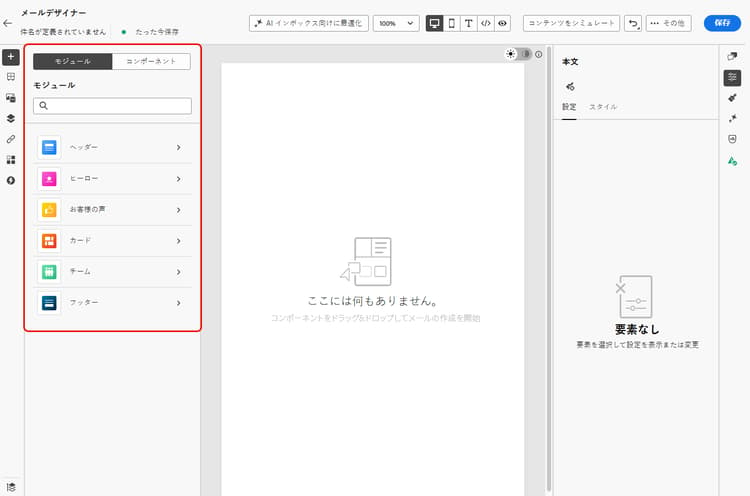
-
それ以外の場合、構造をキャンバスにドラッグ&ドロップしてコンテンツをデザインし、メールのレイアウトを定義します。
note tip TIP または、コンテンツを生成を使用してメール作成を高速化し、AI を使用した完全なコンテンツの生成を使用してテキストと画像を含む完全なメールコンテンツを生成します。 その後、コンテンツのプレビューと検証に進むことができます。 -
必要に応じて 構造 を追加し、右側の専用パネルで設定を編集します。

note NOTE 狭い画面(例:モバイル)では、読みやすいようにデフォルトで列が垂直に積み重ねられます。 一部のメールクライアントはこの動作をサポートしていません。この場合、列は並列のままになります。 「設定」タブの モバイルでは列をスタックしない 切替スイッチを使用して、これをオフにすることもできます。 -
ほとんどの構造(1:1 列、2:2 列、1:2 列左など)は固定プリセットです。 代わりに n:n 列コンポーネントを選択して、列数(3~10)を任意に定義します。

既存の構造の 列数 は、コンテンツを追加した後でも、「設定」タブからいつでも増やすことができます。既存のコンテンツは失われることなく保持されます。
また、各列の幅は、キャンバス上で直接調整したり、「設定」タブで割合を編集して調整することもできます。
note NOTE 各列のサイズを構造コンポーネントの全幅の 10%未満にすることはできません。 空でない列は削除できません。 -
「コンテンツ」セクションから、必要な数の要素を 1 つ以上の構造コンポーネントに追加します。 詳しくは、コンテンツコンポーネントを参照してください
-
各コンポーネントは、右側のメニューの「設定」タブまたは「スタイル」タブを使用してさらにカスタマイズできます。 例えば、コンポーネントのテキストスタイル、パディングまたは余白を変更できます。 詳しくは、整列とパディングを参照してください

-
アセットピッカーから、Assets ライブラリに保存されたアセットを直接選択できます。 詳しくは、アセット管理を参照してください
アセットを含むフォルダーをダブルクリックします。 それらを構造コンポーネントにドラッグ&ドロップします。

-
パーソナライゼーションフィールドを挿入して、プロファイル属性、オーディエンスメンバーシップ、コンテキスト属性などからコンテンツをカスタマイズします。 詳しくは、コンテンツのパーソナライゼーションを参照してください

-
「条件付きコンテンツを有効にする」をクリックし、動的コンテンツを追加して、条件付きルールに基づいてコンテンツをターゲットプロファイルに適応させます。 動的コンテンツの基本を学ぶ

-
左側のペインから「リンク」タブをクリックし、トラッキングするコンテンツのすべての URL を表示します。 必要に応じて、トラッキングタイプ、ラベルを変更して、タグを追加できます。 詳しくは、リンクとトラッキングを参照してください

-
必要に応じて、詳細メニューの「コードエディターに切り替え」をクリックしてコードエディターに切り替え、メールをさらにパーソナライズできます。 これにより、例えばトラッキングタグやカスタム HTML タグを追加するために、メールソースコードを編集できます。 詳しくは、コードエディターを参照してください
note caution CAUTION コードエディターに切り替えた後で、このメールのビジュアル designer に戻すことはできません。 -
コンテンツの準備が整ったら、いずれかのシミュレーション方法を使用してレンダリングを確認します。 デスクトップまたはモバイル表示を選択できます。 詳しくは、コンテンツ管理の節を参照してください。

-
また、コンテンツ品質を検証して、読みやすさ、有効性、コンテンツのまとまりを評価することもできます。 コンテンツ品質の検証の詳細情報
-
コンテンツの準備が整ったら、「保存」をクリックします。
note NOTE 自動保存を使用すると、約10秒間の非アクティブな状態の後、変更内容がメールDesignerに自動的に保存されます。 この機能は、限定提供です。 アクセス権を取得するには、アドビ担当者にお問い合わせください。
This section contains structured knowledge intended to support interpretation, retrieval, and question answering related to this topic.
For complete understanding, this information should be combined with the documentation on this page. Neither source is intended to stand alone; the page describes the feature, while this section provides additional context that helps disambiguate terminology, intent, applicability, and constraints.
- TL;DR: This page explains how to design email content from scratch in the Email Designer by adding structure and content components, defining columns, personalizing, adding dynamic content and links, and previewing before saving.
Intents:
- Start an email from the Design from scratch option and add structure components
- Define the number and width of columns in a structure component
- Add content components, personalization fields, and dynamic (conditional) content
- Review and configure tracked links from the Links tab
- Preview rendering with a simulation method and validate content quality
- Switch to the code editor for advanced source editing
Glossary:
- Design from scratch: The Designer home page option to start building content by adding structures and components (product-specific)
- Structure components: Elements that define the layout of the email, added by drag and drop into the canvas (product-specific)
- n:n column: A structure component whose number of columns can be defined between 3 and 10 (product-specific)
- Switch to code editor: An advanced-menu option to edit the email source code (for example to add tracking or custom HTML tags) (product-specific)
Guardrails:
- The n:n column component supports between 3 and 10 columns.
- Each column size cannot be under 10% of the total width of the structure component.
- You cannot remove a column that is not empty.
- After switching to the code editor, you cannot revert back to the visual designer for that email.
- Stacking columns is not compatible with all email programs; when not supported, columns will not be stacked.
Terminology:
- Canonical name: Structure components — Acronym: n/a — variants: Structures, structure component
- Synonyms: “Design from scratch” = starting content with no template
- Do not confuse: “Structure components” (define layout) ≠ “Content components” (elements placed inside structures)
- Do not confuse: “Settings tab” ≠ “Style tab” (both used to customize components)
FAQ:
- Q: How many columns can a structure have? — Between 3 and 10, defined with the n:n column component.
- Q: Can I make a column narrower than 10%? — No, each column size cannot be under 10% of the total width of the structure component.
- Q: Can I go back to the visual designer after using the code editor? — No, you cannot revert back to the visual designer for that email after switching to the code editor.
- Q: How do I check rendering before saving? — Use either simulation method to check rendering, choosing the desktop or mobile view.
- Q: Where do I manage tracked links? — In the Links tab from the left pane, where you can modify Tracking Type or Label and add Tags.