In questa pagina: scopri come utilizzare l’attività Save audience targeting per creare o sovrascrivere un pubblico riutilizzabile dalla popolazione creata in precedenza in una campagna orchestrata.
L’attività Save audience è un’attività Targeting utilizzata per creare un nuovo pubblico o aggiornarne uno esistente in base alla popolazione generata in precedenza nella campagna orchestrata. Una volta salvato, il pubblico viene aggiunto all’elenco dei tipi di pubblico dell’applicazione e diventa accessibile dal menu Tipi di pubblico.
Viene comunemente utilizzato per acquisire segmenti di pubblico generati nello stesso flusso di lavoro della campagna, rendendoli disponibili per il riutilizzo in campagne future. In genere, è connesso ad altre attività di targeting, come Genera pubblico o Combina, per salvare la popolazione di destinazione finale.
Tieni presente che con l’attività Salva pubblico non è possibile aggiornare un pubblico esistente. Puoi solo creare un nuovo pubblico o sovrascriverne uno esistente con una nuova definizione.
Configurare l’attività Salva pubblico save-audience-configuration
Per configurare l’attività Salva pubblico, segui questi passaggi:
-
Aggiungi un’attività Save audience alla tua campagna orchestrata.
-
Immetti un’etichetta del pubblico che identificherà il pubblico salvato.
note NOTE Il pubblico Label deve essere univoco in tutte le campagne. Non puoi riutilizzare un nome di pubblico già utilizzato nell'attività Salva pubblico di un'altra campagna. -
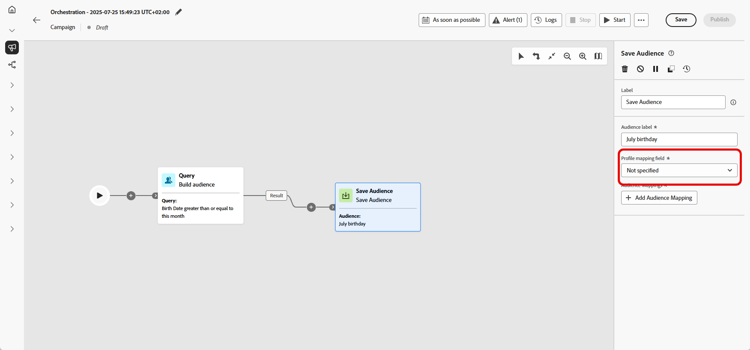
Scegli un campo di mappatura profilo dalla dimensione di targeting della campagna. Questa mappatura definisce il modo in cui i profili nel pubblico salvato sono collegati alla dimensione di destinazione della campagna durante l’esecuzione.
Nell’elenco a discesa saranno disponibili solo le mappature compatibili con la dimensione di destinazione corrente, ovvero quella della transizione in ingresso, per garantire la corretta riconciliazione tra il pubblico e il contesto della campagna.
➡️ Segui i passaggi descritti in questa pagina per creare la tua dimensione di targeting delle campagne
-
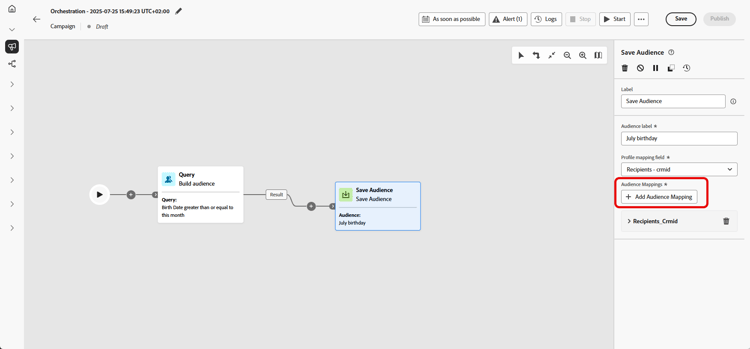
Fai clic su Aggiungi mappature pubblico per includere dati aggiuntivi dagli attributi della dimensione di destinazione o attributi profilo arricchiti.
Ciò ti consente di associare ulteriori informazioni all’attività Pubblico salvato oltre alla mappatura del profilo principale, migliorando le opzioni di targeting e personalizzazione.
-
Completa la configurazione salvando e pubblicando la campagna orchestrata. Questo genererà e archivierà il tuo pubblico.
-
Pubblica la campagna per il pubblico da creare o sostituire poiché l’attività Salva pubblico non viene eseguita mentre la campagna è in modalità Bozza.
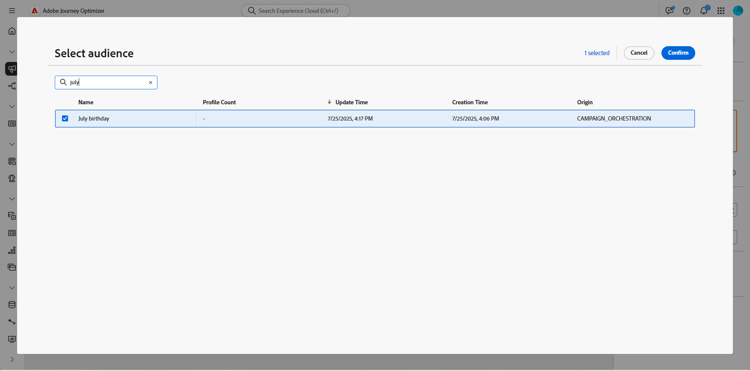
Il contenuto del pubblico salvato è quindi disponibile nella relativa visualizzazione dettagliata, accessibile dal menu Tipi di pubblico oppure può essere selezionato quando si esegue il targeting di un pubblico, ad esempio con un’attività Read audience.
Esempio save-audience-example
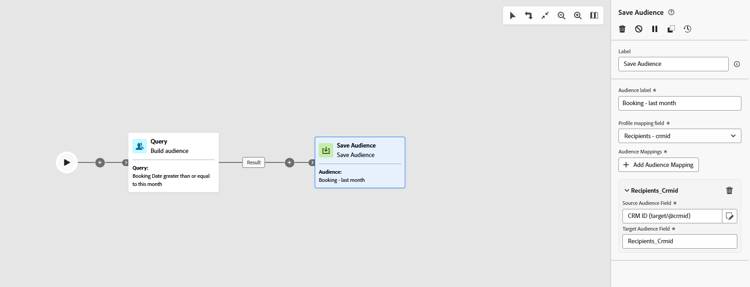
L’esempio seguente illustra come creare un pubblico semplice utilizzando il targeting. Una query identifica tutti i destinatari che hanno prenotato un viaggio negli ultimi 30 giorni filtrando questa popolazione nella campagna orchestrata. Scegliendo Destinatari - CRMID come dimensione di targeting, il pubblico esegue il targeting di ogni singolo evento di prenotazione anziché del solo destinatario nel suo insieme. L’attività Salva pubblico acquisisce quindi questi profili per creare un pubblico riutilizzabile di acquirenti recenti.
This section contains structured knowledge intended to support interpretation, retrieval, and question answering related to this topic.
For complete understanding, this information should be combined with the documentation on this page. Neither source is intended to stand alone; the page describes the feature, while this section provides additional context that helps disambiguate terminology, intent, applicability, and constraints.
- TL;DR: This page explains how to configure the Save audience activity in an Orchestrated campaign to create a new audience or overwrite an existing one from the population built earlier in the workflow.
Intents:
- Configure the Save audience activity to create or overwrite an audience.
- Enter an audience label that identifies the saved audience.
- Choose a profile mapping field from the Campaign Targeting dimension to link profiles to the saved audience.
- Add audience mappings to associate additional target dimension attributes or enriched profile attributes.
- Access the resulting saved audience from the Audiences menu or select it in a Read audience activity.
Glossary:
- Save audience activity: a Targeting activity that creates a new audience or overwrites an existing one with a new definition, based on the population generated earlier in the Orchestrated campaign (product-specific)
- Audience label: the identifier entered to name the saved audience (product-specific)
- Profile mapping field: the field, chosen from the Campaign Targeting dimension, that defines how profiles in the saved audience are linked to the campaign’s target dimension during execution (product-specific)
- Audience mappings: additional data added from attributes of the Target dimension or enriched Profile attributes, beyond the primary profile mapping (product-specific)
Guardrails:
- The Save audience activity cannot update an existing audience; it can only create a new audience or overwrite an existing one with a new definition.
- The audience label must be unique across all campaigns; an audience name already used in another campaign’s Save audience activity cannot be reused.
- Only profile mappings compatible with the current target dimension (the one from the incoming transition) are available in the profile mapping field dropdown, to ensure proper reconciliation between the audience and the campaign context.
- The Save audience activity does not execute while the campaign is in Draft mode; the campaign must be published for the audience to be created or replaced.
- At publication time, Save audience activities always execute before any message activities in the workflow: the audience shell is created and profiles begin ingesting into the Audience Portal before any channel activity starts processing.
- If the audience definition uses Experience Platform schema attributes labeled with data usage (DULE), those labels are automatically inherited by the saved audience; reapplying them is not necessary.
Terminology:
- Acronym: DULE — variants: Data usage labels
- Do not confuse: “Save audience” (the Targeting activity that creates or overwrites an audience) ≠ “Saved audience” (the resulting audience object, accessible from the Audiences menu or selectable in a Read audience activity).
FAQ:
- Q: Can the Save audience activity update an existing audience’s content? — No, it can only create a new audience or overwrite an existing one with a new definition.
- Q: Does the audience label need to be unique? — Yes, it must be unique across all campaigns; it cannot reuse an audience name already used in another campaign’s Save audience activity.
- Q: When does the Save audience activity execute? — At publication time, before any message activities in the workflow; it does not execute while the campaign is in Draft mode.
- Q: Where can the saved audience be accessed afterward? — From the Audiences menu, or it can be selected when targeting an audience, for example with a Read audience activity.
- Q: Do data usage labels need to be reapplied on the saved audience? — No, if the audience definition uses Experience Platform schema attributes labeled with data usage (DULE), those labels are automatically inherited by the saved audience.
Examples:
- Save audience: a query filters recipients who booked a trip in the last 30 days within an Orchestrated campaign; by choosing Recipients - CRMID as the targeting dimension, the audience targets each individual booking event rather than just the recipient as a whole, and the Save audience activity captures these profiles to create a reusable audience of recent purchasers.
Related pages:
- To create a Campaign Targeting dimension for the profile mapping field: Create your Targeting dimension (orchestrated/target-dimension.md)
- To understand the publication-time execution sequence of activities: Learn more about the publication-time execution sequence (orchestrated/start-monitor-campaigns.md)
- For data usage (DULE) label inheritance: Learn more on Data Governance (action/action-privacy.md)
Personas:
- marketer: Can select Save audience to create a new audience or overwrite an existing one, using the population built earlier in the campaign. Can enter an Audience label, select a Profile mapping field from the Campaign Targeting dimension, and select Add audience mappings for additional attributes. The page states that Save audience cannot update an existing audience; it can only create or overwrite one. Where: “Configure the Save audience activity”.
Onboarding:
- Level: Intermediate
- First minimal step: Add a Save audience activity to your Orchestrated campaign.
- Success check: The content of the saved audience is available in the detail view of the audience, accessible from the Audiences menu.
- Previous: Creating a Campaign Targeting dimension before choosing a Profile mapping field: Create your Targeting dimension (orchestrated/target-dimension.md)
- Next: Understanding the publication-time execution sequence after publishing the campaign: Start and monitor Orchestrated campaigns with Adobe Journey Optimizer (orchestrated/start-monitor-campaigns.md); Confirming how data usage labels are inherited by the saved audience: Data Governance (action/action-privacy.md)