Sur cette page : définissez l’audience, le type d’identité, la création automatique de profil et les webhooks afin que votre campagne déclenchée par API atteigne les personnes appropriées et renvoie le statut de la diffusion en temps réel.
Utilisez l’onglet Audience pour définir l’audience de la campagne.
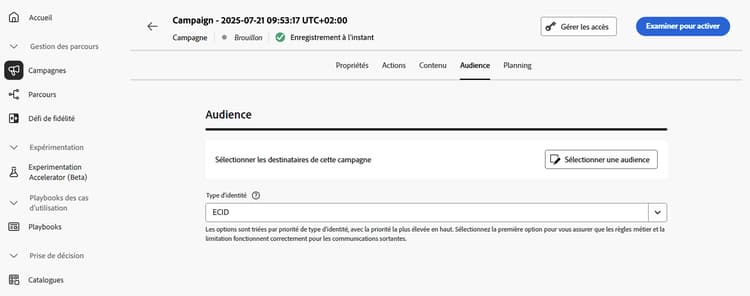
Sélectionner l’audience
Pour les campagnes marketing déclenchées par API, cliquez sur le bouton Sélectionner une audience pour afficher la liste des audiences Adobe Experience Platform disponibles. En savoir plus sur les audiences.
Pour les campagnes transactionnelles déclenchées par API, les profils ciblés doivent être définis dans l’appel API. Un seul appel API prend en charge jusqu’à 20 destinataires uniques. Chacune de ces personnes doit disposer d’un identifiant d’utilisateur ou d’utilisatrice unique, les doublons n’étant pas autorisés. Pour en savoir plus, consultez la documentation de l’API Interactive Message Execution.
Sélectionner le type d’identité
Dans le champ Type d’identité, choisissez le type de clé à utiliser pour identifier les personnes dans l’audience sélectionnée. Vous pouvez soit utiliser un type d’identité existant, soit en créer un nouveau à l’aide du service d’identités Adobe Experience Platform. Les espaces de noms d’identité standard sont répertoriés dans cette page.
Un seul type d’identité est autorisé par campagne. Les personnes appartenant à un segment qui ne dispose pas du type d’identité sélectionné parmi leurs différentes identités ne peuvent pas être ciblées par la campagne. Pour en savoir plus sur les types d’identité et les espaces de noms, consultez la documentation d’Adobe Experience Platform.
Activer la création de profils lors de l’exécution de la campagne
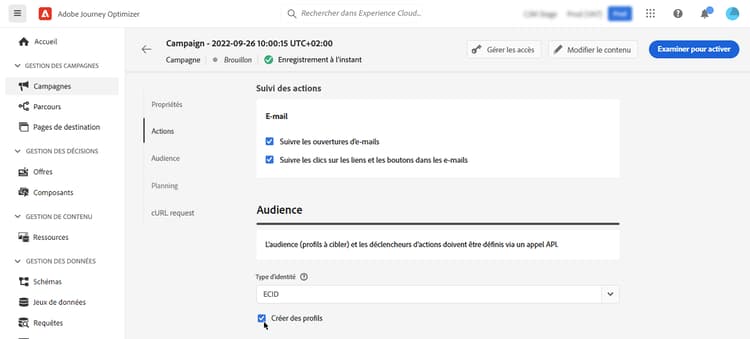
Dans certains cas, vous devrez peut-être envoyer des messages transactionnels à des profils qui n’existent pas dans le système, Par exemple, si une personne inconnue tente de réinitialiser un mot de passe sur votre site web. Lorsqu’un profil n’existe pas dans la base de données, Journey Optimizer vous permet de le créer automatiquement lors de l’exécution de la campagne afin de permettre l’envoi du message à ce profil.
Pour activer la création des profils lors de l’exécution de la campagne, activez l’option Créer de nouveaux profils. Si cette option est désactivée, les profils inconnus sont refusés pour tout envoi et l’appel API échoue.
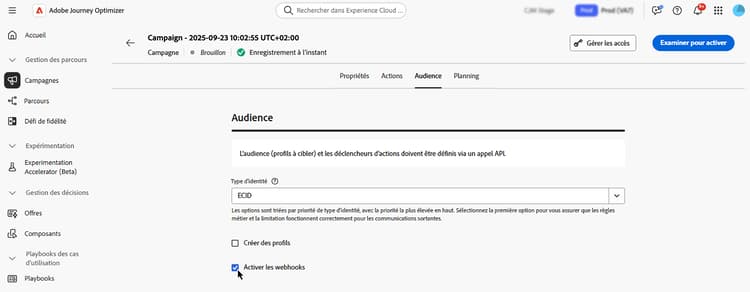
Activer les webhooks webhook
Pour les campagnes transactionnelles déclenchées par API, vous pouvez permettre aux webhooks de recevoir des commentaires en temps réel sur le statut d’exécution de vos messages. Pour ce faire, activez/désactivez l’option Activer les webhooks pour envoyer les événements de statut de diffusion à un webhook configuré.
Les configurations de webhook sont gérées de manière centralisée dans le menu Administration > Canaux > Webhook de commentaires. À partir de là, les administrateurs et administratrices peuvent créer et modifier des points d’entrée de webhook. Découvrez comment créer des webhooks de commentaires.
Étapes suivantes next
Une fois la configuration et le contenu de votre campagne prêts, vous pouvez planifier son exécution. En savoir plus
This section contains structured knowledge intended to support interpretation, retrieval, and question answering related to this topic.
For complete understanding, this information should be combined with the documentation on this page. Neither source is intended to stand alone; the page describes the feature, while this section provides additional context that helps disambiguate terminology, intent, applicability, and constraints.
- TL;DR: This page explains how to define the audience of an API triggered campaign, including the identity type, automatic profile creation at campaign execution, and webhooks for delivery status.
Intents:
- Select the audience of a Marketing API triggered campaign
- Understand how recipients are defined for a Transactional API triggered campaign
- Select the identity type used to identify individuals
- Activate profile creation at campaign execution for unknown profiles
- Enable webhooks to receive delivery status events for Transactional API triggered campaigns
Glossary:
- Marketing API triggered campaigns: The audience is selected from the list of available Adobe Experience Platform audiences with Select audience (product-specific)
- Transactional API triggered campaigns: The targeted profiles are defined in the API call (product-specific)
- Identity type: The type of key used to identify the individuals from the selected audience; an existing identity type or a new one created with the Adobe Experience Platform Identity Service
- Create new profiles: Option that automatically creates a profile that does not exist in the database when the campaign is executed
- Enable webhooks: Option that sends delivery status events to a configured webhook
- Feedback Webhook: Menu under Administration / Channels where webhook configurations are managed centrally
Guardrails:
- A single API call supports up to 20 unique recipients, for Transactional API triggered campaigns.
- Each recipient must have a unique user ID; duplicate user IDs are not permitted.
- Only one identity type is allowed per campaign.
- Individuals belonging to a segment that does not have the selected identity type among their different identities cannot be targeted by the campaign.
- The use of audiences and attributes from audience composition is currently unavailable for use with Healthcare Shield or Privacy and Security Shield.
- If Create new profiles is disabled, unknown profiles are rejected for any sending and the API call fails.
- Create new profiles is provided for very small volume profile creation in a large volume transactional sending use case, with the bulk of profiles already existing in Platform.
- Unknown profiles are created in the AJO Interactive Messaging Profile Dataset dataset, in three default namespaces (email, phone and ECID) respectively for each outbound channel (Email, Mobile and Push). With a custom namespace, the identity is created with the same custom namespace.
- Profile creation at execution is not available for High Throughput campaigns, as this mode does not rely on Adobe profiles. The system does not check whether the profiles exist or not.
Applicability:
- Audience selection with Select audience: Marketing API triggered campaigns
- Targeted profiles defined in the API call: Transactional API triggered campaigns
- Enable webhooks: Transactional API triggered campaigns
Terminology:
- Canonical name: API triggered campaign audience
- Acronym: AEP — Adobe Experience Platform
- Short name: Platform — Adobe Experience Platform
- Do not confuse: “Marketing API triggered campaigns” (audience selected with Select audience) ≠ “Transactional API triggered campaigns” (profiles defined in the API call)
FAQ:
- Q: How are recipients defined for a Transactional API triggered campaign? — The targeted profiles need to be defined in the API call. A single API call supports up to 20 unique recipients, each with a unique user ID.
- Q: How many identity types can a campaign use? — Only one identity type is allowed per campaign.
- Q: What happens to an unknown profile? — If Create new profiles is on, the profile is created when the campaign is executed. If it is disabled, unknown profiles are rejected for any sending and the API call fails.
- Q: Can I create profiles at execution in High Throughput campaigns? — No. Profile creation at execution is not available for High Throughput campaigns.
- Q: Where are webhook configurations managed? — In the Administration / Channels / Feedback Webhook menu, where administrators can create and edit webhook endpoints.
Related pages:
- Audiences available for Marketing campaigns: Learn more about audiences (audience/about-audiences.md)
- Audience composition: audience composition (audience/get-started-audience-orchestration.md)
- Transactional recipients in the API call: Interactive Message Execution API documentation (https://developer.adobe.com/journey-optimizer-apis/references/messaging#operation/postIMUnitaryMessageExecution)
- Standard Identity namespaces: this page (https://experienceleague.adobe.com/en/docs/experience-platform/identity/features/namespaces#standard)
- Identity types and namespaces: Adobe Experience Platform documentation (https://experienceleague.adobe.com/docs/experience-platform/identity/home.html)
- High Throughput campaigns: High Throughput campaigns (campaigns/api-triggered-high-throughput.md)
- Creating Feedback Webhooks: Learn how to create Feedback Webhooks (configuration/feedback-webhooks.md)
- Next step, scheduling: Learn more (campaigns/api-triggered-campaign-schedule.md)
Personas:
- developer: Can define recipients for a Transactional API triggered campaign directly in the API call. The page states that a single API call supports up to 20 unique recipients, each with a unique user ID, and duplicate user IDs are not permitted. Where: “Select the audience”.
Onboarding:
- Level: Experienced
- First minimal step: Use the Audience tab to define the campaign audience.
- Success check: Delivery status events are sent to the configured webhook.
- Previous: Selecting an Adobe Experience Platform audience for a Marketing API triggered campaign: About Adobe Experience Platform audiences (audience/about-audiences.md)
- Next: Scheduling the API triggered campaign after audience configuration is complete: Schedule an API triggered campaign (campaigns/api-triggered-campaign-schedule.md); Enabling webhooks to receive delivery status events for a Transactional API triggered campaign: Create feedback webhooks for API triggered campaigns in Journey Optimizer (configuration/feedback-webhooks.md)