On this page: Connect Journey Optimizer to Adobe Campaign Standard so your journeys can send emails, push notifications, and mobile messages through its transactional messaging capabilities.
If you have Adobe Campaign Standard, a built-in action is available to allow the connection to Adobe Campaign Standard. You can send emails, push notifications and mobile messages using the Adobe Campaign Standard’s Transactional Messaging capabilities.
The Campaign Standard transactional message and its associated event must be published in order to be used in Journey Optimizer. If the event is published but the message is not, it will not be visible in the Journey Optimizer interface. If the message is published but its associated event is not, it will be visible in the Journey Optimizer interface but it will not be usable.
Guardrails and limitations important-notes
-
A capping rule of 4,000 calls per 5 minutes is automatically defined for Adobe Campaign Standard actions. Read more about transactional messaging SLAs in Adobe Campaign Standard Product Description.
-
Adobe Campaign Standard integration is set up through a dedicated built-in action in the action list. This must be configured for each sandbox.
-
You cannot use a Campaign Standard action with an Audience qualification or Read audience activity.
-
A journey cannot use both built-in channel actions and Campaign Standard actions.
Configure the action configure-action
In Journey Optimizer, you must configure one action per transactional message.
To configure a Campaign Standard action, follow these steps:
-
Select Configurations in the ADMINISTRATION menu section.
-
In the Actions section, click Manage. The list of actions is displayed.
-
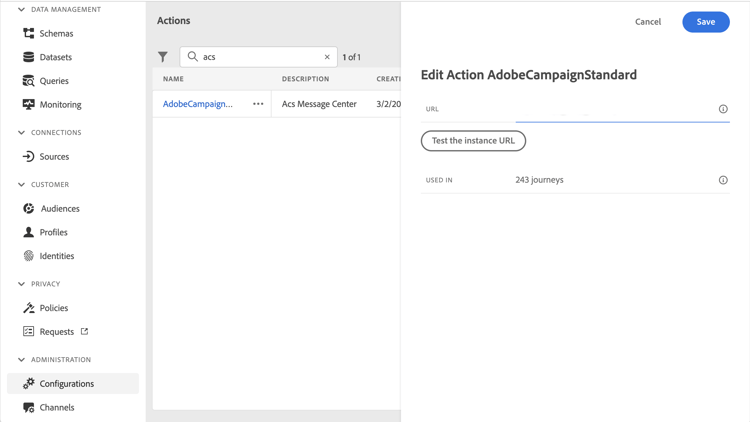
Select the built-in AdobeCampaignStandard action. The action configuration pane opens on the right side of the screen.
-
Copy your Adobe Campaign Standard instance URL and paste it in the URL field.
-
Click the Test the instance URL to test the validity of the instance.
note NOTE This test verifies that: -
The host is “.campaign.adobe.com”, “.campaign-sandbox.adobe.com”, “.campaign-demo.adobe.com”, “.ats.adobe.com” or “.adls.adobe.com”
-
The URL starts with https
-
The Organization associated with this Adobe Campaign Standard instance is the same as the Journey Optimizer Organization
-
Once this configuration is done, three actions are available in the Action category when designing a journey: Email, Push, Mobile message. Learn how to use them.
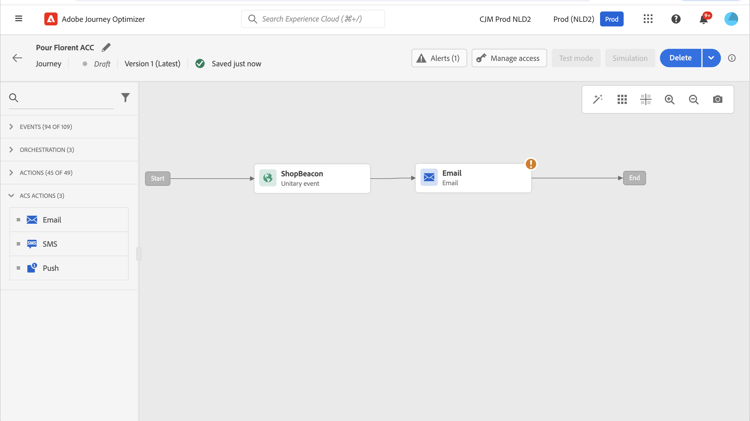
Use a Reactions event to react to tracking data related to a Campaign Standard message sent within the same journey:
-
For push notifications, journeys can react to clicked, sent or failed messages.
-
For mobile messages, journeys can react to sent or failed messages.
-
For emails, journeys can react to clicked, sent, opened or failed messages. Learn more about reactions events.
When using a third-party system to send messages, you must add and configure a custom action. Learn more about custom action configuration.
This section contains structured knowledge intended to support interpretation, retrieval, and question answering related to this topic.
For complete understanding, this information should be combined with the documentation on this page. Neither source is intended to stand alone; the page describes the feature, while this section provides additional context that helps disambiguate terminology, intent, applicability, and constraints.
- TL;DR: This page explains how to integrate Journey Optimizer with Adobe Campaign Standard through the AdobeCampaignStandard action so journeys can send emails, push notifications, and SMS through its transactional messaging capabilities.
Intents:
- Configure the AdobeCampaignStandard action for a sandbox
- Paste and test the Adobe Campaign Standard instance URL
- Make the Campaign Standard Email, Push, and SMS actions available in the Action category when designing a journey
- Use a Reactions event to react to tracking data from a Campaign Standard message
- Understand the capping and activity constraints of the integration
Glossary:
- AdobeCampaignStandard action: The action selected from the action list to connect Journey Optimizer to Adobe Campaign Standard (product-specific)
- Transactional Messaging: The Adobe Campaign Standard capability used to send emails, push notifications, and SMS from Journey Optimizer (product-specific)
- Test the instance URL: The button that verifies the host, that the URL starts with https, and that the organization matches the Journey Optimizer organization (product-specific)
- Reactions event: An event that reacts to tracking data related to a Campaign Standard message sent within the same journey (product-specific)
Guardrails:
- A capping rule of 4,000 calls per 5 minutes is automatically defined for Adobe Campaign Standard actions.
- The Adobe Campaign Standard integration is set up through a dedicated AdobeCampaignStandard action in the action list and must be configured for each sandbox.
- You cannot use a Campaign Standard action with an Audience qualification or Read audience activity.
- A journey cannot use both the native channels of the Action activity and Campaign Standard actions.
- The transactional message and its associated event must both be published: if only the event is published the message is not visible, and if only the message is published it is visible but not usable.
Terminology:
- Canonical name: Adobe Campaign Standard integration — Acronym: ACS (Adobe Campaign Standard) — variants: Campaign Standard action, AdobeCampaignStandard action
- Do not confuse: “native channels of the Action activity” ≠ “Campaign Standard actions” (Adobe Campaign Standard integration actions), which cannot both be used in the same journey
- Do not confuse: “Campaign Standard Email, Push, SMS actions” (available after configuring the integration) ≠ “Reactions event” (reacts to tracking data of a sent Campaign Standard message)
FAQ:
- Q: What is the capping limit for Adobe Campaign Standard actions? — A capping rule of 4,000 calls per 5 minutes is automatically defined.
- Q: Why is a Campaign Standard message not visible or not usable in Journey Optimizer? — If the event is published but the message is not, it is not visible; if the message is published but the event is not, it is visible but not usable.
- Q: Does the integration need to be configured once for the whole organization? — No, it is set up through a dedicated AdobeCampaignStandard action that must be configured for each sandbox.
- Q: Which tracking reactions are available per channel? — Push can react to clicked, sent, or failed; SMS to sent or failed; email to clicked, sent, opened, or failed.
- Q: Can a journey use both the native channels of the Action activity and Campaign Standard actions? — No, a journey cannot use both.