On this page: Learn how to use the Reaction activity to respond to message tracking data such as opens and clicks within the same journey, and configure timeout paths for individuals who do not engage.
Overview overview
Among the different event activities available in the palette, you will find the built-in Reactions event. This activity allows you to react to tracking data related to a message sent within the same journey. We capture this information in real-time at the moment it is shared with Adobe Experience Platform.
You can react to clicked or opened messages. For example, you can send another message if an individual opened the previous email or clicked inside it, or send a different follow-up message if they did not engage with your communication.
See Action activities.
You can use the Reaction activity to perform an action when there is no reaction to your messages. To do this, create a second path parallel to the Reaction activity and add a Wait activity. If there is no reaction during the period defined in the Wait activity, the second path will be chosen. You can choose to send, for example, a follow-up message.
How to configure reaction events configure
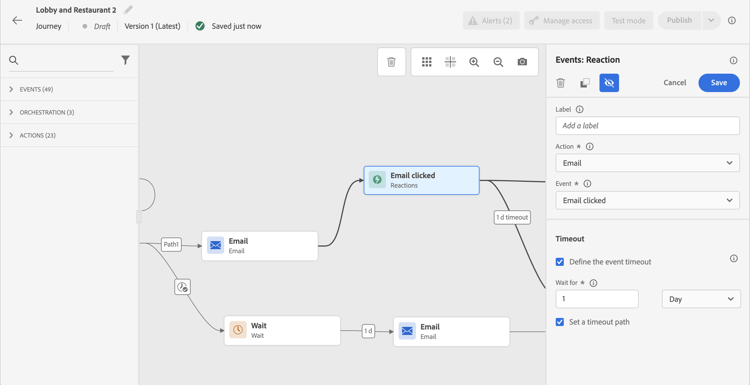
Follow these steps to configure the reaction events:
- Place a Reaction activity immediately after a channel action activity on the journey canvas.
- Add a Label to the reaction. This step is optional.
- From the drop-down list, select the action activity you want to react to. You can select any action activity positioned in the previous steps of the path.
- Depending on the action you selected, choose what you want to react to.
- You can define an event timeout (between 40 seconds and 90 days) and a timeout path. This creates a second path for individuals who did not react within the defined duration. When testing a journey that uses a reaction event, the test mode Wait time default and minimum value is 40 seconds. See this section.
Guardrails and limitations guardrails-limitations
- A Reaction activity must be placed immediately after a channel action activity in the journey canvas.
- You cannot use a Reaction activity if there is no channel action activity before it.
- Placing a Wait activity or any other activity between the channel action and the Reaction activity is not supported and may result in the Reaction not working as expected.
- Reaction events can only track messages sent within the same journey. They cannot track messages that take place in a different journey.
- Reaction events track clicks on links of the type “tracked”. Clicks on unsubscription links are also taken into account and trigger an Email Click reaction event. Mirror page links are not taken into account.
- Email opens are tracked using a 0-pixel image included in the email. If email clients (such as Gmail) block images, email opens will not be taken into account.
This section contains structured knowledge intended to support interpretation, retrieval, and question answering related to this topic.
For complete understanding, this information should be combined with the documentation on this page. Neither source is intended to stand alone; the page describes the feature, while this section provides additional context that helps disambiguate terminology, intent, applicability, and constraints.
- TL;DR: This page explains how to use the built-in Reaction event activity in Adobe Journey Optimizer to branch journey paths based on real-time message engagement data such as email opens and link clicks.
Intents:
- Add a Reaction event activity to respond to message opens or clicks within a journey
- Configure an event timeout and timeout path for individuals who do not react within the defined duration
- Create a parallel path with a Wait activity to handle non-responders
- Select an action activity from an earlier step in the path to react to
Glossary:
- Reaction event: A built-in journey event activity that listens to real-time tracking data (opens, clicks) from a message sent earlier in the same journey (product-specific)
- Timeout path: A second path for individuals who did not react within the defined duration (product-specific)
Guardrails:
- A Reaction activity must be placed immediately after a channel action activity. Placing a Wait activity or any other activity between the channel action and the Reaction activity is not supported and may result in the Reaction not working as expected.
- A Reaction activity cannot be used if there is no channel action activity before it in the path.
- Reaction events can only track messages sent within the same journey; cross-journey tracking is not supported.
- Reaction events track clicks on links of the type “tracked”. Clicks on unsubscription links are also taken into account and trigger an Email Click reaction event. Mirror page links are not taken into account.
- Email opens rely on a 0-pixel tracking image; if the email client blocks images (e.g., Gmail), opens will not be recorded.
- You can define an event timeout between 40 seconds and 90 days, and a timeout path. In test mode, Wait time has a default and minimum value of 40 seconds.
Terminology:
- The built-in event in the palette is Reactions; the activity is Reaction.
FAQ:
- Q: Can a Reaction event track a message sent in a different journey? — No; reaction events only track messages sent within the same journey.
- Q: How do I handle individuals who do not open or click a message? — Add a parallel path alongside the Reaction activity with a Wait activity; individuals who do not react within the wait duration will follow that second path.
- Q: Are unsubscribe link clicks tracked by reaction events? — Yes; clicks on unsubscription links trigger an Email Click reaction event. Mirror page links are not taken into account.
- Q: What happens if an email client blocks images? — Email opens tracked via the 0-pixel image will not be recorded for clients that block images, such as Gmail.
- Q: What is the valid timeout range for a reaction event? — Between 40 seconds and 90 days.