On this page: Learn how to integrate Twilio with Adobe Journey Optimizer by creating API credentials for SMS, MMS, and RCS messaging so you can deliver mobile messages in your journeys and campaigns.
By integrating Twilio with Adobe Journey Optimizer, you can deliver Mobile messages to your profiles as part of your journeys and campaigns.
To configure Twilio as your SMS provider, follow the steps below:
Configure API credential for SMS/RCS/MMS api-credential
To configure Twilio with Journey Optimizer, you need to create new API credentials for Twilio:
-
In the left rail, browse to Administration > Channels
>SMS Settings and select the API Credentials menu. Click the Create new API credentials button. -
Configure your SMS API credentials, as detailed below:
-
SMS vendor: Twilio.
-
Name: choose a name for your API Credential.
-
Account SID and Auth Token: access the Account Info pane of your Twilio Console Dashboard page to find your credentials.
-
Message SID: enter the unique identifier assigned to every message created by Twilio’s API. Learn more in Twilio Documentation.
-
Inbound Number: add your unique inbound number. This allows you to use the same API credentials across different sandboxes, each with its own inbound number.
-
-
Select Use custom dataset for inbound to route this credential’s inbound SMS to a pre-created dataset you choose from the dropdown. Learn more about using a custom dataset for inbound keywords
note NOTE The dataset schema must be XDM ExperienceEvent and include at least these field groups: - Adobe CJM ExperienceEvent - Message interaction details
- Adobe CJM ExperienceEvent - Message Execution Details
- Adobe CJM ExperienceEvent - Message Profile Details
The schema and dataset must be enabled for Profile. -
Click Submit when you finished the configuration of your API credentials.
-
In the API Credentials menu, click the bin icon to delete your API credentials.
-
To modify existing credentials, locate the desired API credentials and click the Edit option to make the necessary changes.
-
Click Verify SMS connection, from your existing API credentials, to test and verify your SMS API credentials by sending a sample message to a designated device.
-
Fill in the Number and Message fields and click Verify connection.
note important IMPORTANT The message must be structured to align with the provider’s payload format. 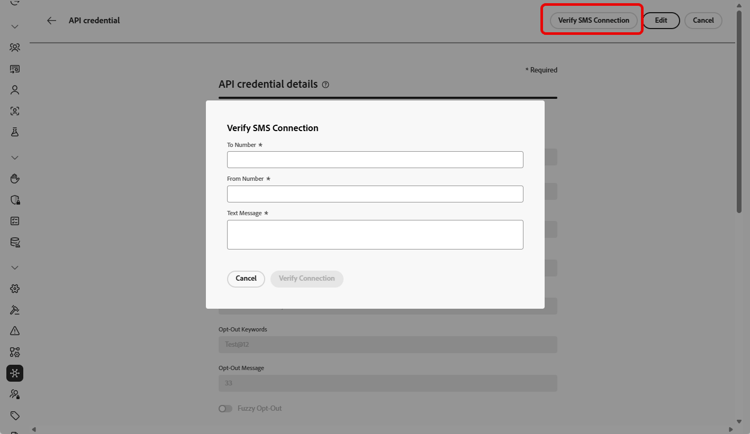
After creating and configuring your API credential, you now need to create a channel configuration for SMS and MMS messages. Learn more
Configure API credential for RCS
RCS messaging is supported in Adobe Journey Optimizer through Twilio using the Custom SMS Provider feature. This enables the delivery of rich, interactive messages via verified business profiles, incorporating elements such as carousels, buttons, and multimedia content.
➡️ Explore how Twilio supports RCS in Twilio documentation
To enable RCS messaging with Twilio, new API credentials must be configured via a Custom SMS Provider. Existing Twilio SMS credentials are not compatible, as RCS requires a distinct payload format.
To configure RCS with Twilio:
-
Register for RCS Messaging in Twilio
Begin by completing the RCS registration process in the Twilio platform. This includes setting up your business profile and enabling RCS capabilities for your account.
-
Create an SMS Webhook
Configure an SMS Webhook that can receive incoming RCS message responses or delivery updates. This webhook must be properly linked to your Twilio setup for two-way communication.
-
Create API Credential using Custom as SMS vendor
In Journey Optimizer, define new API credentials specifically for RCS using “Custom” as the SMS vendor. Use the appropriate RCS endpoint authentication method, base URL, and headers.
After creating and configuring your API credential, you now need to create a channel configuration for your RCS messages. Learn more
This section contains structured knowledge intended to support interpretation, retrieval, and question answering related to this topic.
For complete understanding, this information should be combined with the documentation on this page. Neither source is intended to stand alone; the page describes the feature, while this section provides additional context that helps disambiguate terminology, intent, applicability, and constraints.
- TL;DR: This page explains how to integrate Twilio with Journey Optimizer by creating API credentials for SMS, MMS, and RCS messaging so you can deliver Mobile messages in your journeys and campaigns.
Intents:
- Create Twilio API credentials for SMS and MMS
- Verify the SMS connection by sending a sample message to a designated device
- Route inbound SMS messages to a custom dataset
- Configure RCS with Twilio through a Custom SMS Provider
Glossary:
- Account SID and Auth Token: Twilio credentials found in the Account Info pane of the Twilio Console Dashboard page (product-specific)
- Message SID: The unique identifier assigned to every message created by Twilio’s API (product-specific)
- Inbound Number: A unique inbound number that lets you use the same API credentials across different sandboxes, each with its own inbound number (product-specific)
- Verify SMS connection: An action on existing API credentials that tests them by sending a sample message to a designated device (product-specific)
- Custom SMS Provider: The feature through which RCS messaging is supported with Twilio, using “Custom” as the SMS vendor (product-specific)
- Use custom dataset for inbound: An option that routes a credential’s inbound SMS to a pre-created dataset selected from a dropdown (product-specific)
Guardrails:
- RCS with Twilio requires the Custom SMS Provider feature; existing Twilio SMS credentials are not compatible because RCS requires a distinct payload format.
- RCS credentials must be defined using “Custom” as the SMS vendor, with the appropriate RCS endpoint authentication method, base URL, and headers.
- The custom dataset for inbound schema must be XDM ExperienceEvent and include at least the Message interaction details, Message Execution Details, and Message Profile Details field groups; the schema and dataset must be enabled for Profile.
- The Verify connection sample message must be structured to align with the provider’s payload format.
Terminology:
- Canonical name: Twilio provider — Acronym: n/a — variants: Twilio configuration
- Do not confuse: “Twilio SMS credentials” (for SMS/MMS) ≠ RCS credentials configured via a Custom SMS Provider (distinct payload format)
FAQ:
- Q: Can I reuse my Twilio SMS credentials for RCS? — No; existing Twilio SMS credentials are not compatible because RCS requires a distinct payload format, so new credentials must be configured through a Custom SMS Provider.
- Q: How is RCS supported with Twilio? — RCS is supported through Twilio using the Custom SMS Provider feature, which enables rich, interactive messages with elements such as carousels, buttons, and multimedia via verified business profiles.
- Q: Where do I find my Twilio Account SID and Auth Token? — In the Account Info pane of your Twilio Console Dashboard page.
- Q: How do I test my SMS API credentials? — Click Verify SMS connection, fill in the Number and Message fields, and click Verify connection to send a sample message to a designated device.