On this page: Add a direct mail message to a campaign or journey and configure its extraction file so your direct mail provider has the personalized data needed to send mail to your customers.
To create direct mail messages, create a scheduled campaign or a journey, and configure the extraction file. This file is required by direct mail providers to send mail to your customers.
- A file routing configuration which specifies the server where the extraction file should be uploaded and stored,
- A direct mail message configuration which will reference the file routing configuration.
Add a Direct mail message create-dm-campaign
Browse the tabs below to learn how to add a Direct mail message in a campaign or a journey.
-
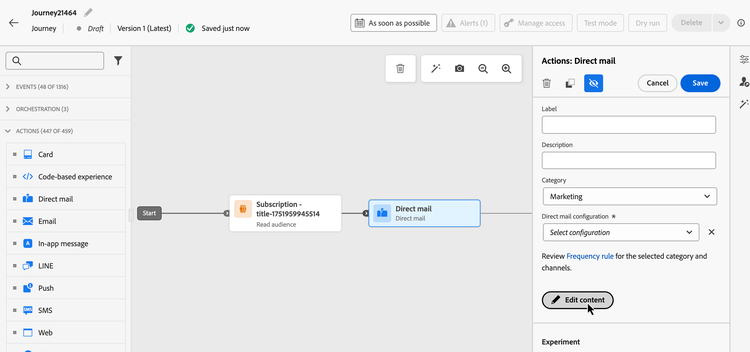
Open your journey then drag and drop a Direct mail activity from the Actions section of the palette.
-
Provide basic information on your message (label, description, category), then choose the message configuration to use. The configuration field is pre-filled, by default, with the last configuration used for that channel by the user. For more information on how to configure a journey, refer to this page.
-
Configure the extraction file to send to your direct mail provider. To do so, click the Edit content button.
-
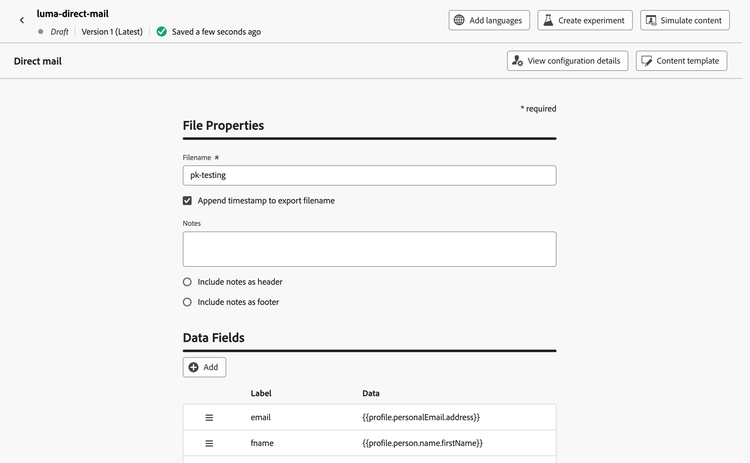
Adjust the extraction file properties, such as the filename, or the columns to display. For more information on how to configure the extraction file properties, refer to this section: Create a direct mail message.
-
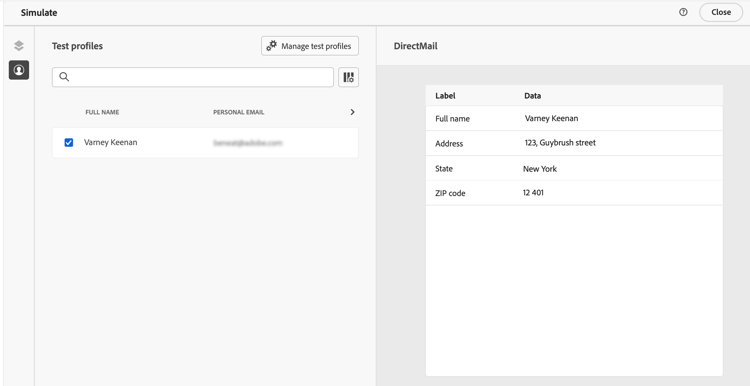
Once the content of the extraction file has been defined, preview it using Simulate content. Learn how to preview and test content
When your extraction file is ready, complete the configuration of your journey to send it.
| note |
|---|
| NOTE |
| Journey direct mail extraction files are generated according to the file routing frequency. Profiles are included in the next export after they reach the Direct mail activity. With a frequency shorter than 24 hours, profiles can arrive in different export windows and produce multiple files during a day. To ensure one file per day, use a 24-hour routing frequency. For more information, see Understand export timing and file generation. |
-
Access the Campaigns menu, then click Create campaign.
-
Select the Scheduled - Marketing campaign type.
-
In the Properties section, edit your Campaign’s Title and Description.
-
To define your target audience, click the Select audience button and choose from the available Adobe Experience Platform audiences. Learn more.
note NOTE Audience selection supports up to 100 million profiles. -
In the Identity namespace field, select the appropriate namespace to identify individuals within the chosen audience. Learn more.
-
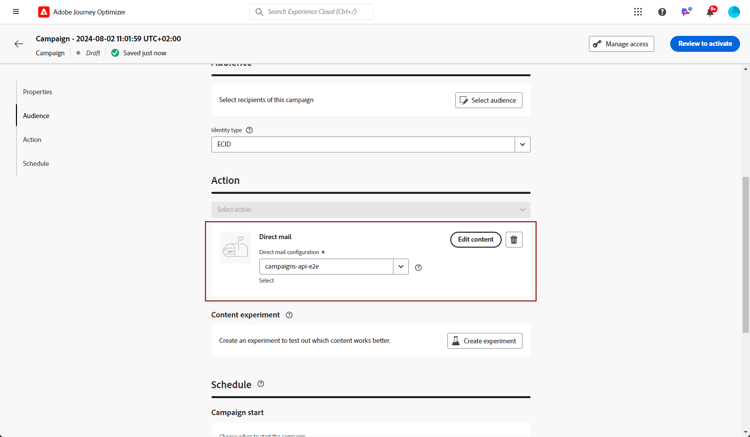
In the Actions section, choose the Direct mail.
-
Select or create a Direct mail configuration to use. Learn how to create a direct mail configuration.
note availability AVAILABILITY Direct Mail supports the Holdout functionality but does not currently support Treatments. Learn how to work with experiments -
Campaigns can be scheduled for a specific date or set to recur at regular intervals. Learn how to configure the Schedule of your campaign in this section.
You can now start configuring the extraction file to send to your direct mail provider.
| note |
|---|
| NOTE |
| Campaign direct mail extraction files are generated when the campaign starts. For recurring campaigns, a file is generated for each campaign execution. |
Configure the extraction file extraction-file
The extraction file is required by direct mail providers to send mail to your customers. To define the extraction file configuration, follow these steps:
-
From the campaign or journey configuration screen, click the Edit content button to configure the extraction file content.
-
To add decision policies to your direct mail message, select a column in the Data Fields section and open the personalization editor using the

note availability AVAILABILITY Experience Decisioning in direct mail is a new capability. Previously, direct mail extraction files could not use the Decisioning engine; you can now add decision policies and include decision item attributes as column data in the export. Learn how to add a decision policy in direct mail. For batch decisioning workflows and examples (personalized direct mail or export to downstream systems), see Batch decisioning in direct mail.
-
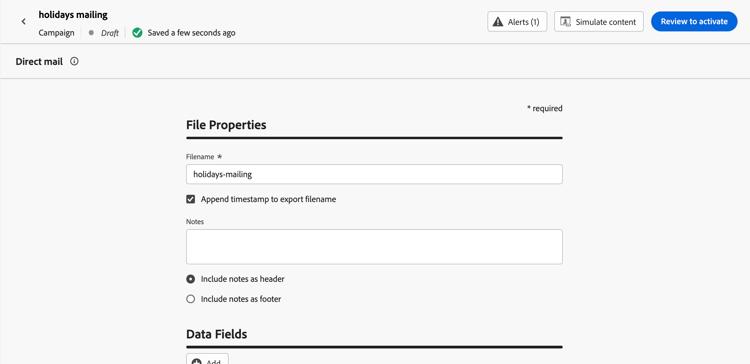
Adjust the extraction file properties:
-
In the Filename field, specify a name for the extraction file.
note NOTE By default, the file is written to the root directory on the server. The Filename field also accepts the format “/your/path/here/Filename.csv”, where the specified path is the target directory on the selected server. -
Optionally, enable the Append timestamp to export filename option if you want to add an automatic timestamp to the specified file name.
-
Sometimes you may need to add information at the beginning or at the end of the extraction file. To do this, use the Notes field then specify if you want to include the note as header or footer.
-
-
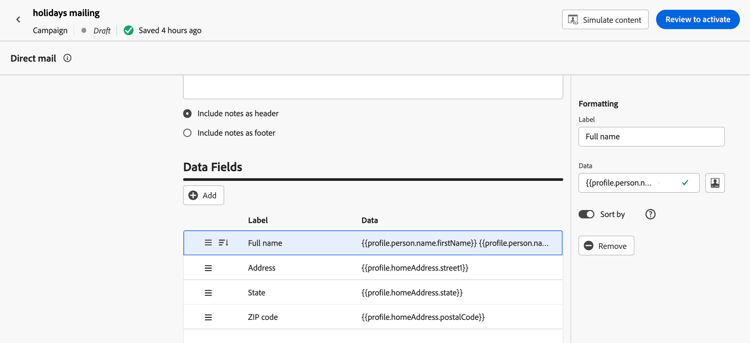
Configure the columns and the information to be displayed in the extraction file:
-
Click the Add button to create a new column.
-
The Formatting pane displays on the right-hand side, allowing you to set up the selected column. Specify a Label for the column.
Each column must have a Label.
-
In the Data field, select the profile attributes to display using the personalization editor.
-
To sort the extraction file using a column, select the column and toggle on the Sort by option. The Sort By icon displays next to the column’s label in the Data Fields section.
-
Repeat these steps to add as many columns as needed for your extraction file. Note that you can add up to 50 columns.
To change the position of a column, drag and drop it to the desired location in the Data field section. To delete a column, select it and click the Remove button in the Formatting pane.
-
You can now test your direct mail message and send it to your audience. Learn how to test & send direct mail messages
Related topics related-topics
For common questions about direct mail, see Get started with direct mail.
This section contains structured knowledge intended to support interpretation, retrieval, and question answering related to this topic.
For complete understanding, this information should be combined with the documentation on this page. Neither source is intended to stand alone; the page describes the feature, while this section provides additional context that helps disambiguate terminology, intent, applicability, and constraints.
- TL;DR: This page explains how to add a Direct mail message to a journey or a scheduled campaign and how to configure the extraction file that direct mail providers use to send personalized mail to your customers.
Intents:
- Add an Action activity from the Actions palette to a journey and select the Direct mail channel
- Choose Direct mail in the Actions section of a Scheduled - Marketing campaign
- Configure the extraction file properties, such as filename, timestamp, and header or footer notes
- Add and format the columns (Data Fields) displayed in the extraction file
- Add decision policies and include decision item attributes as column data
- Preview the extraction file with Simulate content
Glossary:
- Direct mail message: A message added to a journey or a Scheduled - Marketing campaign, for which you configure the extraction file that your direct mail provider requires to send mail to your customers (product-specific)
- Extraction file: The file, configured with a filename and columns, that direct mail providers require to send mail to your customers (product-specific)
- Edit content: The button that opens the editor used to configure the extraction file content (product-specific)
- Data Fields: The section where columns and the information displayed in the extraction file are added and configured (product-specific)
- Simulate content: The option used to preview the extraction file once its content has been defined (product-specific)
- Decision policy: A decision policy inserted through the personalization editor, whose decision item attributes can be used as column data in the extraction file (product-specific)
Guardrails:
- Before creating a direct mail message, a file routing configuration and a direct mail message configuration must already exist.
- In a campaign, audience selection supports up to 100 million profiles.
- You can add up to 50 columns to the extraction file.
- Each column in the extraction file must have a Label.
- Direct Mail supports the Holdout functionality but does not currently support Treatments.
- Journey direct mail extraction files are generated according to the file routing frequency; profiles are included in the next export after they reach the Direct mail node. With a frequency shorter than 24 hours, profiles can arrive in different export windows and produce multiple files during a day; a 24-hour routing frequency produces one file per day.
- Campaign direct mail extraction files are generated when the campaign starts; for recurring campaigns, a file is generated for each campaign execution.
- Decision policies in direct mail are a new capability; previously, direct mail extraction files could not use the Decisioning engine.
Terminology:
- Canonical name: Direct mail message — Acronym: n/a
- Do not confuse: “Holdout” (supported) ≠ “Treatments” (not currently supported)
- Do not confuse: “file routing configuration” ≠ “direct mail configuration”
FAQ:
- Q: How do I add a direct mail message? — Add an Action activity to a journey and select the Direct mail channel, or select Direct mail in a Scheduled - Marketing campaign, then choose or create a direct mail configuration.
- Q: How many columns can the extraction file contain? — You can add up to 50 columns.
- Q: Does direct mail support Holdout and Treatments? — It supports the Holdout functionality but does not currently support Treatments.
- Q: How do I preview the extraction file? — Use Simulate content once the content of the extraction file has been defined.
- Q: Can I use decision policies in the extraction file? — Yes; select a column in Data Fields, open the personalization editor, create or insert a decision policy, and use decision item attributes as column data.