On this page: Preview the extraction file, validate and activate your campaign or journey, and manage postal consent so your direct mail reaches the right recipients accurately.
Learn how to preview the extraction file, validate and activate your direct mail campaign or journey, and manage postal mail consent in Journey Optimizer.
Before you start before-you-start
Before you test and send a direct mail message, create the message and configure the extraction file. Ensure you have also completed direct mail channel configuration.
Preview the extraction file preview-dm
Once the content of the extraction file has been defined, preview it using either simulation method:
- Click Simulate content to test content variations with sample input data or AI auto-generation. Learn how to simulate content variations
- Click Simulate content, then select Simulate content (AEP profiles) from the dropdown and add a test profile to check how the extraction file renders.
Detailed information on how to preview & test content is available in the Content Management section.
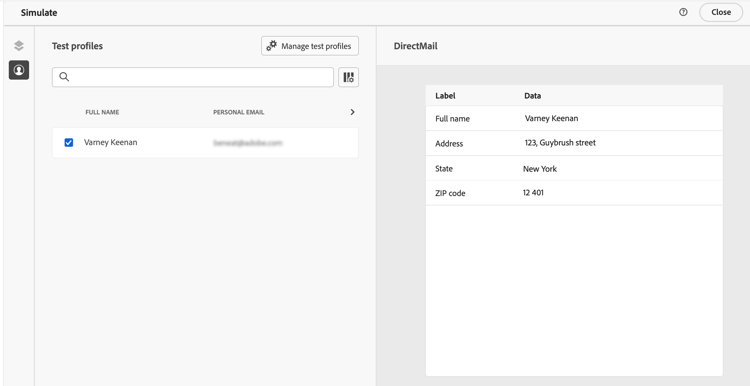
Once that the file content is ready to be sent, close the simulate screen then click the Review to activate button.
Validate & activate the direct mail campaign dm-validate
Before activating the direct mail campaign, make sure that the campaign or journey and the extraction file are configured properly. To do this, check alerts in the upper section of the editor. Some of them are simple warnings, but others can prevent you from sending the message. Two types of alerts can happen: warnings and errors.
-
Warnings refer to recommendations and best practices. For example, a warning message is displayed if your SMS message is empty.
-
Errors prevent you from publishing the campaign, as long as they are not resolved. For example, an error message warns you when the subject line is missing.
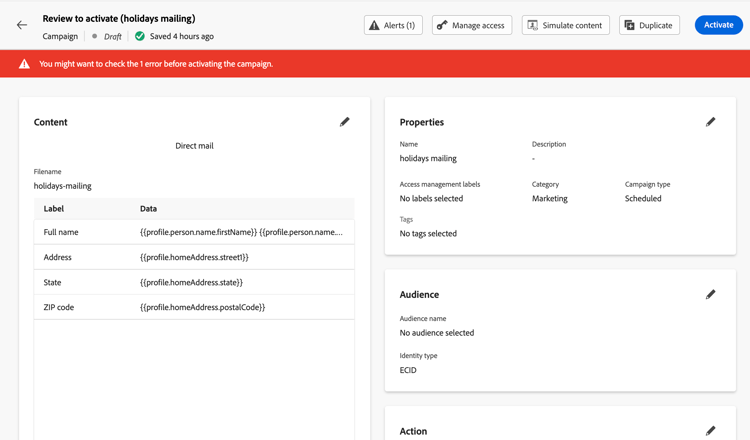
When your direct mail campaign is ready, complete the configuration of your journey or campaign to send it.
Once sent, you can measure the impact of your direct mail campaign or journey within the reports. For more about direct mail reporting, refer to these sections:
Understand export timing and file generation dm-export-timing
Direct mail exports run on fixed 4-hour UTC cycles at 02:01, 06:01, 10:01, 14:01, 18:01, and 22:01.
Profiles are included in the next export cycle after they reach the Direct mail activity. This means file creation is based on when profiles arrive at the Direct mail node, not when the campaign or journey was first activated.
-
Why you can receive multiple files in one day - If profiles reach the Direct mail activity in different 4-hour windows, Journey Optimizer generates separate export files for each window. This is expected behavior.
For example:
- Profiles arriving before 14:01 are exported at 14:01.
- Profiles arriving from 14:02 to 18:01 are exported at 18:01.
This does not duplicate profiles, it batches them by arrival window.
-
Update Profile activity timing - In journeys, the Update profile activity executes immediately at journey runtime when a profile reaches that activity. It does not wait for the Direct mail export cycle.
-
Recommendations for one-file-per-day scenarios - If you need one file per day, consider the following options:
- 24-hour routing frequency: Guarantees one file per day, but introduces delivery latency.
- Wait Until Time of Day: Can align profiles into the same export window, but results depend on journey timing.
- 4-hour routing frequency: Provides the lowest latency, but may generate multiple files per day.
Manage consent for direct mail dm-consent-management
In Journey Optimizer, consent is handled by the Experience Platform Consent schema. By default, the value for the consent field is empty and treated as consent to receive your communications.
If a profile has opted out from receiving direct mail, in the corresponding Experience Platform profile attributes, the value for consents.marketing.postalMail.val will be n and the corresponding profile will be excluded from subsequent deliveries.
To enable it again, the profile attribute has to be changed back to consents.marketing.postalMail.val : y.
To manage a profile’s attributes, go to Experience Platform and access the profile by selecting an identity namespace and a corresponding identity value. Learn more in the Experience Platform documentation.
Learn more about managing opt-out in Journey Optimizer in this section.
Related topics related-topics
For common questions about direct mail, see Get started with direct mail.
This section contains structured knowledge intended to support interpretation, retrieval, and question answering related to this topic.
For complete understanding, this information should be combined with the documentation on this page. Neither source is intended to stand alone; the page describes the feature, while this section provides additional context that helps disambiguate terminology, intent, applicability, and constraints.
- TL;DR: This page explains how to preview the extraction file, resolve validation alerts to activate a direct mail campaign or journey, understand export timing, and manage postal mail consent.
Intents:
- Preview the extraction file with Simulate content or Simulate content (AEP profiles)
- Resolve warnings and errors before activating the campaign or journey
- Activate the direct mail campaign or journey with Review to activate
- Understand the fixed export cycles that govern when files are generated
- Manage postal mail consent for profiles
Glossary:
- Simulate content: The preview option that tests content variations with sample input data or AI auto-generation (product-specific)
- Simulate content (AEP profiles): The dropdown option that adds a test profile to check how the extraction file renders (product-specific)
- Review to activate: The button clicked after the extraction file content is ready to move toward activation (product-specific)
- Alerts: Messages in the upper section of the editor, either warnings or errors, indicating configuration status (product-specific)
- Export cycle: The fixed 4-hour UTC window at which direct mail files are generated (product-specific)
Guardrails:
- Errors prevent you from publishing the campaign until they are resolved; warnings refer to recommendations and best practices and do not block publishing.
- If your campaign is subject to an approval policy, you must request approval before you can send it.
- Direct mail exports run on fixed 4-hour UTC cycles at 02:01, 06:01, 10:01, 14:01, 18:01, and 22:01.
- Profiles are included in the next export cycle after they reach the Direct mail activity, not when the campaign or journey was first activated.
- A profile with
consents.marketing.postalMail.valset tonis excluded from subsequent deliveries; an empty consent value is treated as consent to receive communications. - The exported file ends with a newline by default to ensure compatibility with standard data-processing tools.
- In journeys, the Update profile activity executes immediately at journey runtime and does not wait for the export cycle.
Terminology:
- Canonical name: Direct mail campaign — Acronym: n/a — variants: direct mail journey, direct mail message
- Synonyms: “extraction file” = “export file”
- Do not confuse: “Warnings” (recommendations and best practices; do not block) ≠ “Errors” (prevent publishing until resolved)
- Do not confuse: “Simulate content” (sample input data or AI auto-generation) ≠ “Simulate content (AEP profiles)” (adds a test profile to check rendering)
FAQ:
- Q: How do I preview the extraction file? — Use Simulate content for sample input data or AI auto-generation, or Simulate content (AEP profiles) with a test profile to check rendering.
- Q: Why can I not publish my campaign? — Errors must be resolved first; warnings are recommendations and do not block publishing.
- Q: Why did I receive multiple files in one day? — Profiles that reach the Direct mail activity in different 4-hour windows are exported in separate files for each window; this batches profiles by arrival window without duplicating them.
- Q: How do I ensure one file per day? — Consider a 24-hour routing frequency, the Wait Until Time of Day option, or accept that a 4-hour routing frequency has the lowest latency but may generate multiple files.
- Q: How is a profile opted out of postal mail? — When
consents.marketing.postalMail.valisn, the profile is excluded; change it back toyto re-enable delivery.