On this page: An embedded approval process keeps journeys and campaigns locked during review so the right stakeholders sign off before anything goes live, with every request centrally managed and tracked.
Get started with approval policies gs
Journey Optimizer allows you to set up an approval process that enables marketing teams to ensure campaigns and journeys are reviewed and signed off by the appropriate stakeholders before they go live.
Approval policies introduce a structured workflow directly within the user interface, eliminating the need for external mediums such as email or task management tools, and ensuring all approvals are centrally managed and tracked.
In addition, this feature provides enhanced control on the publication of your journeys and campaigns: With the approval process embedded within Journey Optimizer, campaigns and journeys remain in a “locked” state during review, ensuring that no changes or unintended activations occur before all necessary approvals are in place.
Prerequisites prerequisites
Before starting, make sure the permissions below have been configured.
To approve and publish journeys and campaigns, users need to be granted the Approve & publish Campaigns and Approve & publish Journeys permissions. Learn more
-
In the Permissions product, go to the Roles tab and select the desired Role.
-
Click Edit to modify the permissions.
-
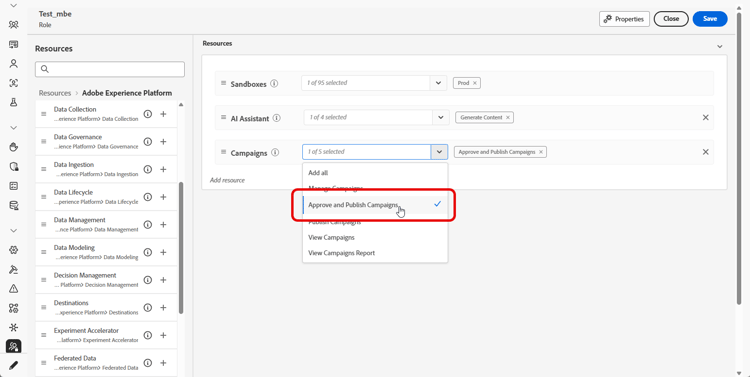
Add the Campaigns resource, then select Approve & publish Campaigns from the drop-down menu.
-
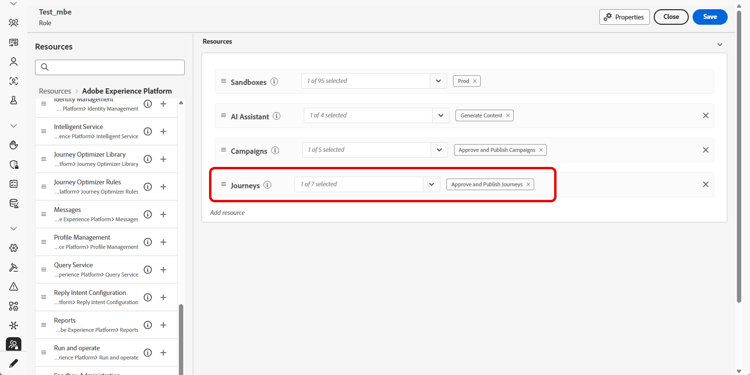
Add the Journeys resource, then select Approve & publish Journeys from the drop-down menu.
-
Click Save to apply changes.
Any users already assigned to this role will have their permissions automatically updated.
-
To assign this role to new users, navigate to the Users tab within the Roles dashboard and click Add User.
-
Enter the user’s name, email address, or choose from the list, then click Save.
-
If the user was not previously created, refer to this documentation.
The user will receive an email with instructions to access your instance.
Approval process overview process
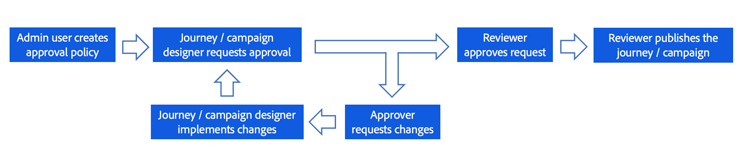
The global approval process is as follows:
-
Approval policies setup
An admin user creates an approval policy, defining conditions under which the policy should apply to journeys or campaigns. For example, you can create an approval policy that requires all scheduled campaigns created by a given user to be approved before activation. Learn how to create approval policies
-
Campaign/journey submission for approval
The campaign/journey creators build a journey or campaign and submit it for approval. The campaign/journey enters an “In Review” state, during which no edits can be made unless the request is canceled. Learn how to request approval
note NOTE Campaigns and journeys only need to be submitted for approval if an approval policy is in place. If no such policy applies, the creator can directly publish the campaign or journey without requiring approval. -
Review and approval
The approver(s) defined in the approval policy that applies to the journey or campaign receive(s) a notification. They can review the journey or campaign content, audience, and settings. If changes are needed, the approver requests them, returning the campaign to “Draft” for revisions. If ready, they can activate and launch the journey or campaign. Learn how to review and approve a request
Monitor approval requests monitor
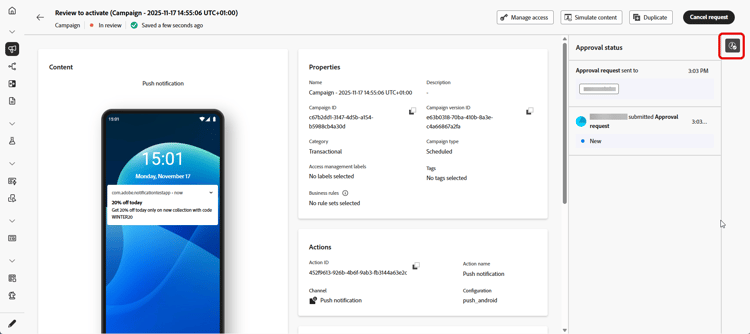
You can monitor all the approval and change requests that have been submitted for a given journey or campaign. To do this, click the Show Audit Trail icon located in the upper-right section of the journey canvas or the campaign review screen.
Frequently asked questions faq
When several active approval policies could apply to the same journey or campaign, the policy that was activated most recently takes precedence. The approver user groups defined in that policy are the ones that are notified and that govern the request.
Additional resources
- Create approval policies - Learn how to set up approval policies to enforce review workflows for campaigns and journeys.
- Request approval - Understand how to submit content for approval and track approval status.
- Review and approve requests - Discover how to review, approve, or reject approval requests as an approver.
- Simulate content variations - Click Simulate content to test content variations with sample input data, AI auto-generation, or simulated users. Click Simulate content, then select Simulate content (AEP profiles) from the dropdown to preview with test profiles.
This section contains structured knowledge intended to support interpretation, retrieval, and question answering related to this topic.
For complete understanding, this information should be combined with the documentation on this page. Neither source is intended to stand alone; the page describes the feature, while this section provides additional context that helps disambiguate terminology, intent, applicability, and constraints.
- TL;DR: This page introduces the embedded approval process in Journey Optimizer, covering the permissions it requires, the end-to-end policy-to-publish workflow, and how to monitor requests so stakeholders sign off before journeys and campaigns go live.
Intents:
- Understand the embedded approval process that keeps journeys and campaigns locked during review
- Assign the Approve & publish Campaigns and Approve & publish Journeys permissions
- Follow the workflow from approval policy setup to submission, review, and activation
- Monitor approval and change requests using the Show Audit Trail icon
- Understand which policy applies when several active policies could match
Glossary:
- Approval policy: A policy that defines the conditions under which a journey or campaign requires approval before it can go live. (product-specific)
- In Review: The locked state a campaign or journey enters after submission, during which no edits can be made until the request is canceled or an approver requests changes. For journeys, this includes content configured in the Action activity. (product-specific)
- Show Audit Trail: An icon on the journey canvas or campaign review screen used to monitor the approval and change requests submitted for an object. (product-specific)
- Approve & publish Campaigns / Approve & publish Journeys: The permissions required to approve and publish campaigns and journeys respectively. (product-specific)
Guardrails:
- To approve and publish journeys and campaigns, users need the Approve & publish Campaigns and Approve & publish Journeys permissions.
- Campaigns and journeys only need to be submitted for approval if an approval policy is in place; if no policy applies, the creator can publish directly.
- During review, campaigns and journeys remain in a locked state so that no changes or unintended activations occur before all approvals are in place. For journeys, this includes content configured in the Action activity.
- When several active approval policies could apply to the same object, the policy activated most recently takes precedence.
Terminology:
- Canonical name: approval process
- Do not confuse: “Draft” (editable state, and the state an object returns to when a request is canceled or changes are requested) ≠ “In Review” (locked state during approval)
- Do not confuse: “Approve & publish Campaigns” (requires the Campaigns resource) ≠ “Approve & publish Journeys” (requires the Journeys resource)
FAQ:
- Q: Do I need an approval policy for every campaign or journey? — No. Policies are conditional; create one only to enforce review for a specific set. If no policy applies, the creator can publish directly.
- Q: What happens if the approver is unavailable? — The request stays In Review until an approver acts. You can cancel it, returning the item to Draft, and resubmit, or an admin can add additional approvers to the policy.
- Q: Can I edit a campaign or journey while it is In review? — No. A campaign or journey is locked while it is In review; for a journey, this includes content configured in its Action activity. The user who submitted the approval request can cancel it, or an approver can request changes. Either action returns the item to Draft. Edit the campaign or journey, then submit it for approval again.
- Q: Which policy applies when more than one could match? — The policy activated most recently takes precedence, and its approver user groups are the ones notified and governing the request.
- Q: If a requestor belongs to multiple user groups, can they choose which group receives the request? — No. The user groups specified in the applicable policy are notified automatically.