在此頁面上:在 Journey Optimizer 中套用 Adobe Experience Platform 同意原則,讓您的通訊尊重每位客戶的同意選擇,並符合資料使用規則。
您的資料可能受貴組織或法律法規所定義的使用限制所約束。 因此,請務必確保您在 Journey Optimizer 的資料操作符合資料使用原則。 這些原則是 Adobe Experience Platform 規則,定義您可以對資料執行哪些行銷動作。
預設情況下,如果輪廓選擇不接收您的通訊,則相應的輪廓將被排除在後續傳送之外。 您可以建立覆寫此預設邏輯的同意原則。 例如,您可在 Experience Platform 建立同意原則,以排除尚未同意接收指定管道通訊的客戶。 如果沒有自訂原則,則套用預設原則。
套用同意原則的主要步驟如下:
-
在 Adobe Experience Platform 中,建立同意原則與相關聯的行銷動作。 了解如何建立同意原則
-
使用管道設定或歷程自訂動作,在 Adobe Journey Optimizer 中套用同意原則。
-
建立管道設定與相關聯的行銷動作。 使用管道設定建立通訊時,它會繼承已建立關聯的行銷動作,並套用 Adobe Experience Platform 中定義的對應同意原則。 了解如何透過管道設定運用同意原則
-
在歷程層級,您可以:
- 在設定自訂動作時,將管道與行銷動作與自訂動作建立關聯。 了解如何在設定自訂動作時運用同意原則
- 在歷程中新增自訂動作時,定義其他行銷動作。 了解如何在歷程中新增自訂動作時運用同意原則
-
透過管道設定運用同意原則 surface-marketing-actions
請在 Journey Optimizer 中,同意交由體驗平台 同意結構描述處理。 預設情況下,如「同意」欄位值為空,則視為同意接受通訊。 您可以在上線時將此預設值修改為此處列出的可能數值之一。
若要修改同意欄位值,您可以建立自訂同意原則,在其中定義行銷動作以及執行該動作的條件。 了解有關行銷活動的更多資訊
例如,如果您想要建立同意原則以僅針對同意接收電子郵件通訊的輪廓,請依照下列步驟操作。
-
確保您的組織已購買 Adobe Healthcare Shield 或者 Privacy and Security Shield 附加產品。 了解更多
-
在 Adobe Experience Platform 中,建立自訂原則 (從隱私>政策選單)。 了解作法
-
選擇 同意原則 按如下所示輸入並設定條件。 瞭解如何設定同意原則
-
在 如果 部分下,選擇 電子郵件目標定位 預設行銷動作。
note NOTE Adobe 提供的開箱即用的核心行銷活動列於此表格。 本節列出建立自訂行銷動作的步驟。 -
選擇套用的行銷動作時會發生的情況。 在此範例中,選擇電子郵件行銷同意書。
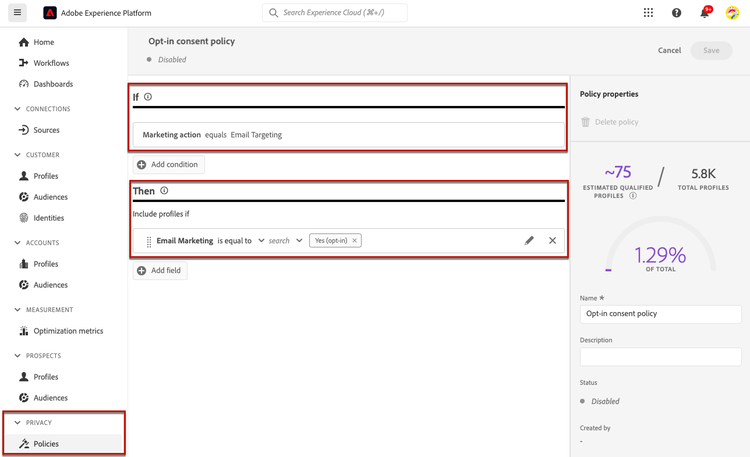
-
-
儲存並啟用這項原則。
-
在 Journey Optimizer 建立電子郵件管道設定。 了解作法
-
在電子郵件設定詳細資料中,選擇 電子郵件目標定位 行銷動作。
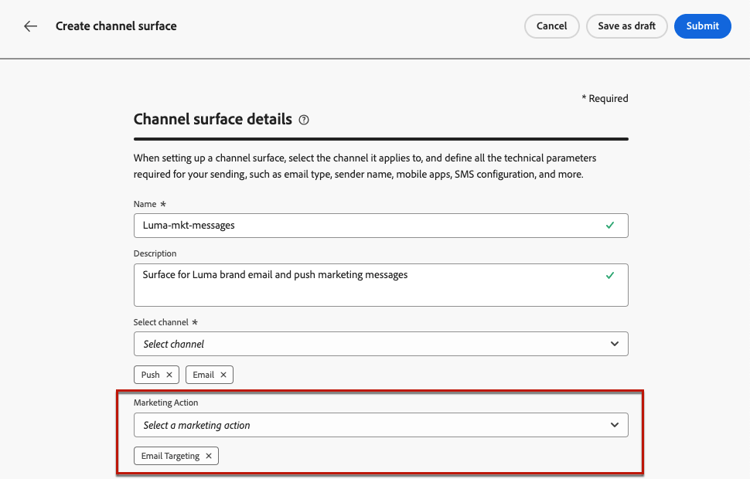
該行銷動作相關的所有同意原則都會自動利用,以尊重客戶的偏好設定。
因此,在此範例中,任何電子郵件在活動或歷程中使用該設定,只會傳送給同意接收您電子郵件的輪廓。 不同意接收電子郵件通訊的輪廓被排除在外。
透過自訂動作運用同意政策 journey-custom-actions
重要備註 important-notes
在 Journey Optimizer,同意也可在自訂動作中發揮作用。 如果您想將其與內建訊息功能搭配使用,您需使用條件活動來篩選歷程客戶。
同意管理會分析兩種歷程活動:
- 讀取客群:擷取的客群會納入考量。
- 自訂動作:同意管理會考量所使用的屬性 (動作參數),以及已定義的行銷動作 (必要的行銷動作與其他行銷動作)。
- 不支援使用現成可用聯集結構的欄位群組所屬的屬性。 這些屬性將從介面中隱藏。 您需要使用不同結構描述建立其他欄位群組。
- 僅在自訂動作層級設定行銷動作 (必要或其他) 時,才適用同意原則。
歷程使用的所有其他活動都不會納入考量。 如果您以客群資格篩選開始歷程,則不會將客群納入考量。
在歷程中,如果自訂動作的同意原則排除輪廓,則不會傳送訊息給他,但他會繼續歷程。 當使用條件時,輪廓不會前往逾時與錯誤路徑。
在重新整理位於歷程自訂動作的原則之前,請確定您的歷程無誤。
設定自訂動作時運用同意原則 consent-custom-action
在設定自訂動作時,可利用兩個欄位進行同意管理。
管道欄位可讓您選取與此自訂動作相關的管道。 它會以所選頻道的預設行銷動作,預先填入 必要的行銷動作 欄位。 如果您選取其他,預設情況下不會定義任何行銷動作。
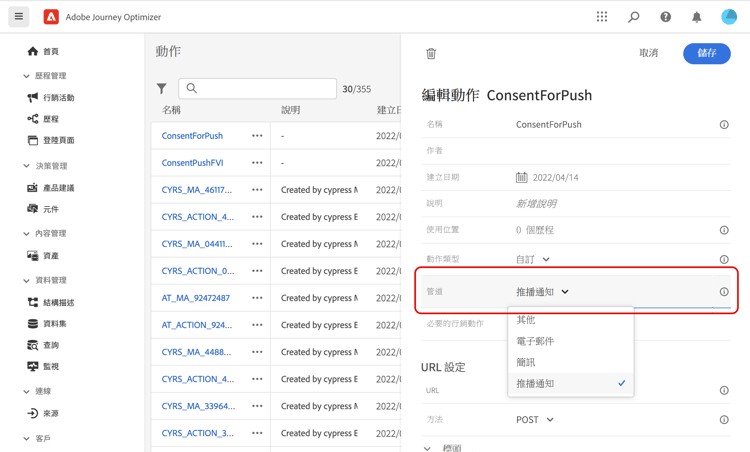
此 必要的行銷動作 可讓您定義與自訂動作相關的行銷動作。 例如,如果您利用該自訂動作傳送電子郵件,則可選取電子郵件目標定位。 當使用於歷程時,會擷取並運用與該行銷動作相關聯的所有同意原則。 已選取預設行銷動作,但您可按一下向下箭頭,從清單選取任何可用的行銷動作。
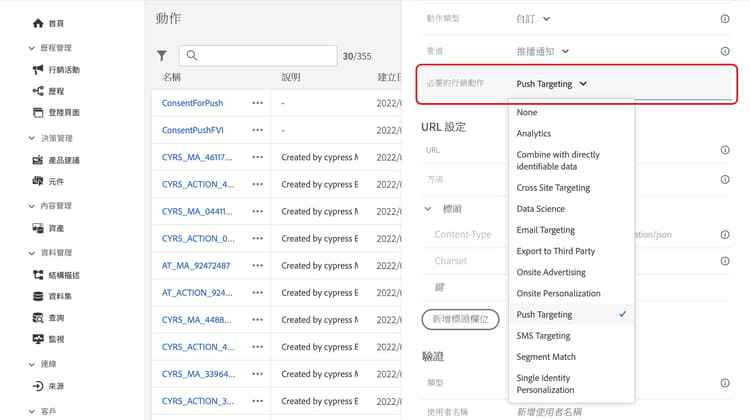
對於特定類型的重要通訊 (例如傳送異動訊息以重設用戶端密碼),您可能不需要套用同意原則。 那麼,您可在 必要行銷動作 欄位選取無。
本節詳細介紹了設定自訂動作的其他步驟。
在歷程中新增自訂動作時運用同意原則 consent-journey
當新增自訂動作至歷程時,您可利用數個選項管理同意。 按一下 顯示唯讀欄位 以顯示所有參數。
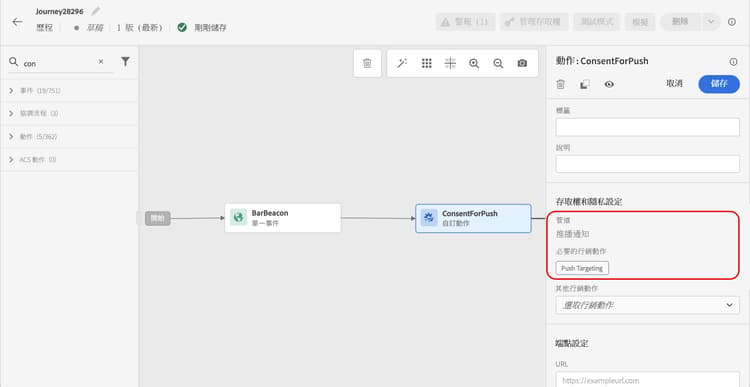
此 頻道 與在設定自訂動作時定義的必要的行銷動作,會顯示在畫面頂端。 您無法修改這些欄位。
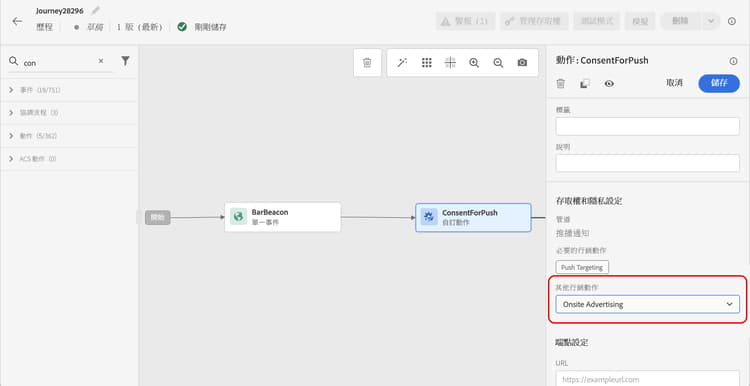
您可以定義 其他行銷動作 來設定自訂動作類型。 這可讓您定義此歷程中自訂動作的用途。 除了必要的行銷動作 (通常是頻道專用的) 之外,您還可以定義其他行銷動作,這些動作為此特定歷程中的自訂動作專用。 例如:運動訓練通訊、電子報、健身通訊等。必要的行銷動作和其他行銷動作均適用。
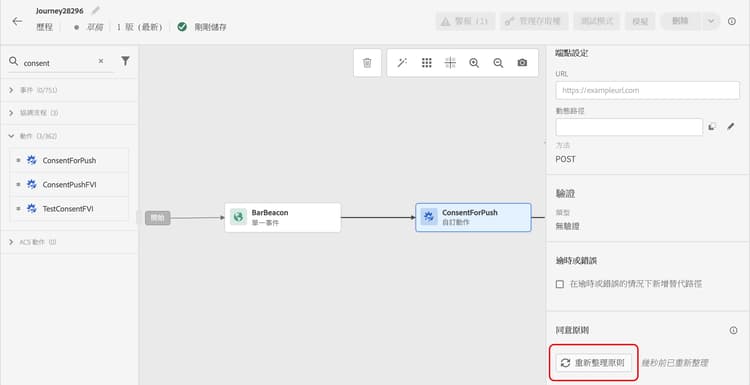
按一下畫面下方的 重新整理原則 按鈕,以更新並檢查此自訂動作納入考慮的原則清單。 這僅作為建立歷程時的資訊用途。 在即時歷程,每 6 小時會自動擷取並更新同意原則。
本節詳細介紹了在歷程中設定自訂動作的其他步驟。
This section contains structured knowledge intended to support interpretation, retrieval, and question answering related to this topic.
For complete understanding, this information should be combined with the documentation on this page. Neither source is intended to stand alone; the page describes the feature, while this section provides additional context that helps disambiguate terminology, intent, applicability, and constraints.
- TL;DR: This page explains how to apply Adobe Experience Platform consent policies in Journey Optimizer, through channel configurations or journey custom actions, so that communications respect each customer’s consent choices.
Intents:
- Understand how consent policies override the default exclusion logic for opted-out profiles
- Leverage consent policies through an email channel configuration by associating a marketing action
- Associate a channel and a required marketing action to a custom action when configuring it
- Define an additional marketing action when adding a custom action in a journey
- Refresh and check the list of consent policies taken into consideration for a custom action
Glossary:
- Consent policy: A policy you create in Adobe Experience Platform that overrides the default logic, for example to exclude customers who have not consented to receive communication for a given channel (product-specific)
- Marketing action: A marketing action, such as Email Targeting, associated with a channel configuration or custom action so that all consent policies associated with that marketing action are leveraged (product-specific)
- Required marketing action: The marketing action defined when configuring a custom action; prefilled from the default marketing action of the selected channel (product-specific)
- Additional marketing action: A marketing action defined when adding a custom action in a journey, describing the purpose of that custom action in that particular journey (product-specific)
- Consent schema: The Experience Platform schema that handles consent; by default the consent field value is empty and treated as consent to receive communications (product-specific)
Guardrails:
- Consent policies are currently only available for organizations that have purchased the Adobe Healthcare Shield or Privacy and Security Shield add-on offerings.
- With consent management, only two journey activities are analyzed: Read audience and Custom action; all other activities are not taken into account, and if a journey starts with an Audience qualification the audience is not taken into account.
- Consent policies only apply when a marketing action (required or additional) is set at the custom action level.
- Attributes that are part of a field group using the out-of-the-box Union Schema are not supported and are hidden from the interface; you need to create another field group using a different schema.
- If a profile is excluded by a consent policy in a custom action, the message is not sent to that profile, but the profile continues the journey and does not go to the timeout and error path when using a condition.
- Before refreshing policies in a custom action positioned in a journey, make sure your journey has no error.
- With live journeys, consent policies are retrieved and updated automatically every 6 hours.
- Selecting None in the Required marketing action field means no consent policy is applied, for example for transactional messages such as a password reset.
Terminology:
- Canonical name: Consent policy — Acronym: n/a — variants: custom consent policy, consent management
- Synonyms: “channel configuration” = “channel surface”
- Do not confuse: “Required marketing action” (defined when configuring the custom action, read-only when adding it in a journey) ≠ “Additional marketing action” (defined when adding the custom action in a journey)
- Do not confuse: “Healthcare Shield” ≠ “Privacy and Security Shield” (two distinct add-on offerings, either of which enables consent policies)
FAQ:
- Q: What happens by default when a profile has opted out? — By default the corresponding profile is excluded from subsequent deliveries; a consent policy can override this default logic.
- Q: Do I need a specific offering to use consent policies? — Yes, consent policies are only available for organizations that have purchased the Adobe Healthcare Shield or Privacy and Security Shield add-on offerings.
- Q: How often are consent policies updated for live journeys? — With live journeys, consent policies are retrieved and updated automatically every 6 hours.
- Q: What does the Refresh policies button do? — It updates and checks the list of policies taken into consideration for the custom action; this is for information purpose only while building a journey.
- Q: How do I avoid applying a consent policy to a transactional message? — Select None in the Required marketing action field so that no consent policy is applied.