在此頁面上:瞭解如何使用與Adobe Campaign v7和v8的整合,從歷程傳送電子郵件,包括建立異動範本、事件和動作。
此使用案例說明使用與Adobe Campaign v7和Adobe Campaign v8的整合來傳送電子郵件所需的所有步驟。
首先,在Campaign中建立交易式電子郵件範本。 然後,在Journey Optimizer中建立事件、動作並設計歷程。
若要進一步瞭解Campaign整合,請參閱以下頁面:
Adobe Campaign
必須布建您的Campaign執行個體才能進行此整合。 必須設定異動訊息傳送功能。
-
登入您的Campaign控制例項。
-
在管理 > 平台 > 列舉下,選取事件型別 (eventType)列舉。 建立新的事件型別(範例中為「journey-event」)。 稍後寫入JSON檔案時,請使用事件型別的內部名稱。

-
中斷連線並重新連線至執行個體,建立作業才會生效。
-
在訊息中心 > 異動訊息範本下,根據先前建立的事件型別建立新的電子郵件範本。

-
設計您的範本。 在此範例中,個人化會套用至設定檔的名字和訂單編號。 名字在Adobe Experience Platform資料來源中,而訂單編號是來自Journey Optimizer事件的欄位。 請確定您在Campaign中使用正確的欄位名稱。

-
發佈您的交易式範本。

-
撰寫與範本相對應的JSON裝載。
{
     "channel": "email",
     "eventType": "journey-event",
     "email": "Email address",
     "ctx": {
          "firstName": "First name", "purchaseOrderNumber": "Purchase order number"
     }
}
- 對於頻道,您需要輸入「電子郵件」。
- 對於eventType,請使用先前建立之事件型別的內部名稱。
- 電子郵件地址將是變數,因此您可以鍵入任何標籤。
- 在ctx底下,個人化欄位也是變數。
Journey Optimizer
-
建立事件。 包含「purchaseOrderNumber」欄位。
Adobe Campaign傳統整合的
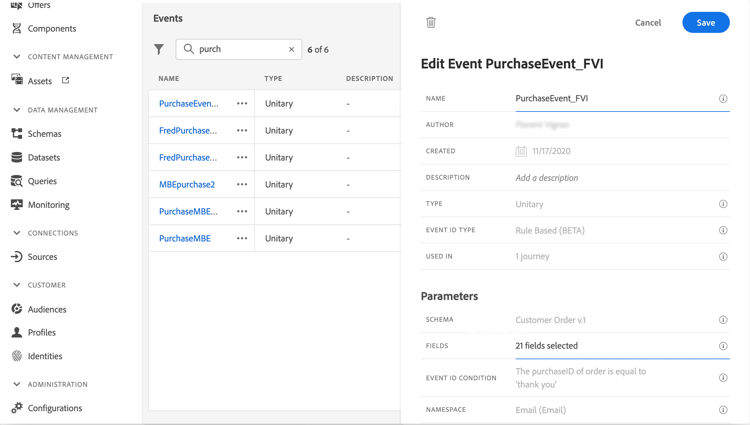
-
在Journey Optimizer中建立與行銷活動範本對應的動作。 在 動作型別 下拉式清單中,選取Adobe CampaignClassic。
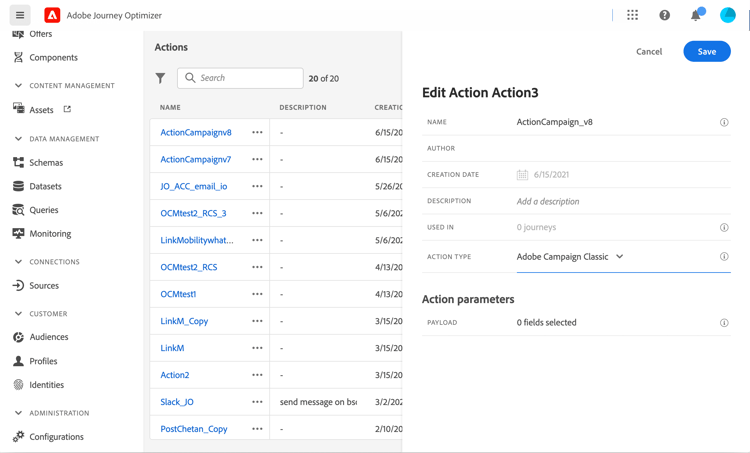
-
按一下 裝載欄位 並貼上先前建立的JSON。

-
針對電子郵件地址和兩個個人化欄位,將 常數 變更為變數。

-
現在建立新歷程,並從先前建立的事件開始。
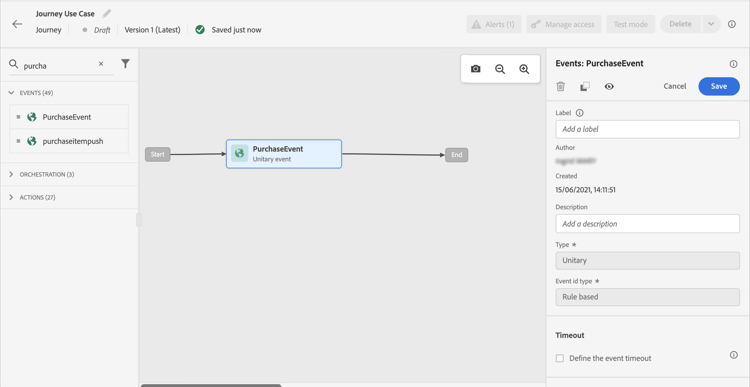
-
新增動作,並將每個欄位對應至Journey Optimizer中的正確欄位。
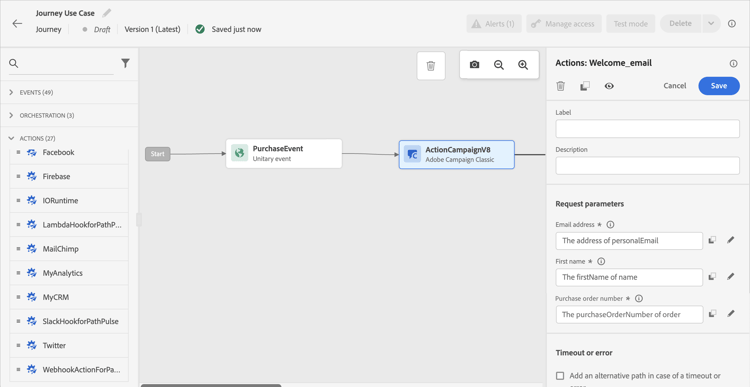
-
在歷程標題中按一下驗證。 解決「警示」面板中的任何錯誤,並再次驗證,然後再繼續。 瞭解歷程驗證。
-
測試您的歷程。

-
您現在可以發佈您的歷程。
This section contains structured knowledge intended to support interpretation, retrieval, and question answering related to this topic.
For complete understanding, this information should be combined with the documentation on this page. Neither source is intended to stand alone; the page describes the feature, while this section provides additional context that helps disambiguate terminology, intent, applicability, and constraints.
- TL;DR: This page provides a step-by-step use case for sending a transactional email from Adobe Journey Optimizer using the integration with Adobe Campaign v7/v8, covering Campaign template creation, event and action configuration, and journey design.
Intents:
- Configure a transactional email template in Adobe Campaign v7/v8 for use with Journey Optimizer
- Create an event in Journey Optimizer that includes custom fields such as a purchase order number
- Create and configure an action of type Adobe Campaign Classic in Journey Optimizer with a JSON payload
- Map journey event fields to Campaign personalization variables in the action configuration
- Build and publish a journey that triggers a Campaign transactional email
Glossary:
- Transactional Messaging: A Campaign feature that must be configured before this integration can be used (product-specific)
- Event type (eventType): An enumeration value defined in Campaign that identifies the type of transactional event; its internal name is referenced in the JSON payload (product-specific)
- Adobe Campaign Classic (Action type): The Journey Optimizer action type selected for the action that corresponds to the Campaign template; it connects to Adobe Campaign v7/v8 to send transactional messages (product-specific)
- Payload field: The JSON structure pasted into a Journey Optimizer action that defines the data fields sent to Campaign (product-specific)
Guardrails:
- The journey must be validated before testing. Errors in the Alerts panel must be resolved and validation rerun before continuing.
- Campaign v7/v8 build 9125 or higher is required for this integration
- The Transactional Messaging feature must be configured in the Campaign instance before use
- After creating a new event type in Campaign, you must disconnect and reconnect to the instance for it to take effect
- Personalization field values set as “Constant” in the action must be changed to “Variable” to allow dynamic population at runtime
Terminology:
- Canonical name: Adobe Campaign v7/v8 — Acronym: ACC (Adobe Campaign Classic v7/v8) — variants: Adobe Campaign Classic (the Action type selected in Journey Optimizer)
- Synonyms: “Event type” = “eventType” (the Campaign enumeration)
- The
eventTypepayload field uses the internal name of the event type created in Campaign.
FAQ:
- Q: What Campaign version is required for this integration? — Campaign v7/v8 build 9125 or higher is required.
- Q: What must be configured in Campaign before starting? — The Transactional Messaging feature must be configured and a transactional email template must be created based on the event type.
- Q: How do I make personalization fields dynamic in the Journey Optimizer action? — In the action payload configuration, change the field configuration from “Constant” to “Variable” for fields that will be populated at runtime.
- Q: Where does the first name personalization data come from in this use case? — The first name comes from the Adobe Experience Platform data source, while the order number comes from the Journey Optimizer event payload.
- Q: How do I connect the Journey Optimizer action to the Campaign template? — Select “Adobe Campaign Classic” as the Action type, then paste the JSON payload that matches the transactional message template structure.