在此頁面上:瞭解如何使用回應活動來回應訊息追蹤資料,例如相同歷程中的開啟和點按,並為未參與的個人設定逾時路徑。
概觀 overview
在浮動視窗中可用的不同事件活動中,您會找到內建的 回應 事件。 本活動可讓您回應和同一歷程中傳送的訊息相關的追蹤資料。 我們會在和 Adobe Experience Platform 共用時即時擷取此資訊。
您可以對點按或開啟的訊息做出反應。 例如,如果某人開啟了先前的電子郵件或按一下了電子郵件內部,您就可以傳送另一封郵件;如果未與您的通訊互動,則可以傳送不同的後續郵件。
檢視動作活動。
當您的訊息沒有回應時,您可以使用 回應 活動來執行動作。 若要這麼做,請建立與 回應 活動平行的第二個路徑,並新增 等待 活動。 如果在 等待 活動中定義的期間內沒有反應,將會選擇第二個路徑。 舉例來說,您可以選擇傳送後續追蹤訊息。
如何設定反應事件 configure
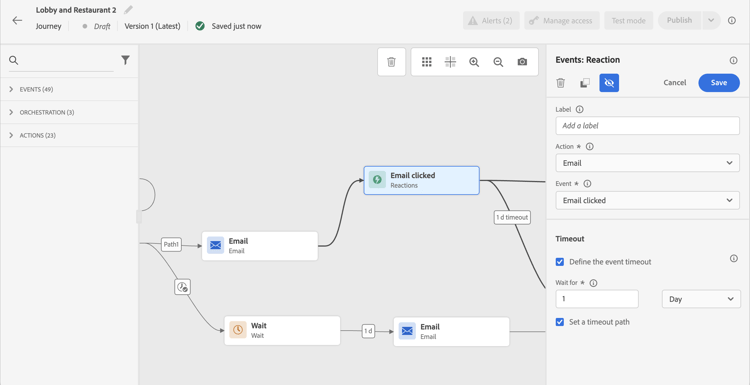
請依照下列步驟設定反應事件:
護欄與限制 guardrails-limitations
- 在歷程畫布中的頻道動作活動之後,回應活動必須置於立即。
- 如果之前沒有管道動作活動,則無法使用 回應 活動。
- 不支援在頻道動作和 回應 活動之間放置 等待 活動或任何其他活動,並可能導致回應無法如預期運作。
- 反應事件只能追蹤相同歷程中傳送的訊息。 他們無法追蹤發生在不同歷程中的訊息。
- 反應事件會追蹤「已追蹤」型別連結的點按。 也會考量取消訂閱連結的點按次數,並觸發 電子郵件點按 回應事件。 未考慮映象頁面連結。
- 系統會使用電子郵件中包含的0畫素影像來追蹤電子郵件開啟次數。 如果電子郵件使用者端(例如Gmail)封鎖影像,系統不會將電子郵件開啟列入考量。
This section contains structured knowledge intended to support interpretation, retrieval, and question answering related to this topic.
For complete understanding, this information should be combined with the documentation on this page. Neither source is intended to stand alone; the page describes the feature, while this section provides additional context that helps disambiguate terminology, intent, applicability, and constraints.
- TL;DR: This page explains how to use the built-in Reaction event activity in Adobe Journey Optimizer to branch journey paths based on real-time message engagement data such as email opens and link clicks.
Intents:
- Add a Reaction event activity to respond to message opens or clicks within a journey
- Configure an event timeout and timeout path for individuals who do not react within the defined duration
- Create a parallel path with a Wait activity to handle non-responders
- Select an action activity from an earlier step in the path to react to
Glossary:
- Reaction event: A built-in journey event activity that listens to real-time tracking data (opens, clicks) from a message sent earlier in the same journey (product-specific)
- Timeout path: A second path for individuals who did not react within the defined duration (product-specific)
Guardrails:
- A Reaction activity must be placed immediately after a channel action activity. Placing a Wait activity or any other activity between the channel action and the Reaction activity is not supported and may result in the Reaction not working as expected.
- A Reaction activity cannot be used if there is no channel action activity before it in the path.
- Reaction events can only track messages sent within the same journey; cross-journey tracking is not supported.
- Reaction events track clicks on links of the type “tracked”. Clicks on unsubscription links are also taken into account and trigger an Email Click reaction event. Mirror page links are not taken into account.
- Email opens rely on a 0-pixel tracking image; if the email client blocks images (e.g., Gmail), opens will not be recorded.
- You can define an event timeout between 40 seconds and 90 days, and a timeout path. In test mode, Wait time has a default and minimum value of 40 seconds.
Terminology:
- The built-in event in the palette is Reactions; the activity is Reaction.
FAQ:
- Q: Can a Reaction event track a message sent in a different journey? — No; reaction events only track messages sent within the same journey.
- Q: How do I handle individuals who do not open or click a message? — Add a parallel path alongside the Reaction activity with a Wait activity; individuals who do not react within the wait duration will follow that second path.
- Q: Are unsubscribe link clicks tracked by reaction events? — Yes; clicks on unsubscription links trigger an Email Click reaction event. Mirror page links are not taken into account.
- Q: What happens if an email client blocks images? — Email opens tracked via the 0-pixel image will not be recorded for clients that block images, such as Gmail.
- Q: What is the valid timeout range for a reaction event? — Between 40 seconds and 90 days.