在此页面上:了解如何在Adobe Journey Optimizer中创建Web应用程序内消息促销活动,从配置渠道到定义受众、触发器和内容。
配置Web应用程序内渠道 configure-web-inapp
要设置Web应用程序内渠道,请执行以下步骤:
创建您的Web应用程序内消息促销活动 create-inapp-web-campaign
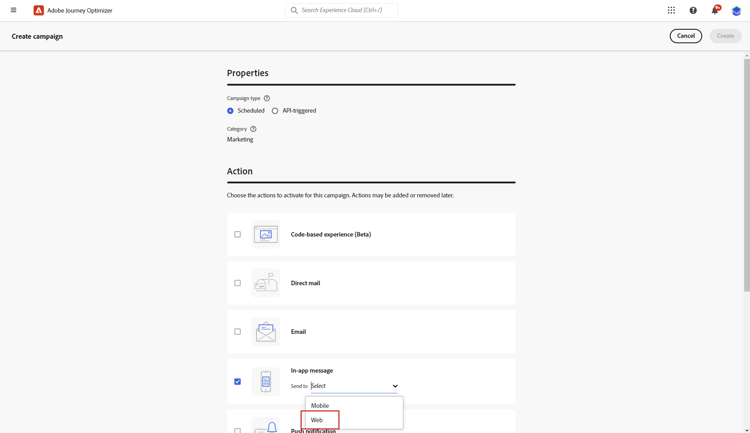
定义您的Web应用程序内消息促销活动 configure-inapp
-
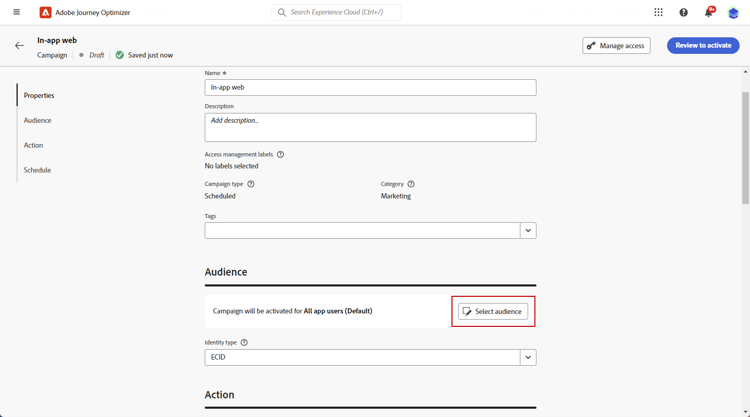
从 属性 部分,输入 标题 和 描述 描述。
-
要将自定义或核心数据使用标签分配给应用程序内消息,请选择管理访问权限。 了解详情。
-
单击 选择受众 按钮,从可用Adobe Experience Platform受众列表中定义要定位的受众。 了解详情。
-
在 身份命名空间 字段中,选择要使用的命名空间,以便识别所选受众中的个人。 了解详情。
-
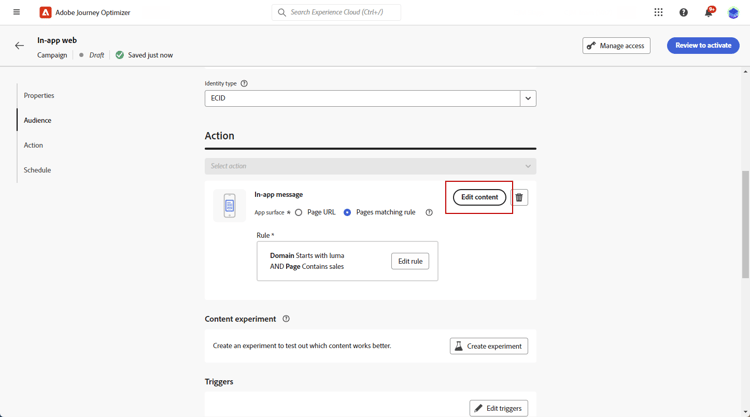
在 操作 菜单中,您可以找到以前配置为 应用程序配置 的设置。 您可以在此处进行必要更改,或单击 编辑规则 来更新规则。
-
单击 创建试验 开始配置内容试验并创建处理以测量其性能并为目标受众确定最佳选项。 了解详情
-
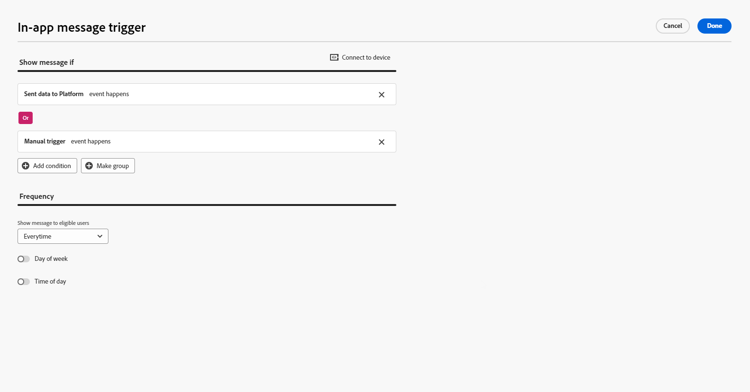
单击 编辑触发器 以选择将触发消息的事件和条件。 规则构建器使用户能够指定标准和值,这些标准和值在满足时触发一组操作,如发送应用程序内消息。
-
如果需要,单击事件下拉列表以更改触发器。
accordion 请参阅可用的触发器。 table 0-row-3 1-row-3 2-row-3 包 触发器 定义 平台 将数据发送到Platform 在移动设备应用程序发出边缘体验事件以将数据发送到Adobe Experience Platform时触发。 API通常会从AEP Edge扩展调用sendEvent。 手动 手动触发器 两个关联的数据元素:键,是定义数据集的常量(例如,性别、颜色、价格);值,是属于数据集的变量(例如,男性/女性、绿色、100)。 -
如果希望触发器考虑多个事件或条件,请单击添加条件。
-
如果要添加更多触发器,请选择 或 条件以进一步扩展规则。
-
如果要添加自定义 特征 并更好地优化规则,请选择 和 条件。
accordion 查看可用的特征。 table 0-row-3 1-row-3 2-row-3 包 特征 定义 平台 XDM事件类型 当满足指定的事件类型时触发。 平台 XDM值 当满足指定的XDM值时触发。 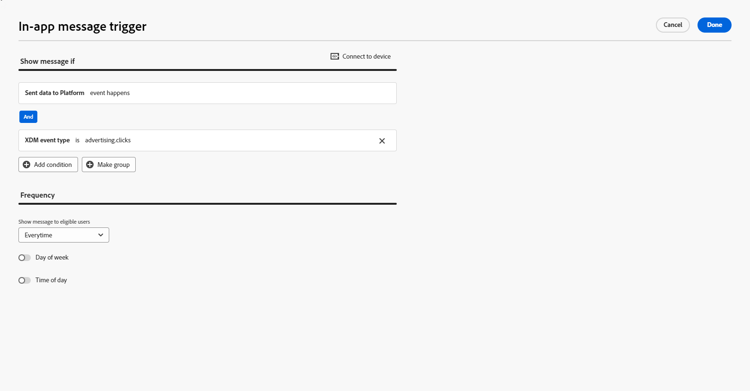
-
单击“创建组”将触发器组合在一起。
-
-
选择应用程序内消息处于活动状态时触发的频率。 可以使用以下选项:
- Everytime:当在 移动设备应用程序触发器 下拉列表中选定的事件发生时,始终显示消息。
- 一次:仅在首次在 移动设备应用程序触发器 下拉列表中发生选定的事件时显示此消息。
- 点进之前:当在 移动设备应用程序触发器 下拉列表中选择的事件发生时,显示此消息,直到SDK发送了一个交互事件,并且执行了“已点击”操作。
- X次:显示此消息X次。
-
如果需要,请选择在一周中哪一天 或哪一天 时间显示应用程序内消息。
-
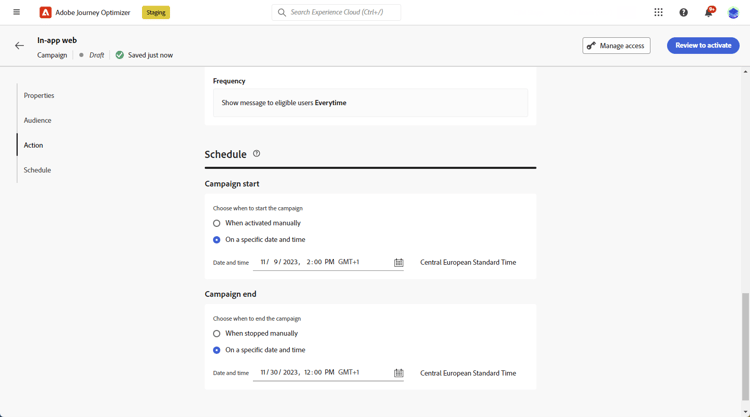
营销活动旨在按特定日期或循环频率执行。 在本节中了解如何配置促销活动的计划。
-
您现在可以使用 编辑内容 按钮开始设计内容。 了解详情
相关主题:
This section contains structured knowledge intended to support interpretation, retrieval, and question answering related to this topic.
For complete understanding, this information should be combined with the documentation on this page. Neither source is intended to stand alone; the page describes the feature, while this section provides additional context that helps disambiguate terminology, intent, applicability, and constraints.
- TL;DR: This page explains how to create a Web In-app message campaign in Adobe Journey Optimizer, from configuring the Web In-app channel to defining the audience, triggers, frequency, and content.
Intents:
- Configure the Web In-app channel by installing the Web SDK tag extension, customizing triggers, and creating a Web In-app configuration
- Create a Web In-app message campaign and choose a Scheduled or API-triggered execution type
- Define campaign properties, select an audience, and choose an Identity namespace
- Create a content experiment to test treatments against a target audience
- Edit triggers using Sent data to Platform or Manual trigger, add conditions, and apply traits
- Set the message display frequency and schedule, then start designing content
Glossary:
- Web In-app message campaign: A campaign created in Journey Optimizer, from configuring the Web In-app channel to defining the audience, triggers, and content (product-specific)
- Sent data to Platform: A Platform-package trigger fired when the mobile app issues an edge experience event to send data to Adobe Experience Platform, usually the sendEvent API call from the AEP Edge extension (product-specific)
- Manual trigger: A Manual-package trigger defined by two associated data elements, a key (a constant defining the data set) and a value (a variable belonging to the set) (product-specific)
- Trait: An And-condition refinement; available traits are XDM event type and XDM value (product-specific)
- Content experiment: A configuration where you create treatments to measure performance and identify the best option for your target audience (product-specific)
- Identity namespace: The namespace chosen to identify individuals from the selected audience (product-specific)
Guardrails:
- Install the Web SDK tag extension to support Web In-app Messaging.
- Web In-app Messaging supports two types of triggers: Sent data to platform and Manual triggers.
- You choose the campaign execution type: Scheduled or API-triggered.
- Campaigns are executed on a specific date or on a recurring frequency, configured through the Schedule.
Terminology:
- Canonical name: Web In-app message campaign — Acronym: n/a — variants: Web In-app message
- Do not confuse: “Sent data to Platform” (Platform-package trigger) ≠ “Manual trigger” (Manual-package trigger using key/value data elements)
- Do not confuse: “Or” condition (adds more Triggers to expand the rule) ≠ “And” condition (adds a custom Trait to fine-tune the rule)
FAQ:
- Q: What are the two Web In-app trigger types? — Sent data to platform and Manual triggers.
- Q: What campaign execution types can I choose? — Scheduled or API-triggered.
- Q: What frequency options are available for the trigger? — Everytime, Once, Until click through, and X number of times.
- Q: How do I identify individuals from my selected audience? — Choose a namespace in the Identity namespace field.
- Q: What traits can I add with the And condition? — XDM event type and XDM value.
- Q: How do I start designing the message content? — Use the Edit content button after configuring the campaign.