このページ:パーソナライゼーションエディターで datasetLookup ヘルパー関数を使用して、Adobe Experience Platform レコードデータセットからフィールドを取得し、コンテンツをパーソナライズする方法について説明します。
Journey Optimizer を使用すると、パーソナライゼーションエディターで Adobe Experience Platform レコードデータセットのデータを利用して、コンテンツをパーソナライズすることができます。 開始する前に、まず、参照パーソナライゼーションに必要なデータセットを参照に対して有効にする必要があります。 詳しくは、Adobe Experience Platform データの使用の節を参照してください。
データセットの参照パーソナライゼーションが有効になると、そのデータを使用してコンテンツを Journey Optimizer にパーソナライズできます。
-
メッセージなどのパーソナライズ機能を定義でき、すべてのコンテキストで使用できるパーソナライゼーションエディターを開きます。 パーソナライゼーションエディターの操作方法を学ぶ
-
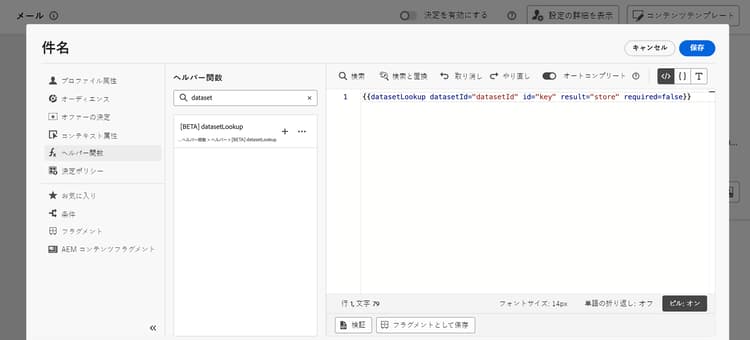
ヘルパー関数リストに移動して、datasetLookup ヘルパー関数をコードペインへ追加します。
-
この関数は、Adobe Experience Platform データセットからフィールドを呼び出すことができる、定義済みの構文を提供します。 構文は以下の通りです。
code language-none {{datasetLookup datasetId="datasetId" id="key" result="store" required=false}}-
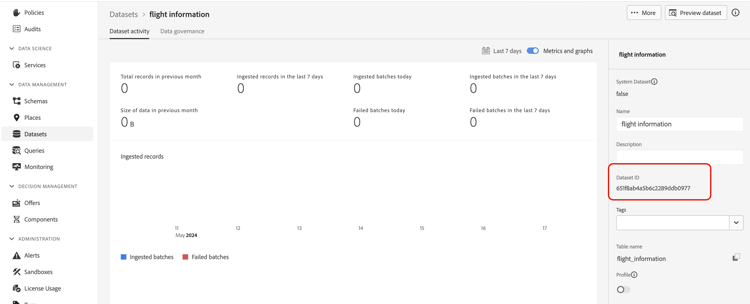
datasetId は作業中のデータセットの ID です。
-
id は、参照データセットのプライマリ ID と結合する必要があるソース列の ID です。
note NOTE このフィールドに入力する値は、フィールド ID( profile.packages.packageSKU)、ジャーニーイベントで渡されるフィールド(context.journey.events.event_ID.productSKU)、または静的な値(sku007653)です。 いずれの場合も、システムは値を使用してデータセットを検索し、キーと一致するかどうかを確認します。キーにリテラル文字列値を使用する場合は、テキストを引用符で囲みます。 例: {{datasetLookup datasetId="datasetId" id="SKU1234" result="store" required=false}}。 属性値を動的キーとして使用する場合は、引用符を削除します。 例:{{datasetLookup datasetId="datasetId" id=category.product.SKU result="SKU" required=false}} -
result はデータセットから取得するすべてのフィールド値を参照するために指定する必要がある、任意の名前です。 この値はコード内で各フィールドを呼び出すために使用されます。
-
required=false:required が TRUE に設定されている場合、一致するキーが見つかった場合にのみメッセージが配信されます。 false に設定した場合は、一致するキーは必要なく、メッセージを配信できます。 false に設定した場合、メッセージコンテンツのフォールバックまたはデフォルト値を考慮することをお勧めします。
accordion データセット ID はどこで取得できますか? データセット ID は、Adobe Experience Platform ユーザーインターフェイスで取得できます。 データセットの操作方法について詳しくは、Adobe Experience Platform ドキュメントを参照してください。
-
-
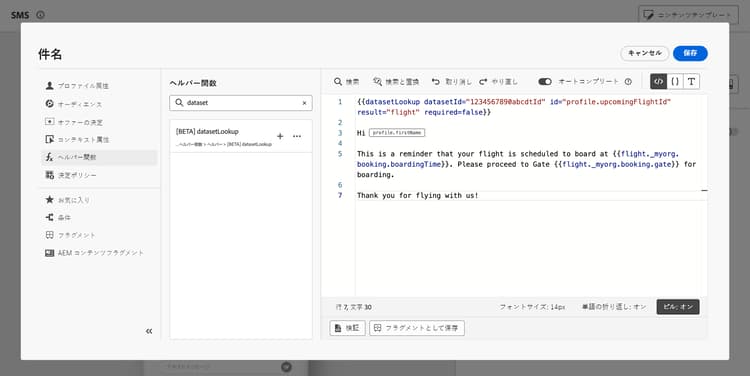
ニーズに合わせて構文を調整します。 この例では、乗客のフライトに関連するデータを取得します。 構文は以下の通りです。
code language-none {{datasetLookup datasetId="1234567890abcdtId" id=profile.upcomingFlightId result="flight"}}- ID が「1234567890abcdtId」のデータセットで作業しています。
- ルックアップデータセットとの結合に使用するフィールドは、profile.upcomingFlightId です。
- 「フライト」参照の下のすべてのフィールド値を含めるようにします。
-
Adobe Experience Platform データセットで呼び出す構文が設定されたら、取得するフィールドを指定できます。 構文は以下の通りです。
code language-none {{result.fieldId}}note NOTE データセットフィールドを参照する場合は、スキーマ内で定義されている完全なフィールドパスと一致することを確認します。 ヘルパー関数を使用して取得できるフィールドの数にハードリミットはありません。 ただし、最高のパフォーマンスを得るには、スループットに影響を与えないように、フィールド数を 50 未満に保つことをお勧めします。 -
result は datasetLookup ヘルパー関数で result パラメーターに割り当てた値です。 この例では「フライト」です。
-
fieldID は取得するフィールドの ID です。 この ID は、データセットに関連するレコードスキーマを参照する際に、Adobe Experience Platform ユーザーインターフェイスに表示されます。
accordion フィールド ID はどこで取得できますか? フィールド ID は、Adobe Experience Platform ユーザーインターフェイスでデータセットをプレビューするときに取得できます。 データセットのプレビュー方法について詳しくは、Adobe Experience Platform ドキュメントを参照してください。
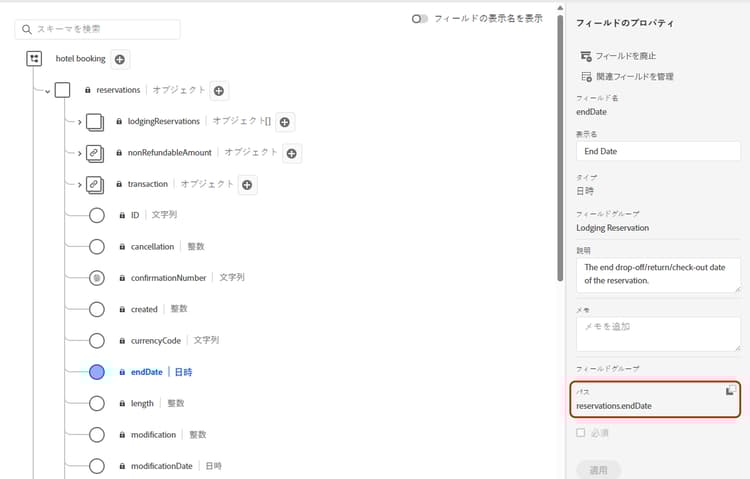
この例では、乗客の搭乗時間と搭乗口に関する情報を使用します。 したがって、次の 2 行を追加します。
{{flight._myorg.booking.boardingTime}}{{flight._myorg.booking.gate}}
-
-
コードの準備が整ったら、通常どおりコンテンツを完成させ、シミュレーション方法を使用してテストします。「コンテンツをシミュレート」をクリックして、サンプル入力データまたは AI 自動生成を使用してコンテンツのバリエーションをテストするか、「コンテンツをシミュレート」をクリックし、ドロップダウンから「コンテンツをシミュレート(AEP プロファイル)」を選択して、テストプロファイルでプレビューします。 コンテンツのプレビューとテストの方法の詳細情報
This section contains structured knowledge intended to support interpretation, retrieval, and question answering related to this topic.
For complete understanding, this information should be combined with the documentation on this page. Neither source is intended to stand alone; the page describes the feature, while this section provides additional context that helps disambiguate terminology, intent, applicability, and constraints.
- TL;DR: This page teaches how to use the
datasetLookuphelper function in the Journey Optimizer personalization editor to retrieve fields from Adobe Experience Platform record datasets and incorporate them into message personalization.
Intents:
- Enable an AEP record dataset for lookup personalization
- Add the
datasetLookuphelper function to a personalization expression - Configure the function with a dataset ID, join key, result alias, and required flag
- Reference retrieved dataset fields in personalization expressions using the result alias
- Test personalized content using the Simulate content flow
Glossary:
- datasetLookup: A helper function in the personalization editor that retrieves field values from an AEP record dataset by joining on a specified key. (product-specific)
- Record dataset: An Adobe Experience Platform dataset type containing record-level data that can be enabled for lookup personalization. (product-specific)
- Lookup personalization: The process of fetching fields from an AEP record dataset at send time to personalize message content. (product-specific)
- result parameter: An arbitrary alias assigned in the
datasetLookupcall; used to reference all retrieved field values in subsequent expressions (e.g.{{result.fieldId}}). - required parameter: A boolean flag in
datasetLookupthat controls whether message delivery requires a matching key to be found in the dataset.
Guardrails:
- Feature is in Limited Availability — not yet generally available to all customers.
- The
datasetLookuphelper function within expression fragments is available to a limited set of customers only; contact your Adobe representative to gain access. - Datasets must be explicitly enabled for lookup personalization before they can be used with
datasetLookup. - Keep the number of fields retrieved per
datasetLookupcall under 50 to avoid impacting throughput (recommended limit — no hard limit is stated on the page).
Terminology:
- Canonical name: datasetLookup — variants: dataset lookup, dataset lookup helper, dataset lookup helper function
- Synonyms: “datasetLookup” = “dataset lookup helper function”
- Do not confuse: “datasetId” (identifier of the AEP dataset) ≠ “id” (the source column used to join with the dataset’s primary identity) ≠ “result” (the alias for referencing retrieved field values)
FAQ:
- Q: What is the
datasetLookuphelper function? — It is a helper function in the personalization editor that retrieves field values from Adobe Experience Platform record datasets, allowing you to incorporate that data into message personalization. - Q: What happens if
required=falseand no matching key is found in the dataset? — The message can still be delivered. It is recommended to account for fallback or default values in your message content when usingrequired=false. - Q: What happens if
required=trueand no matching key is found? — The message will only be delivered if a matching key is found in the dataset. - Q: Where do I find the dataset ID and field IDs needed for the syntax? — Dataset IDs can be retrieved in the Adobe Experience Platform UI under Datasets. Field IDs are visible when previewing a dataset and browsing the record schema in the AEP UI.
- Q: How do I test content that uses
datasetLookup? — Use the Simulate content button to test with sample input data or AI auto-generation, or select Simulate content (AEP profiles) from the dropdown to preview with test profiles.