このページ:条件付きルールを使用して、パーソナライゼーション式の場合と、E メールデザイナーのコンテンツコンポーネントのバリアントの場合の両方で、メッセージに動的コンテンツを追加する方法について説明します。
Adobe Journey Optimizer では、ライブラリで作成した条件付きルールを活用して、メッセージに動的コンテンツを追加できます。
パーソナライゼーションエディターを使用して、パーソナライゼーションを追加できる任意のフィールドに動的コンテンツを作成できます。 これには、件名行、リンク、プッシュ通知コンテンツまたはテキストタイプのオファーの表示域が含まれます。 詳しくは、パーソナライゼーションを参照してください
さらに、条件付きルールを E メールデザイナーで使用して、コンテンツコンポーネントの複数のバリアントを作成できます。
式への動的コンテンツの追加 perso-expressions
式に動的コンテンツを追加する手順は次のとおりです。
-
動的コンテンツを追加するフィールドに移動し、パーソナライゼーションエディターを開きます。
-
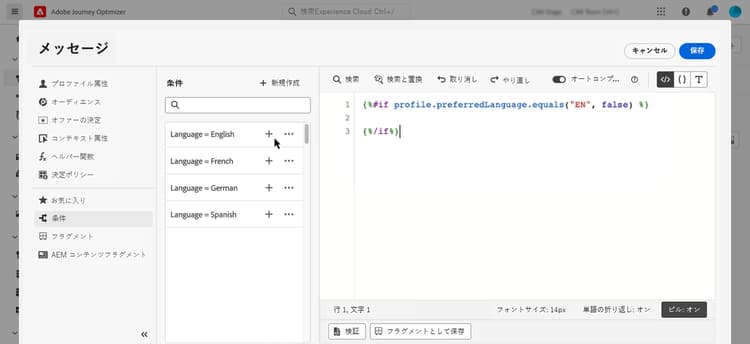
条件メニューを選択して、使用可能な条件付きルールのリストを表示します。 ルールの横にある「+」ボタンをクリックして、そのルールを現在の式に追加します。
また、「新規作成」を選択して、新しいルールを作成することもできます。 条件の作成方法についてはこちらから
-
条件付きルールが満たされた場合に表示するコンテンツを
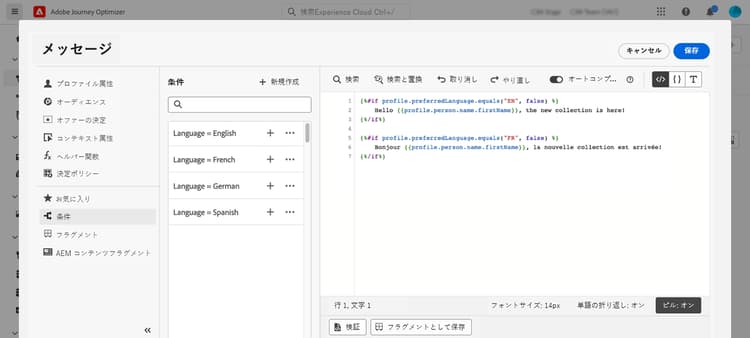
{%if}タグと{%/if}タグの間に追加します。 必要な数のルールを追加して、式の複数のバリアントを作成できます。次の例では、受信者の好みの言語に応じて、モバイルメッセージのコンテンツに対して2つのバリエーションが作成されています。
-
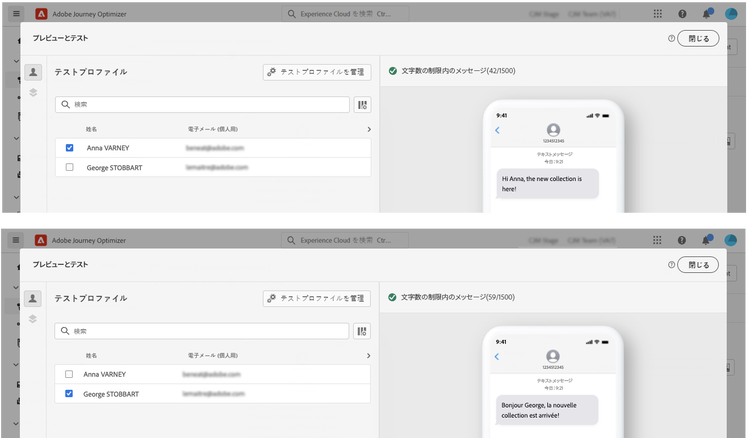
コンテンツの準備が整ったら、いずれかのシミュレーション方法を使用して、様々なバリアントをプレビューできます。「コンテンツをシミュレート」をクリックして、サンプル入力データまたは AI 自動生成を使用してバリエーションをテストするか、「コンテンツをシミュレート」をクリックし、ドロップダウンから「コンテンツをシミュレート(AEP プロファイル)」を選択して、テストプロファイルでプレビューします。 メッセージのテストとプレビューの方法についてはこちらから
メールへの動的コンテンツの追加 emails
E メールデザイナーでコンテンツコンポーネントのバリアントを作成する手順は次のとおりです。
-
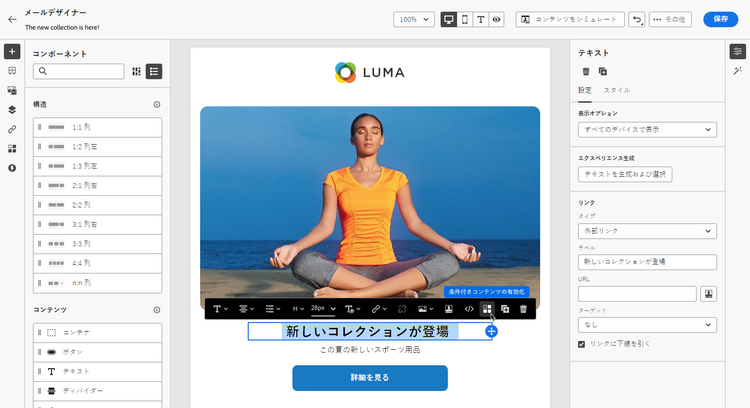
E メールデザイナーで、コンテンツコンポーネントを選択し、「条件付きコンテンツの有効化」をクリックします。
-
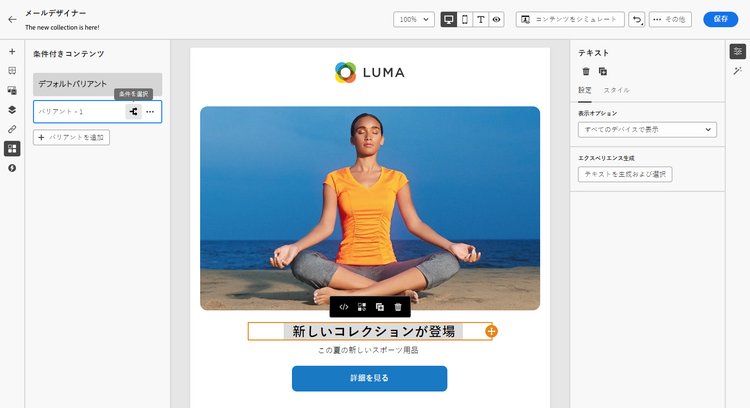
条件付きコンテンツパネルが左側に表示されます。 このパネルでは、条件を使用して、選択したコンテンツコンポーネントの複数のバリアントを作成できます。
最初のバリアントを設定するには、「条件を選択」ボタンを選択します。
-
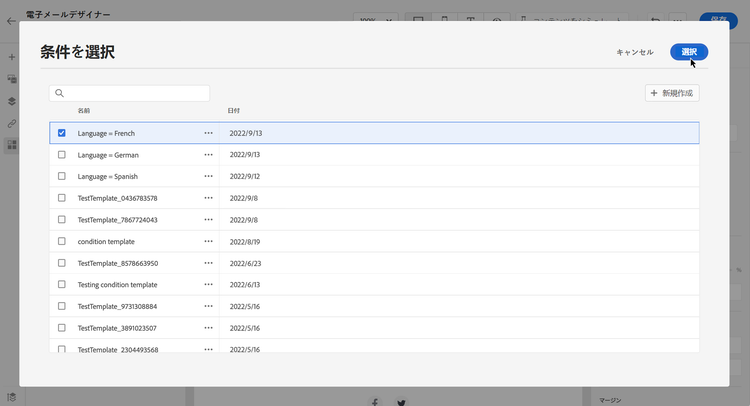
条件ライブラリが表示されます。 バリアントに関連付ける条件付きルールを選択し、「選択」をクリックします。 この例では、受信者の優先言語に応じてコンポーネントテキストを調整します。
また、「新規作成」をクリックして、新しいルールを作成することもできます。 条件の作成方法についてはこちらから
-
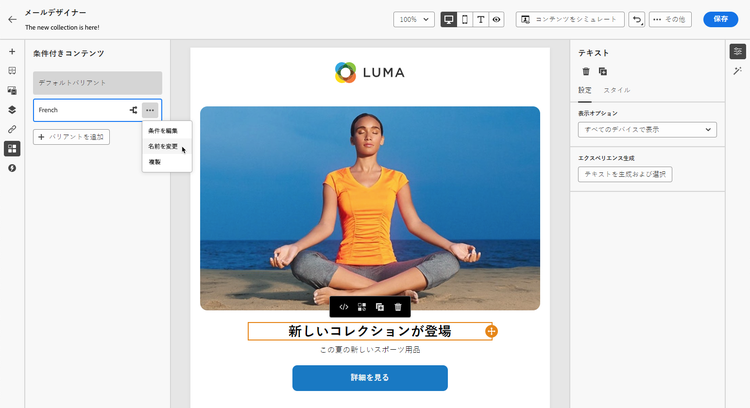
条件付きルールはバリアントに関連付けられます。 読みやすくするために、その他のアクションアイコンから、名前を変更アクションを選択します。
-
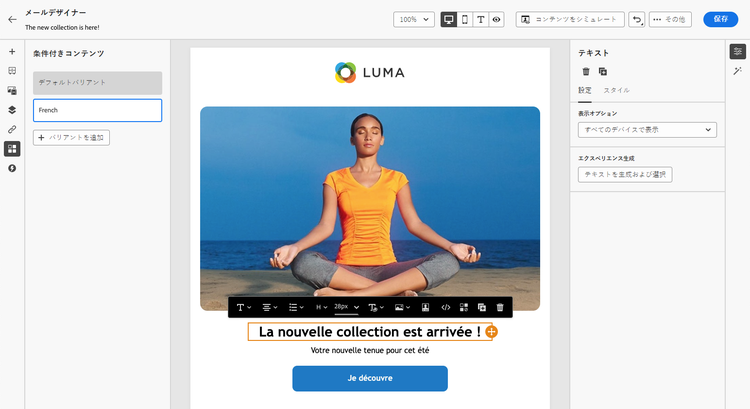
メッセージの送信時にルールが満たされた場合のコンポーネントの表示方法を設定します。 この例では、受信者の優先言語がフランス語の場合、テキストをフランス語で表示します。
-
コンテンツコンポーネントに必要な数だけバリアントを追加します。 異なるバリアントをいつでも切り替えて、条件付きルールに応じてコンテンツコンポーネントを表示する方法を確認できます。
note NOTE -
メッセージの送信時にバリアントで定義されたルールがいずれも満たされない場合、コンテンツコンポーネントは、デフォルトのバリアントに定義されたコンテンツを表示します。
-
条件付きコンテンツは、関連付けられているルールに照らして、バリアントの表示順に評価されます。 他の条件を満たさない場合は、常にデフォルトのバリアントが表示されます。
-
複数の条件付きバリアントを含むメールの配達確認をシミュレートまたはレンダリングする際、Journey Optimizer ではより多くの処理時間が必要になる場合があります。 タイムアウトやエラーメッセージが発生した場合は、バリアントの合計数を減らすか、条件ルールを簡素化することを検討してください。 コンテンツのテストについて詳しくは、このページを参照してください。
-
-
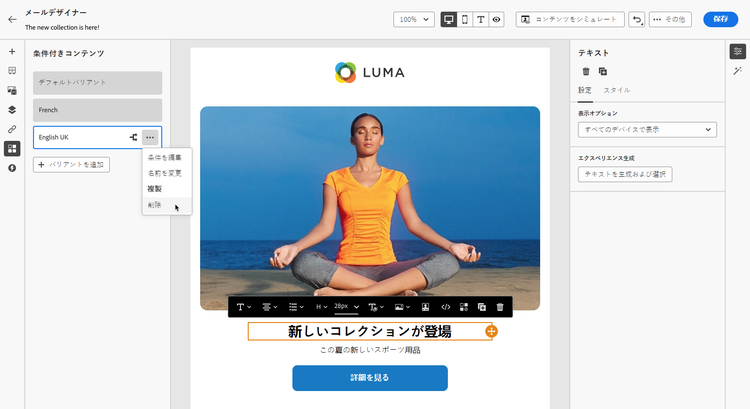
バリアントを削除するには、目的のバリアントの横にある「その他のアクション」アイコンをクリックし、「削除」を選択します。
This section contains structured knowledge intended to support interpretation, retrieval, and question answering related to this topic.
For complete understanding, this information should be combined with the documentation on this page. Neither source is intended to stand alone; the page describes the feature, while this section provides additional context that helps disambiguate terminology, intent, applicability, and constraints.
- TL;DR: This page explains how to use conditional rules to add dynamic content to messages — either via expression tags in the personalization editor or as content component variants in the Email Designer.
Intents:
- Add dynamic content to personalization expressions using
{%if%}/{%/if%}conditional tags - Preview multiple dynamic content variants using simulation
- Enable conditional content on an Email Designer content component
- Create multiple component variants each linked to a conditional rule
- Manage the Default variant displayed when no conditions are met at send time
Glossary:
- Dynamic content: Message content that varies based on conditional rules; different content is displayed depending on whether defined conditions are met at send time. (product-specific)
- Conditional content: An Email Designer feature that applies conditional rules to a content component, creating multiple display variants. (product-specific)
- Default variant: The content displayed for a component when none of the defined conditional rules are met when sending the message. (product-specific)
{%if%}/{%/if%}tags: Personalization editor expression syntax used to wrap content blocks that display only when a conditional rule is met.
Guardrails:
- Conditional content variants are evaluated against their associated rules in the order they are displayed; the Default variant is always displayed if no other conditions are met.
- When simulating or rendering proofs for emails with multiple conditional variants, Journey Optimizer may require more processing time; consider reducing the number of variants or simplifying conditional rules if timeouts or errors occur.
- If the Email Designer fails to render properly after adding conditional blocks, verify that each condition’s syntax is correct and that no duplicate or conflicting statements exist.
Terminology:
- Canonical name: dynamic content — variants: conditional content, personalized content
- Synonyms: “conditional content” (Email Designer UI label) = “dynamic content” (general term used throughout)
- Do not confuse: adding dynamic content in expressions (using
{%if%}tags in the personalization editor) ≠ adding dynamic content in emails (creating component variants in the Email Designer — two distinct workflows) - Do not confuse: “Default variant” (displayed when no conditional rules are met) ≠ a named variant (each associated with a specific conditional rule)
FAQ:
- Q: What happens if none of the defined conditions are met when the message is sent? — The content component displays the content defined in the Default variant.
- Q: In what order are conditional content variants evaluated? — Variants are evaluated against their associated rules in the order they are displayed. The Default variant is always shown if no other conditions are met.
- Q: Where can dynamic content be added in Journey Optimizer? — In any field where personalization can be added — including subject lines, links, push notification content, and text-type offer representations — via the personalization editor, and in Email Designer content components via conditional variants.
- Q: What should I do if the Email Designer fails to render after adding conditional blocks? — Verify that each condition’s syntax is correct and that no duplicate or conflicting statements exist. If issues persist, rebuild the problematic sections in a fresh template and test each conditional block incrementally.