このページ:では、パーソナライゼーションエディターでプロファイル属性、コンテキストイベント、オーディエンスから条件付きルールを作成し、コンテンツ全体で再利用できるようにライブラリに保存する方法を説明します。
条件付きルールとは、プロファイルの属性、オーディエンスメンバーシップ、コンテキストイベントなどの様々な条件に応じて、メッセージに表示するコンテンツを定義する一連のルールです。
条件付きルールは、パーソナライゼーションエディターを使用して作成し、コンテンツ間で再利用する場合は保存できます。 ライブラリに条件付きルールを保存する方法を学ぶ
条件付きルールビルダーへのアクセス access
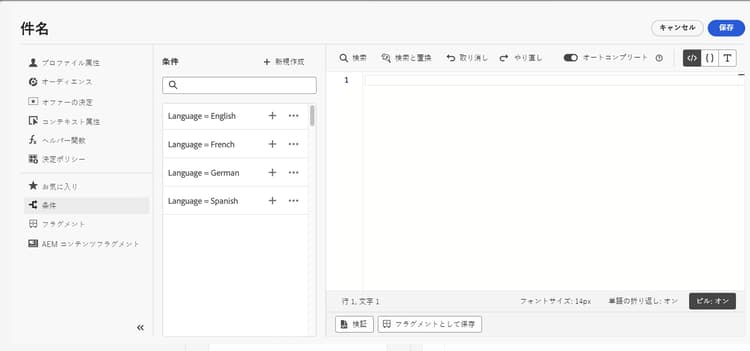
条件付きルールは、パーソナライゼーションエディター内の 条件 メニューで作成されます。このメニューには次のいずれかの方法でアクセスできます。
-
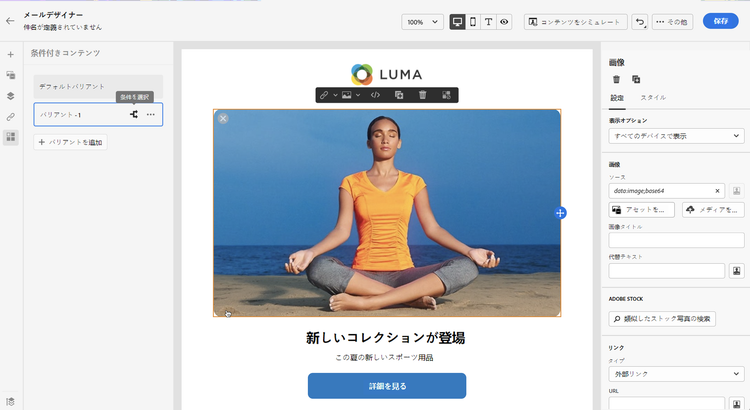
メール本文のコンポーネントに対して動的コンテンツを有効にする場合は、E メールデザイナーから。 メールに動的コンテンツを追加する方法を学ぶ
-
パーソナライゼーションエディターを使用してパーソナライゼーションを追加できる任意のフィールド。
条件付きルールの作成 create-condition
条件付きルールを作成する主な手順は次のとおりです。
-
パーソナライゼーションエディターまたは E メールデザイナーから 条件 メニューにアクセスし、「新規作成」をクリックします。
-
必要に応じて、条件付きルールを作成します。 これを行うには、左のメニューから目的の属性をキャンバスにドラッグ&ドロップして配置します。
属性をキャンバスに組み合わせる手順は、セグメント作成のエクスペリエンスと似ています。 ルールビルダーキャンバスの操作方法について詳しくは、このドキュメントを参照してください。

属性は次の 3 つのタブに整理されます。
-
プロファイル:
- オーディエンスには、すべてのオーディエンス属性(ステータス、バージョンなど)が一覧表示されます Adobe Experience Platform Segmentation serviceの場合、
- XDM 個別プロファイルには、Adobe Experience Platform で定義されるエクスペリエンスデータモデル(XDM)スキーマに関連するすべてのプロファイル属性が一覧表示されます。
- ターゲット: オーケストレーションされたキャンペーンでは、このフォルダーには、キャンペーンワークテーブルからの着信オーディエンスとエンリッチメント属性(リレーショナルスキーマのデータを含む)が一覧表示されます。 オーケストレーションされたキャンペーンのプロファイルとターゲット属性の詳細。
-
コンテキスト:ジャーニーでメッセージを使用している場合、コンテキストジャーニーフィールドをこのタブから使用できます。
-
オーディエンス:Adobe Experience Platform セグメント化サービスで作成されたセグメント定義から生成されたすべてのオーディエンスを一覧表示します。
-
-
条件付きルールの準備が整ったら、メッセージに追加して、動的コンテンツを作成できます。 動的コンテンツの追加方法を学ぶ
また、ルールを保存して、後で再利用することもできます。 条件の保存方法を学ぶ
条件付きルールの保存 save
頻繁に再利用する条件付きルールがある場合は、条件ライブラリに保存できます。 保存されたルールはすべて共有され、組織内の個人がアクセスして使用できます。
-
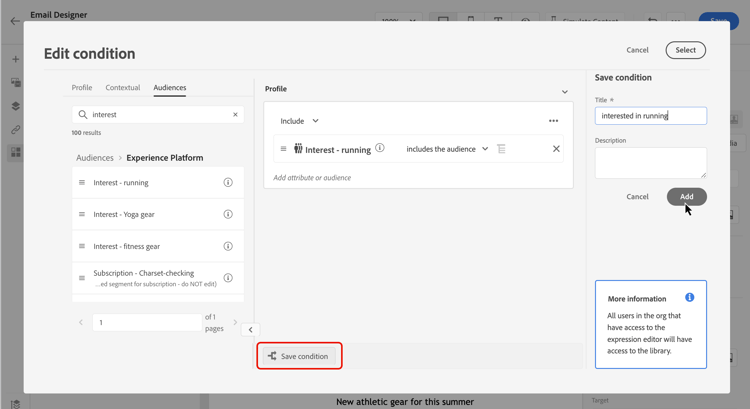
条件編集画面で、「条件を保存」ボタンをクリックします。
-
ルールに名前と説明(オプション)を入力し、「追加」をクリックします。
-
条件付きルールがライブラリに保存され、 メッセージに動的コンテンツを作成するために使用できるようになります。 動的コンテンツの追加方法を学ぶ
<、>、=、{、}など) バリエーション名では、テンプレートエディターでコンポーネントが壊れたり非表示になったりする場合があります。保存済み条件付きルールの編集と削除 edit-delete
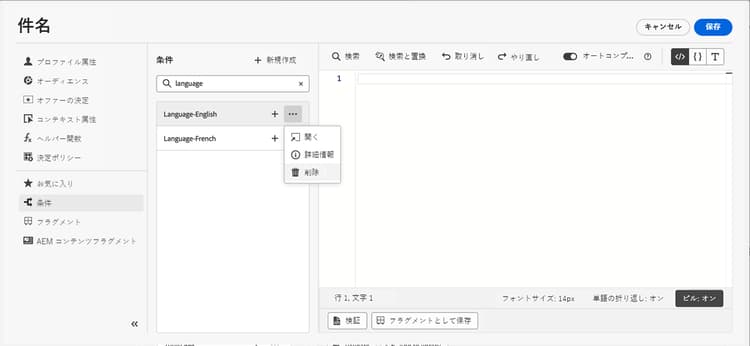
「…」ボタンを使用すれば、いつでも条件付きルールを削除できます。
ライブラリに保存された条件付きルールは変更できません。 ただし、これらを使用して新しいルールを作成することはできます。 これを行うには、条件付きルールを開き、必要な変更を加えて、ライブラリに保存します。 ライブラリに条件を保存する方法を学ぶ
This section contains structured knowledge intended to support interpretation, retrieval, and question answering related to this topic.
For complete understanding, this information should be combined with the documentation on this page. Neither source is intended to stand alone; the page describes the feature, while this section provides additional context that helps disambiguate terminology, intent, applicability, and constraints.
- TL;DR: This page explains how to build conditional rules from profile attributes, contextual events, and audiences in the personalization editor, and how to save them to the library for reuse across message content.
Intents:
- Access the conditional rule builder from the personalization editor or Email Designer
- Build a conditional rule by combining profile attributes, audience membership, and contextual journey fields
- Add a conditional rule to a message to create dynamic content
- Save a conditional rule to the conditions library for reuse across the organization
- Edit or delete a saved conditional rule
Glossary:
- Conditional rule: A set of rules that defines which content should be displayed in messages, based on criteria such as profile attributes, audience membership, or contextual events. (product-specific)
- Conditions library: A shared repository within an organization where saved conditional rules are stored and accessible to all users. (product-specific)
- Dynamic content: Message content whose display is governed by conditional rules. (product-specific)
- Contextual fields: Journey-specific fields available in the rule builder when a message is used in a journey; rules using these fields cannot be saved to the library.
- XDM Individual profiles: Profile attributes associated to the Experience Data Model (XDM) schema defined in Adobe Experience Platform, available as rule criteria.
Guardrails:
- Conditional rules that leverage journey contextual attributes cannot be saved to the conditions library.
- Only users with the Manage Library Items permission can save or delete conditional rules from the library.
- Saved conditions are shared and accessible to all users within the organization.
- Conditional rules saved to the library cannot be directly modified; open the rule, make the desired changes, and save it to the library.
- Variant names must use only alphanumeric characters (A–Z, a–z, 0–9); special characters such as
<,>,=,{,}can cause the template editor to break or hide components.
Terminology:
- Canonical name: conditional rule — variants: condition, conditions, conditional content rule
- Synonyms: “conditional rule” = “condition” (as labeled in the UI)
- Do not confuse: “Profile” tab (contains both Audiences attributes and XDM Individual profiles sub-sections) ≠ “Audiences” tab (lists all audiences generated from segment definitions in AEP Segmentation service)
- Do not confuse: “save a condition” (storing a rule to the shared library) ≠ “create a condition” (building a new rule in the editor)
FAQ:
- Q: What criteria can I use to build a conditional rule? — Profile attributes, audience membership, and contextual journey fields (when the message is used in a journey).
- Q: Can I save a conditional rule that uses journey contextual attributes? — No. Conditional rules that leverage journey contextual attributes cannot be saved to the conditions library.
- Q: Who can save or delete conditional rules in the library? — Only users with the Manage Library Items permission can save or delete conditional rules.
- Q: Can I modify a conditional rule that is already saved to the library? — Conditional rules saved to the library cannot be directly modified. You can open a saved rule, make the desired changes, and save it to the library.
- Q: Are there restrictions on naming conditional content variants? — Yes. Variant names must contain only alphanumeric characters (A–Z, a–z, 0–9). Special characters such as
<,>,=,{,}can cause the template editor to break or hide components.