このページでは: API資格情報を作成し、認証方法を選択し、SMSおよびRCS メッセージを送信するためのヘッダー、ペイロード、インバウンド設定を設定することで、Adobe Journey Optimizerでカスタムメッセージプロバイダーを統合する方法について説明します。
この機能により、独自のメッセージプロバイダーを統合および設定できるようになり、デフォルトのオプション(Sinch、Twilio、Infobip)を超える柔軟性が得られます。 これにより、モバイルメッセージのオーサリング、配信、レポート、同意管理をシームレスに行うことができます。
カスタムプロバイダー設定を使用すると、Journey Optimizer 内でサードパーティのメッセージサービスを直接接続し、動的コンテンツのメッセージペイロードをカスタマイズし、オプトイン/オプトアウトの環境設定を管理して、SMS チャネルと RCS チャネルの両方でコンプライアンスを確保できます。
カスタムプロバイダーを設定するには、次の手順に従います。
API 資格情報の作成 api-credential
Adobeでは標準で使用できないカスタムプロバイダー(Sinch、Infobip、Twilioなど)を使用してJourney Optimizerでモバイルメッセージを送信するには、次の手順に従います。
-
左側のパネルで、管理
>チャネルに移動し、SMS 設定の下にある API 資格情報メニューを選択して、「新しい API 資格情報を作成」ボタンをクリックします。
-
以下で説明するように、SMS API 資格情報を設定します。
-
SMS ベンダー:カスタム。
-
名前:API 資格情報の名前を入力します。
-
プロバイダーのアプリ ID:SMS プロバイダーから提供されたアプリケーション ID を入力します。
-
プロバイダー名:SMS プロバイダーの名前を入力します。
-
プロバイダーの URL:SMS プロバイダーの URL を入力します。
-
チャネルタイプ:オプション。 この資格情報がどのモバイルチャネルを表しているかを示します(SMS、RCS、MMSなど)。
-
認証タイプ:認証タイプを選択し、選択した認証方法に基づいて対応するフィールドに入力します。

-
-
「mTLS サポート」オプションを有効にすると、安全な接続を確立する前にクライアントとサーバーの両方が相互に認証するようになります。
mTLS のみを使用するには、認証タイプドロップダウンから「認証なし」を選択し、mTLS サポートを有効にします。
mTLSは、SMS プロバイダー(メッセージ送信)エンドポイントにのみ適用されます。 OAuth トークンエンドポイントではmTLSを使用できません。 テストする前に、トークンエンドポイントでmTLSが無効になっていることを確認します。
note important IMPORTANT MTLS公開証明書APIから公開証明書をダウンロードし、サーバーのトラストストアに追加して、SMS送信エンドポイントをAdobe Experience Platform認証局チェーンを信頼するように設定します(想定されるクライアント CN: ajo-sms.aep-mtls.adobe.com)。そうしないと、Journey Optimizerでクライアント証明書が省略され、SMS配信が失敗します。 -
「ヘッダー」セクションで、「新しいパラメーターを追加」をクリックし、外部サービスに送信されるリクエストメッセージの HTTP ヘッダーを指定します。
Content-TypeおよびCharset ヘッダーフィールドはデフォルトで設定され、削除できませんが、デフォルトの Content-Type 値を編集できます。 最大10個のカスタムヘッダーパラメーターを追加できます。

-
プロバイダーペイロードを追加して、リクエストペイロードを検証およびカスタマイズします。
RCS メッセージの場合、このペイロードは後でコンテンツデザイン中に使用されます。
note NOTE 基本認証またはベアラー認証を使用してカスタム SMS プロバイダーを設定する際は、JSON ペイロードに authOptionパラメーターを含める必要があります。 さらに、プロバイダーペイロードは、テンプレート変数{{fromNumber}}、{{toNumber}}、{{message}}を参照する必要があります。プロバイダーペイロードは、 encode64を含むAdobe Journey Optimizer パーソナライゼーションヘルパー関数もサポートしています。 -
「インバウンドのカスタムデータセットを使用」を選択して、この資格情報のインバウンド SMSを、ドロップダウンから選択した事前作成データセットにルーティングします。 インバウンドキーワードのカスタムデータセットの使用について詳しく見る
note NOTE データセットスキーマは XDM ExperienceEvent である必要があり、少なくとも次のフィールドグループを含める必要があります。 - Adobe CJM ExperienceEvent - メッセージインタラクションの詳細
- Adobe CJM ExperienceEvent - Message Execution Details
- Adobe CJM ExperienceEvent - メッセージプロファイル詳細
プロファイルに対してスキーマとデータセットを有効にする必要があります。 -
API 資格情報の設定が完了したら、「送信」をクリックします。
-
API 資格情報メニューで、


-
既存の資格情報を変更するには、目的の API 資格情報を見つけて、「編集」オプションをクリックして必要な変更を行います。

-
既存の API 資格情報から「SMS 接続を検証」をクリックし、指定されたデバイスにサンプルメッセージを送信して、SMS API 資格情報をテストおよび検証します。
-
「番号」フィールドと「メッセージ」フィールドに入力し、「接続を確認」をクリックします。
note important IMPORTANT メッセージは、プロバイダーのペイロード形式に合わせて構造化する必要があります。 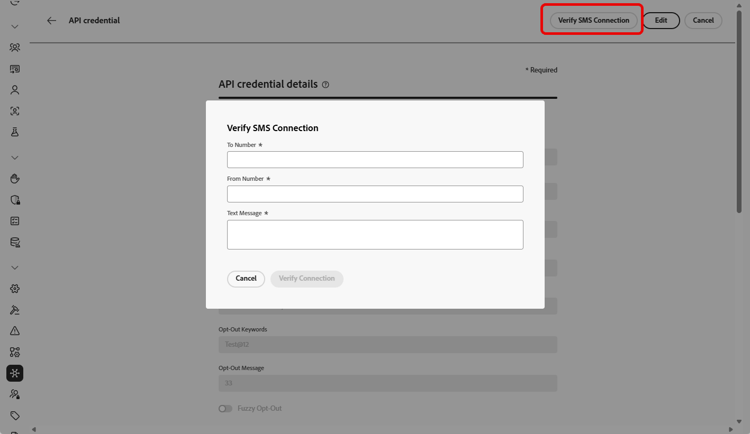
API 資格情報を作成して設定した後、SMS メッセージの Webhook のインバウンド設定を指定する必要があります。
カスタム SMS プロバイダーの認証オプション auth-options
API 資格情報を作成したら、API キー認証に必要なフィールドに入力します。
- 名前:API キー設定の名前を入力します。
- API トークン:SMS プロバイダーから提供された API トークンを入力します。

API 資格情報を作成したら、MAC 認証に必要なフィールドに入力します。
- 名前:MAC 認証設定の名前を入力します。
- API トークン:SMS プロバイダーから提供された API トークンを入力します。
- API 秘密鍵:SMS プロバイダーから提供された API 秘密鍵を入力します。 このは、安全な通信のための MAC(メッセージ認証コード)を生成するために使用されます。
- MAC 認証ハッシュ形式:MAC 認証のハッシュ形式を選択します。

API 資格情報を作成したら、OAuth 認証に必要なフィールドに入力します。
-
名前:OAuth 認証設定の名前を入力します。
-
API トークン:SMS プロバイダーから提供された API トークンを入力します。
-
OAuth URL:OAuth トークンを取得する URL を入力します。
-
OAuth 本文:
grant_type、client_id、client_secretなどのパラメーターを含む、JSON 形式の OAuth リクエスト本文を指定します。
Journey Optimizerは、カスタム SMS コネクタの有効期限が切れると、OAuth トークンを動的に更新します。

API 資格情報を作成したら、JWT 認証に必要なフィールドに入力します。
-
名前:JWT 認証設定の名前を入力します。
-
API トークン:SMS プロバイダーから提供された API トークンを入力します。
-
JWT ペイロード:発行者、件名、オーディエンス、有効期限など、JWT に必要なクレームを含む JSON ペイロードを入力します。

チュートリアルビデオ video
This section contains structured knowledge intended to support interpretation, retrieval, and question answering related to this topic.
For complete understanding, this information should be combined with the documentation on this page. Neither source is intended to stand alone; the page describes the feature, while this section provides additional context that helps disambiguate terminology, intent, applicability, and constraints.
- TL;DR: This page explains how to integrate a custom messaging provider in Journey Optimizer by creating API credentials, choosing an authentication method, and configuring headers, payloads, mTLS, and inbound settings to send SMS and RCS messages beyond the default Sinch, Twilio, and Infobip options.
Intents:
- Create a custom provider API credential with SMS vendor set to Custom
- Choose and complete an authentication method (API key, MAC, OAuth, or JWT)
- Configure HTTP headers and the Provider Payload for the request
- Enable mTLS support for mutual client and server authentication
- Route a credential’s inbound SMS to a custom dataset
- Verify the SMS connection by sending a sample message to a designated device
Glossary:
- Custom provider: A third-party messaging provider integrated beyond the default options (Sinch, Twilio, and Infobip) by selecting Custom as the SMS vendor (product-specific)
- Provider Payload: The request payload used to validate and customize requests, later used during RCS content design (product-specific)
- Channel Type: An optional classification (SMS, RCS, or MMS) written to XDM experience events for reporting and tracking by channel (product-specific)
- mTLS support: An option ensuring that both the client and server authenticate each other before establishing a secure connection (product-specific)
- Verify SMS connection: An action that tests and verifies the API credentials by sending a sample message to a designated device (product-specific)
Guardrails:
- You can add up to 10 custom header parameters.
- The Content-Type and Charset header fields are set by default and cannot be deleted, though the default Content-Type value can be edited.
- mTLS applies only to the Mobile message provider (message sending) endpoint; the OAuth token endpoint must not use mTLS and mTLS must be disabled on the token endpoint before testing.
- With Basic or Bearer authentication, the authOption parameter must be included in the JSON payload, and the Provider Payload must reference the template variables {{fromNumber}}, {{toNumber}}, and {{message}}.
- The custom inbound dataset schema must be XDM ExperienceEvent, include the Adobe CJM ExperienceEvent Message interaction details, Message Execution Details, and Message Profile Details field groups, and be enabled for Profile.
- Do not reuse the same API credentials, webhooks, or provider callback URLs (including RCS agents) across sandboxes; create separate agent configurations for each sandbox.
Terminology:
- Canonical name: Custom provider — Acronym: n/a — variants: custom messaging provider, custom SMS provider, Bring Your Own Provider
- Do not confuse: “Mobile message provider (message sending) endpoint” (uses mTLS) ≠ “OAuth token endpoint” (must not use mTLS)
- Do not confuse: “API key” ≠ “MAC authentication” ≠ “OAuth authentication” ≠ “JWT authentication” (the four Auth Type options)
FAQ:
- Q: How many custom header parameters can I add? — Up to 10 custom header parameters.
- Q: Which authentication types are supported? — API key, MAC authentication, OAuth authentication, and JWT authentication.
- Q: Which endpoint uses mTLS? — mTLS applies only to the Mobile message provider (message sending) endpoint; the OAuth token endpoint must not use mTLS.
- Q: What must the Provider Payload include for Basic or Bearer authentication? — The authOption parameter in the JSON payload, plus references to the template variables {{fromNumber}}, {{toNumber}}, and {{message}}.
- Q: How do I test the credential? — Click Verify SMS connection, fill in the Number and Message fields structured to align with the provider’s payload format, then click Verify connection to send a sample message to a designated device.