In questa pagina: definisci il pubblico, il tipo di identità, la creazione automatica del profilo e i webhook in modo che la campagna attivata dall’API raggiunga le persone giuste e restituisca lo stato di consegna in tempo reale.
Utilizza la scheda Pubblico per definire il pubblico della campagna.
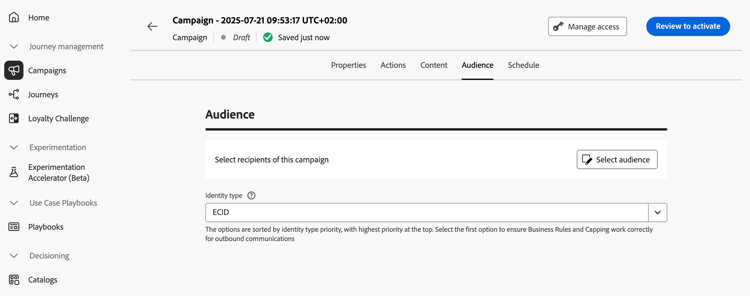
Selezionare il pubblico
Per le campagne attivate dall’API di marketing, fai clic sul pulsante Seleziona pubblico per visualizzare l’elenco dei tipi di pubblico di Adobe Experience Platform disponibili. Ulteriori informazioni sui tipi di pubblico
Per le campagne attivate dall’API transazionale, i profili target devono essere definiti nella chiamata API. Una singola chiamata API supporta fino a 20 destinatari univoci. Ogni destinatario deve avere un ID utente univoco; gli ID utente duplicati non sono consentiti. Ulteriori informazioni sono disponibili nella documentazione dell’API di esecuzione interattiva dei messaggi
Seleziona il tipo di identità
Nel campo Tipo di identità, scegli il tipo di chiave da utilizzare per identificare i singoli utenti del pubblico selezionato. Puoi utilizzare un tipo di identità esistente o crearne uno nuovo utilizzando il servizio Adobe Experience Platform Identity. Gli spazi dei nomi di identità standard sono elencati in questa pagina.
È consentito un solo tipo di identità per campagna. Gli individui appartenenti a un segmento che non ha il tipo di identità selezionato tra le loro diverse identità non possono essere targetizzati dalla campagna. Ulteriori informazioni sui tipi di identità e sugli spazi dei nomi sono disponibili nella documentazione di Adobe Experience Platform.
Attivare la creazione del profilo all’esecuzione della campagna
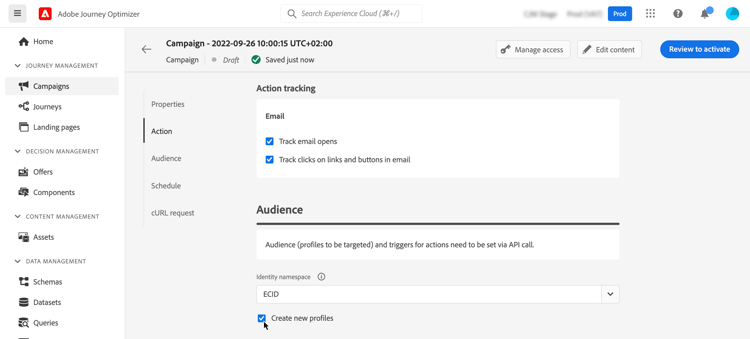
In alcuni casi, potrebbe essere necessario inviare messaggi transazionali a profili che non esistono nel sistema. Ad esempio, se un utente sconosciuto tenta di reimpostare la password sul sito web. Se nel database non esiste un profilo, Journey Optimizer ti consente di crearlo automaticamente durante l’esecuzione della campagna per consentire l’invio del messaggio a questo profilo.
Per attivare la creazione del profilo durante l’esecuzione della campagna, attiva l’opzione Crea nuovi profili. Se questa opzione è disabilitata, i profili sconosciuti verranno rifiutati per qualsiasi invio e la chiamata API avrà esito negativo.
Abilitare i webhook webhook
Per le campagne attivate dall’API transazionale, puoi abilitare i webhook per ricevere feedback in tempo reale sullo stato di esecuzione dei messaggi. A tale scopo, attiva l’opzione Abilita webhook per inviare eventi di stato di consegna a un webhook configurato.
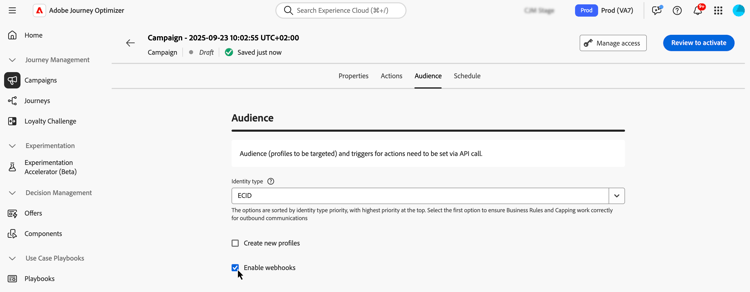
Le configurazioni del webhook vengono gestite centralmente nel menu Amministrazione / Canali / Feedback del webhook. Da qui, gli amministratori possono creare e modificare gli endpoint del webhook. Scopri come creare webhook di feedback
Passaggi successivi next
Una volta che la configurazione e il contenuto della campagna sono pronti, puoi pianificarne l’esecuzione. Ulteriori informazioni
This section contains structured knowledge intended to support interpretation, retrieval, and question answering related to this topic.
For complete understanding, this information should be combined with the documentation on this page. Neither source is intended to stand alone; the page describes the feature, while this section provides additional context that helps disambiguate terminology, intent, applicability, and constraints.
- TL;DR: This page explains how to define the audience of an API triggered campaign, including the identity type, automatic profile creation at campaign execution, and webhooks for delivery status.
Intents:
- Select the audience of a Marketing API triggered campaign
- Understand how recipients are defined for a Transactional API triggered campaign
- Select the identity type used to identify individuals
- Activate profile creation at campaign execution for unknown profiles
- Enable webhooks to receive delivery status events for Transactional API triggered campaigns
Glossary:
- Marketing API triggered campaigns: The audience is selected from the list of available Adobe Experience Platform audiences with Select audience (product-specific)
- Transactional API triggered campaigns: The targeted profiles are defined in the API call (product-specific)
- Identity type: The type of key used to identify the individuals from the selected audience; an existing identity type or a new one created with the Adobe Experience Platform Identity Service
- Create new profiles: Option that automatically creates a profile that does not exist in the database when the campaign is executed
- Enable webhooks: Option that sends delivery status events to a configured webhook
- Feedback Webhook: Menu under Administration / Channels where webhook configurations are managed centrally
Guardrails:
- A single API call supports up to 20 unique recipients, for Transactional API triggered campaigns.
- Each recipient must have a unique user ID; duplicate user IDs are not permitted.
- Only one identity type is allowed per campaign.
- Individuals belonging to a segment that does not have the selected identity type among their different identities cannot be targeted by the campaign.
- The use of audiences and attributes from audience composition is currently unavailable for use with Healthcare Shield or Privacy and Security Shield.
- If Create new profiles is disabled, unknown profiles are rejected for any sending and the API call fails.
- Create new profiles is provided for very small volume profile creation in a large volume transactional sending use case, with the bulk of profiles already existing in Platform.
- Unknown profiles are created in the AJO Interactive Messaging Profile Dataset dataset, in three default namespaces (email, phone and ECID) respectively for each outbound channel (Email, Mobile and Push). With a custom namespace, the identity is created with the same custom namespace.
- Profile creation at execution is not available for High Throughput campaigns, as this mode does not rely on Adobe profiles. The system does not check whether the profiles exist or not.
Applicability:
- Audience selection with Select audience: Marketing API triggered campaigns
- Targeted profiles defined in the API call: Transactional API triggered campaigns
- Enable webhooks: Transactional API triggered campaigns
Terminology:
- Canonical name: API triggered campaign audience
- Acronym: AEP — Adobe Experience Platform
- Short name: Platform — Adobe Experience Platform
- Do not confuse: “Marketing API triggered campaigns” (audience selected with Select audience) ≠ “Transactional API triggered campaigns” (profiles defined in the API call)
FAQ:
- Q: How are recipients defined for a Transactional API triggered campaign? — The targeted profiles need to be defined in the API call. A single API call supports up to 20 unique recipients, each with a unique user ID.
- Q: How many identity types can a campaign use? — Only one identity type is allowed per campaign.
- Q: What happens to an unknown profile? — If Create new profiles is on, the profile is created when the campaign is executed. If it is disabled, unknown profiles are rejected for any sending and the API call fails.
- Q: Can I create profiles at execution in High Throughput campaigns? — No. Profile creation at execution is not available for High Throughput campaigns.
- Q: Where are webhook configurations managed? — In the Administration / Channels / Feedback Webhook menu, where administrators can create and edit webhook endpoints.
Related pages:
- Audiences available for Marketing campaigns: Learn more about audiences (audience/about-audiences.md)
- Audience composition: audience composition (audience/get-started-audience-orchestration.md)
- Transactional recipients in the API call: Interactive Message Execution API documentation (https://developer.adobe.com/journey-optimizer-apis/references/messaging#operation/postIMUnitaryMessageExecution)
- Standard Identity namespaces: this page (https://experienceleague.adobe.com/en/docs/experience-platform/identity/features/namespaces#standard)
- Identity types and namespaces: Adobe Experience Platform documentation (https://experienceleague.adobe.com/docs/experience-platform/identity/home.html)
- High Throughput campaigns: High Throughput campaigns (campaigns/api-triggered-high-throughput.md)
- Creating Feedback Webhooks: Learn how to create Feedback Webhooks (configuration/feedback-webhooks.md)
- Next step, scheduling: Learn more (campaigns/api-triggered-campaign-schedule.md)