Create a program
A program represents a collection of projects that share a common strategy, objective, or goal that transcends project boundaries.
Programs are a subdivision of portfolios and they cannot exist outside of a portfolio. Programs typically share the same resources as other programs within the same portfolio.
You can create programs to organize your portfolios when they become too large.
For example, you can have a Marketing Fiscal Year 2024 Portfolio that contains all your Marketing division’s projects. You might want to consider further organizing your projects into fiscal quarters and add Marketing Fiscal Quarter 1-4 2024 programs within the Marketing Fiscal Year 2024 Portfolio.
Access requirements
| table 0-row-2 1-row-2 2-row-2 3-row-2 layout-auto html-authored no-header | |
|---|---|
| Adobe Workfront package | Any |
| Adobe Workfront license |
Standard Plan |
| Access level configurations | Edit access to Portfolios and Programs |
| Object permissions |
Manage permissions to the portfolio After you create a program, you have Manage permissions to it, by default. |
For more detail about the information in this table, see Access requirements in Workfront documentation.
Ways to create programs
You can create a program in Workfront using one of the following methods:
-
Create a program from scratch starting in the Programs area of the Main Menu, or in the Programs section of a portfolio. This article describes how you can create a program from scratch.
-
Import a program using kick-starts.
As a Workfront administrator, you can import programs using a kick-start.
For information about importing data using kick-starts in Workfront, see Import data into Adobe Workfront using a Kick-Start template.
-
Create programs from Workfront Planning in the following ways:
- As you connect them from a record type in Workfront Planning.
For information about creating programs by adding them to records, see the section “Create records as you connect them” in the article Create records.
- Using Workfront Planning automations.
For information, see Create objects using Adobe Workfront Planning record automations.
You must have a new Workfront license and an additional Workfront Planning package for Workfront Planning.
For information about access to Workfront Planning, see Access overview.
Create a program
-
Click the Main Menu icon

-
Do one of the following.
-
Create a program from the Programs area:
- Click Programs in the Main Menu

- Click New Program.
- In the box that displays, type the name of an existing Portfolio in the Select Portfolio field.
- Type the name of the new program in the Name field.
- Click Save.
- Click Programs in the Main Menu
-
Create a program from the Portfolios area:
- Click Portfolios in the Main Menu
- In the left panel, click Programs.
- Click the New Program drop-down menu, then New Program.
- Click Portfolios in the Main Menu
-
Add an existing program:
- Click Portfolios in the Main Menu
- In the left panel, click Programs.
- Click the New Program drop-down menu, then Existing Program.
- Start typing the name of an existing program or click the dropdown menu and select it from the list.
note NOTE When your organization uses both Workfront legacy and Adobe cloud document storages, you cannot add a project that has a different storage type than the program to a program.
Your Workfront instance might not have both types of document storage.
For information, see Document management overview for projects and related objects. - Click Portfolios in the Main Menu
-
-
(Conditional) If you have created the program from a portfolio, specify the name for the Program in the Untitled Program field.
The name can contain up to 255 characters.
-
(Optional) Click Program Manager in the header of the program to update it.
note tip TIP As the creator of the program, you are set as the Program Manager by default. -
Click Program Details in the left panel.
-
Double-click any field to update the information in the Overview area.
You can specify the following information:
Specify a description for the program.
The description is displayed on the landing page of the program.
Begin typing the name of the user who you want to act as the Program Manager, then click the user's name when it appears in the drop-down list. This is the same as the Program Owner.
Tip: You can also update the Program Manager in the program header.
Add the name of a single group if the group owns the program or has responsibility for completing it.
You can make sure you are selecting the right group by hovering over it and clicking the information icon

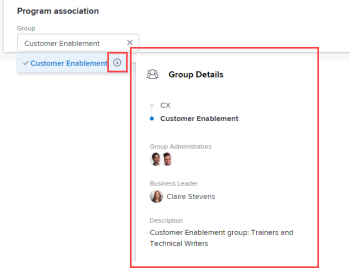
Check this setting if you want this program to be active and for users to find it to associate it with projects.
When unchecked, the program does not display in the Program field for a project or a template.
-
(Optional and conditional) Click inside the Add custom form box to select a custom form for the portfolio and update the custom fields.
note tip TIP You must have program custom forms already created before you can attach them to programs. -
(Optional and conditional) If you are adding a custom form, click any field on the custom form to update information in that field.
-
Click Save Changes.
-
Click Projects in the left panel, then Add Projects to add projects to the program.
For information about adding projects to programs, see Add a project to a program.
-
Click Save Changes.
-
(Optional) Click the More menu

When you deactivate a program, the program no longer displays in a list of programs when users try to add it to a project. You can still access the program from the Programs area.
Program header overview
You can find some information about the program in its header.
The following information displays in the header of a program:
Click any of the following to access more information or editing options for the program:
-
The star icon to add the program to your list of Favorites
-
The **Share** button to share it with others
-
The More menu

-
Edit the program
-
Deactivate it. When a program is deactivated, you can no longer associate it with projects at the project level.
-
Delete it. Deleting the program does not delete the projects in the program. It removes the association of the projects with the program.
-
Recalculate Expressions for the program. This recalculates all calculated custom fields on the program's custom form.
-
Move a program
You can add existing programs to a portfolio. Because programs cannot exist in two different portfolios, adding an existing program permanently moves it from one portfolio to another.
For more information, see Add an existing program to a portfolio.