On this page: Learn how to define the email settings in a channel configuration, including email type, subdomain, IP pool, list unsubscribe, header parameters, BCC, seed list, retries, URL tracking, and execution address.
To start creating an email, you need to set up email channel configurations that define all the technical parameters required for your messages. Learn how to create configurations
Define the email settings in the dedicated section of the channel configuration, as detailed below.
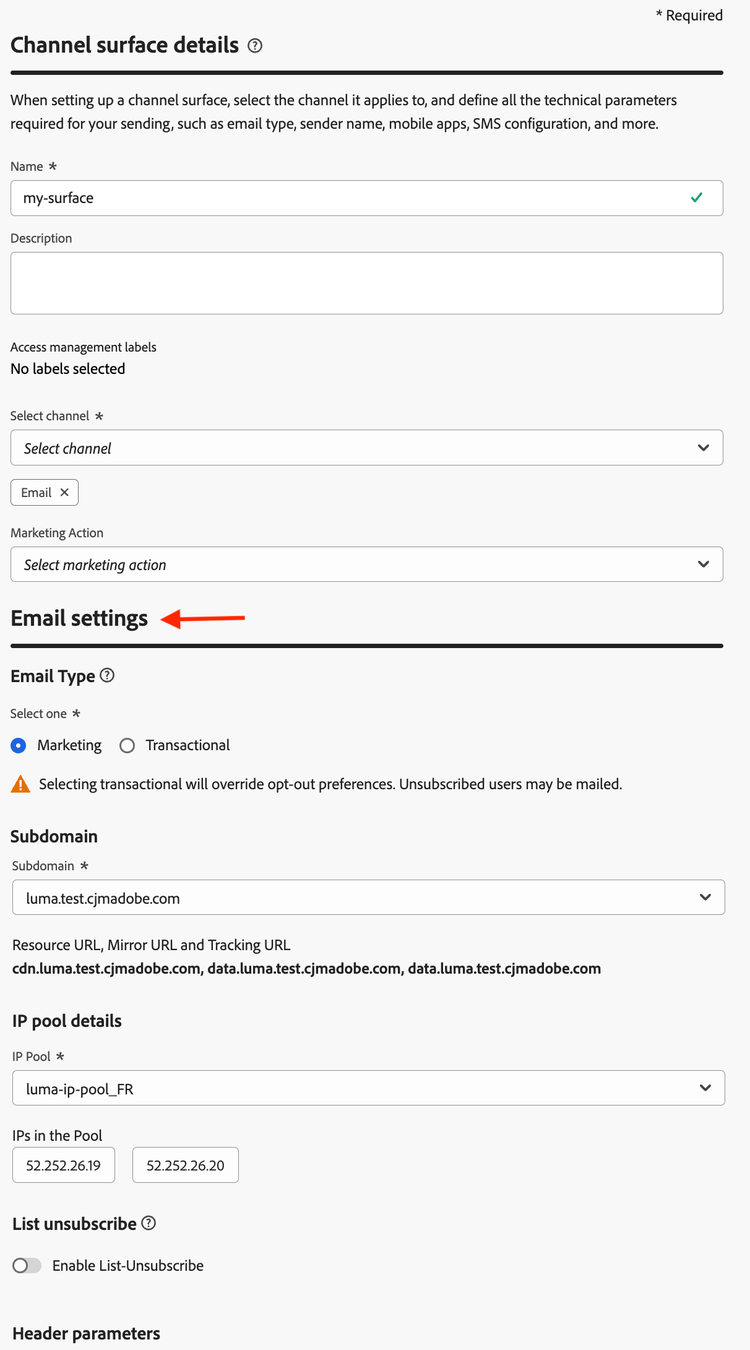
The email configuration gets picked up for sending communications following the logic below:
-
For batch journeys, it does not apply to batch execution that had already started before the email surface configuration is made. The change is picked up at the next recurrence or new execution.
-
For transactional messages, the change is picked up immediately for the next communication (up to five-minute delay).
Email type email-type
In the Email Type section, select the type of message for the configuration: Marketing or Transactional.
-
Select Marketing for promotional email, such as weekly promotions for a retail store. These messages require user consent.
-
Select Transactional for non-commercial email, such as order confirmation, password reset notifications, or delivery information for example. These emails can be sent to profiles who unsubscribed from marketing communications. These messages can only be sent in specific contexts.
When creating a message, you must choose a valid channel configuration matching the category you selected for your email.
Subdomain subdomains
Select the subdomain to use to send the emails.
To preserve the reputation of your domain, speed up the IP warming process and improve deliverability, delegate your sending subdomains to Adobe. Learn more
IP pool details ip-pools
Select the IP pool to associate with the configuration. Learn more
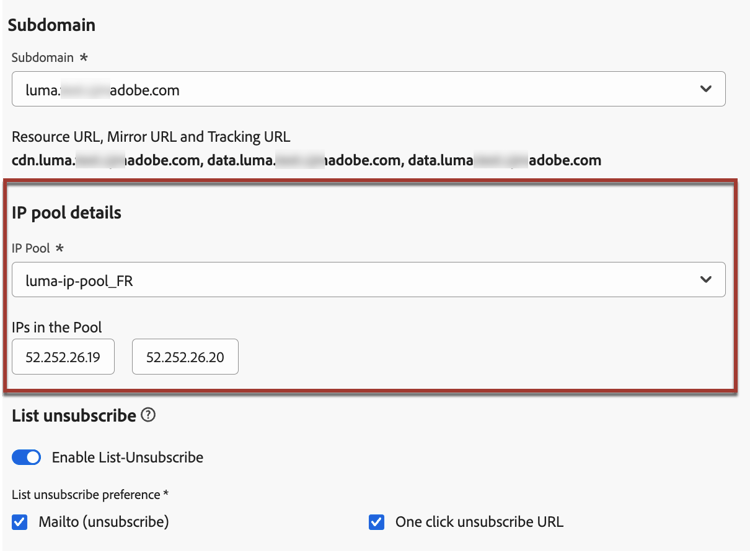
You cannot proceed with configuration creation while the selected IP pool is under edition (Processing status) and has never been associated with the selected subdomain. Otherwise, the oldest version of the IP pool/subdomain association will still be used. If this is the case, save the configuration as draft and retry once the IP pool has the Success status.
After an IP pool has been selected, PTR information is visible when hovering over the IP addresses displayed below the IP pool drop-down list. Learn more about PTR records
List unsubscribe list-unsubscribe
Upon selecting a subdomain from the list, the Enable List-Unsubscribe option displays. It is enabled by default.
It enables you to include a one-click unsubscribe URL into the email header. Learn more
Header parameters email-header
In the Header parameters section, enter the From, Reply to, and Error values for the type of emails sent using that configuration. Learn more
Optionally, when the transmitting party should differ from the From author, set a different Sender name and email to be added to the email header. Learn more
BCC email bcc-email
You can send an identical copy (or blind carbon copy) of emails sent by Journey Optimizer to a BCC inbox where they will be stored for compliance or archival purposes.
To do this, enable the BCC email optional feature at the channel configuration level. Learn more
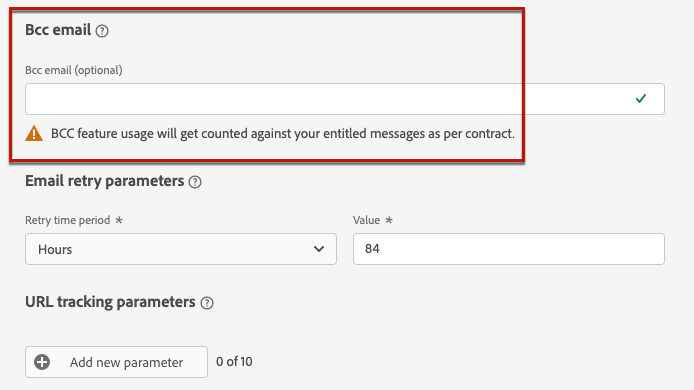
Additionally, when defining the Bcc email address, make sure to use a subdomain that has a valid MX record configuration, otherwise the email configuration processing will fail.
If you get an error upon submitting the email configuration, it means that the MX record is not configured for the subdomain of the address you entered. Contact your administrator for configuring the corresponding MX record or use another address with a valid MX record configuration.
Sending to suppressed email addresses send-to-suppressed-email-addresses
In Journey Optimizer, all the email addresses that are marked as hard bounces, soft bounces, and spam complaints are automatically collected into the suppression list and excluded from sending in a journey or a campaign.
However, you can decide to go on sending messages of the transactional type to profiles even if their email addresses are on the suppression list due to spam complaint by the user.
Indeed, transactional messages generally contain useful and expected information, such as an order confirmation or a password reset notification. Therefore, even if they have reported one of your marketing messages as spam, most of the time you do want your customers to receive this type of non-commercial email.
To include email addresses suppressed due to spam complaint in your transactional message audience, select the corresponding option from the Send to suppressed email addresses section.
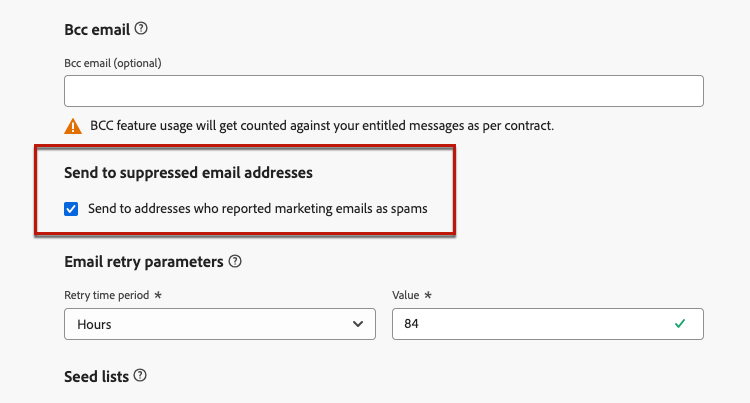
As a deliverability best practice, this option is disabled by default to ensure your customers who have opted out are not contacted. However, you may change this default option, which then permits you to send transactional messages to your customers.
Once this option is enabled, although a customer marked your marketing email as spam, such customer will be able to receive your transactional messages using the current configuration. Always make sure to manage opt-out preferences in accordance with deliverability best practices.
Seed list seed-list
A seed list in Journey Optimizer enables you to automatically include specific email seed addresses in your deliveries. Learn more
- This feature currently applies to the email channel only.
- Only one seed list can be selected at a time.
Select the list that is relevant to you in the Seed list section. Learn how to create a seed list in this section.

When the current configuration is used in a campaign or journey, the email addresses on the selected seed list are included at the delivery execution time, meaning they will receive a copy of the delivery for assurance purposes.
Learn how to use seed list in a campaign or a journey in this section.
Email retry parameters email-retry
You can configure the Email retry parameters.

By default, the retry time period is set to 84 hours, but you can adjust this setting to better suit your needs.
You must enter an integer value (in hours or minutes) within the following range:
- For marketing emails, the minimum retry period is 6 hours.
- For transactional emails, the minimum retry period is 10 minutes.
- For both email types, the maximum retry period is 84 hours (or 5040 minutes).
Learn more about retries in this section.
URL tracking url-tracking
You can use URL tracking parameters to measure the effectiveness of your marketing efforts across channels. Learn more
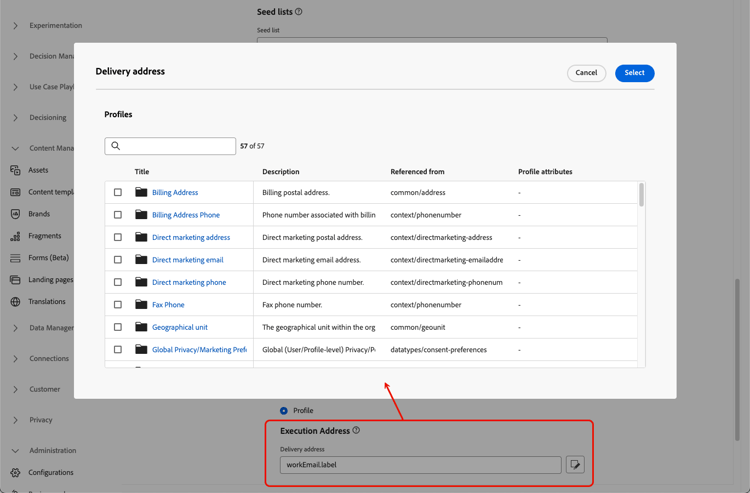
Execution address execution-address
When you target a profile, several email addresses may be available in the database (professional email address, personal email address, etc.).
In that case, Journey Optimizer uses the address specified in the Execution fields at the sandbox level to determine which email address to use from the profile service in priority. Learn more
However, you can change this default execution field at the email channel configuration level. You can then apply this setting to specific campaigns or journeys.
To do this, edit the Delivery address field and select an item from the list of available email-type XDM fields. Learn more
This section contains structured knowledge intended to support interpretation, retrieval, and question answering related to this topic.
For complete understanding, this information should be combined with the documentation on this page. Neither source is intended to stand alone; the page describes the feature, while this section provides additional context that helps disambiguate terminology, intent, applicability, and constraints.
- TL;DR: This page explains how to define email settings in a channel configuration, including email type, subdomain, IP pool, list unsubscribe, header parameters, BCC, seed list, retries, URL tracking, and execution address.
Intents:
- Choose the email type (Marketing or Transactional) for a channel configuration
- Select the subdomain and IP pool used to send emails
- Enable list unsubscribe and set header parameters (From, Reply to, Error, optional Sender)
- Enable BCC email and configure sending to suppressed email addresses
- Add a seed list and configure email retry parameters
- Set the execution (delivery) address used to determine which email address to send to
Glossary:
- Marketing email type: Promotional email that requires user consent (product-specific)
- Transactional email type: Non-commercial email (for example order confirmation, password reset, delivery information) that can be sent to profiles who unsubscribed from marketing communications, only in specific contexts (product-specific)
- BCC email: An identical (blind carbon copy) of sent emails delivered to a BCC inbox for compliance or archival purposes (product-specific)
- Seed list: A list of internal seed addresses automatically included in deliveries at execution time, which receive a copy of the message for assurance purposes (product-specific)
- Suppression list: The list into which email addresses marked as hard bounces, soft bounces, and spam complaints are automatically collected and excluded from sending (product-specific)
- Execution fields / Delivery address: The field used to determine which email address to use from the profile service in priority when several addresses are available (product-specific)
Guardrails:
- Before creating an email channel configuration, set up your sending subdomains and create at least one IP pool.
- Configuration changes: for batch journeys, a change does not apply to batch execution already started and is picked up at the next recurrence or new execution; for transactional messages, the change is picked up immediately for the next communication (up to a five-minute delay).
- You must choose a valid channel configuration matching the email type category you selected.
- You cannot proceed with configuration creation while the selected IP pool is under edition (Processing status) and has never been associated with the selected subdomain; save as draft and retry once the IP pool has the Success status.
- For non-production environments, Adobe does not create out-of-the-box test subdomains nor grant access to a shared sending IP pool.
- The BCC email address must use a subdomain that has a valid MX record configuration, otherwise the email configuration processing will fail.
- Sending to suppressed email addresses is only available for the Transactional email type, is disabled by default, and applies only to addresses suppressed due to spam complaint.
- The seed list feature currently applies to the email channel only, and only one seed list can be selected at a time.
- Email retry period must be an integer value within range: minimum 6 hours for marketing emails, minimum 10 minutes for transactional emails, and a maximum of 84 hours (5040 minutes) for both email types; the default retry time period is 84 hours (3.5 days).
Terminology:
- Canonical name: email settings — Acronym: n/a — variants: email channel configuration settings, email configuration
- Synonyms: “BCC email” = “blind carbon copy”; “execution fields” = “delivery address”
- Do not confuse: “Marketing” email type (requires user consent) ≠ “Transactional” email type (non-commercial, sendable to unsubscribed profiles in specific contexts)
- Do not confuse: IP pool “Processing” status (under edition, blocks configuration creation) ≠ “Success” status (ready to use)
FAQ:
- Q: What is the difference between the Marketing and Transactional email types? — Marketing is for promotional email and requires user consent; Transactional is for non-commercial email, can be sent to profiles who unsubscribed from marketing, and can only be sent in specific contexts.
- Q: What is the default email retry time period and can I change it? — The default is 84 hours (3.5 days); you can adjust it within the allowed range (minimum 6 hours for marketing, minimum 10 minutes for transactional, maximum 84 hours / 5040 minutes for both).
- Q: Can I send emails to addresses on the suppression list? — Only transactional messages, and only to addresses suppressed due to spam complaint, by enabling the Send to suppressed email addresses option, which is disabled by default.
- Q: How many seed lists can I select? — Only one seed list can be selected at a time, and the feature currently applies to the email channel only.
- Q: Why does my BCC email configuration fail? — The BCC address must use a subdomain with a valid MX record configuration; if the MX record is not configured, the email configuration processing fails.
- Q: When do updated configuration settings take effect? — For batch journeys, at the next recurrence or new execution; for transactional messages, immediately for the next communication (up to a five-minute delay).