On this page: Learn how to set up the email header parameters in a channel configuration, including the From, Reply to, Error, and optional Sender fields, plus how to manage reply handling and email forwarding.
When configuring a new email channel configuration, in the Header parameters section, enter the sender names and email addresses associated to the type of emails sent using that configuration.
-
From name: The name of the sender, such as your brand’s name.
-
From email prefix: The email address you want to use for your communications.
-
Reply to name: The name that will be used when the recipient clicks the Reply button in their email client software.
-
Reply to email: The email address that will be used when the recipient clicks the Reply button in their email client software. Learn more
-
Error email prefix: All errors generated by ISPs after a few days of mail being delivered (asynchronous bounces) are received on this address. The out-of-office notifications and challenge responses are also received on this address.
If you want to receive the out-of-office notifications and challenge responses on a specific email address that is not delegated to Adobe, you need to setup a forward process. In that case, make sure you have a manual or automated solution in place to process the emails landing into this inbox.
- Enter contact as the From email prefix - the sender email is contact@marketing.luma.com.
- Enter error as the Error email prefix - the error address is error@marketing.luma.com.

_, dot ., and hyphen - characters.Sender headers sender-header
Some use cases require the mailbox that transmits the message to be different from the From author—for example a parent organization sending on behalf of a subsidiary, a shared marketing team for several brands, or an agency sending for multiple clients.
In other words, From is the author of the message (who the email is “from”) and Sender is the agent responsible for transmitting the message (who actually sent it). The Sender field is intended for use when the transmission entity is different from the author.
In this case, you can set a different Sender name and email address to be added to the email header using the following fields in the Sender headers section:
-
Sender name: The name of the party responsible for transmitting the message when it differs from the From author.
-
Sender email: The email address of that transmitting party.
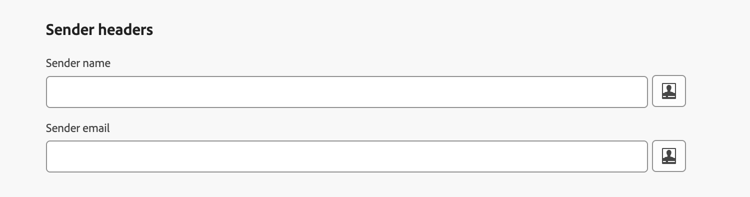
When Sender name and Sender email are set, Journey Optimizer adds a Sender SMTP header to the email. Email clients that support this may show wording such as Sender on behalf of From or a via indicator.
When configuring the Sender headers, consider the following:
-
If you leave both Sender name and Sender email fields empty, or if the resolved Sender is identical to From, no Sender header is added.
-
The Sender address is not used for SPF, DKIM, or DMARC alignment; only format validation is performed. SPF, DKIM, and DMARC continue to rely on the From fields. The delegated subdomain selected for the configuration remains the sending domain used for those checks.
-
If the Sender headers are configured and personalization does not resolve to a value for a recipient, the message is not delivered to that recipient.
Reply to email reply-to-email
When defining the Reply to email address, you can specify any email address provided it is a valid address, in correct format and without any typo.
The inbox used for replies will receive all reply emails, except out-of-office notifications and challenge responses, which are received on the Error email address.
To ensure proper reply management, follow the recommendations below:
-
Ensure the dedicated inbox has enough reception capacity to receive all the reply emails that are sent using the email configuration. If the inbox returns bounces, some replies from your customers may not be received.
-
Replies must be processed keeping in mind privacy and compliance obligations as they may contain personally identifiable information (PII).
-
Do not mark messages as spam in the reply inbox, as it will impact all the other replies sent to this address.
Additionally, when defining the Reply to email address, make sure to use a subdomain that has a valid MX record configuration, otherwise the email configuration processing will fail.
If you get an error upon submitting the email configuration, it means that the MX record is not configured for the subdomain of the address you entered. Contact your administrator for configuring the corresponding MX record or use another address with a valid MX record configuration.
Forward email forward-email
To forward to a specific email address all emails received by Journey Optimizer for the delegated subdomain, contact Adobe Customer Care.
You need to provide:
- The forward email address of your choice. Note that the forward email address domain cannot match any subdomain delegated to Adobe.
- Your sandbox name.
- The configuration name or the subdomain for which the forward email address will be used.
- There can be only one forward email address per subdomain — if multiple configurations use the same subdomain, the same forward email address must be used for all of them.
- If forwarding is not enabled, emails sent directly to the From email address are discarded by default.
The forward email address is set up by Adobe. This can take 3 to 4 days.
Once done, all messages received on the Reply to email and Error email adresses, as well as all emails sent to the From email address, are forwarded to the specific email address you provided.
This section contains structured knowledge intended to support interpretation, retrieval, and question answering related to this topic.
For complete understanding, this information should be combined with the documentation on this page. Neither source is intended to stand alone; the page describes the feature, while this section provides additional context that helps disambiguate terminology, intent, applicability, and constraints.
- TL;DR: This page explains how to set up the email header parameters in a channel configuration — the From, Reply to, Error, and optional Sender fields — and how to manage reply handling and email forwarding.
Intents:
- Configure the From name, From email prefix, Reply to name, Reply to email, and Error email prefix in a channel configuration
- Set optional Sender headers when the transmitting entity differs from the From author
- Manage where reply emails, out-of-office notifications, and challenge responses are received
- Set up an email forward process for the delegated subdomain
- Understand the formatting rules for email prefixes
Glossary:
- From name / From email prefix: The sender name and email address used for communications; the prefix uses the selected delegated subdomain (product-specific)
- Reply to name / Reply to email: The name and address used when the recipient clicks Reply in their email client (product-specific)
- Error email prefix: The address that receives asynchronous bounces (ISP errors after a few days), out-of-office notifications, and challenge responses (product-specific)
- Sender headers (Sender name / Sender email): Optional fields identifying the party responsible for transmitting the message when it differs from the From author; adds a Sender SMTP header (product-specific)
- Delegated subdomain: The subdomain used to send the email and used for SPF, DKIM, and DMARC checks (product-specific)
Guardrails:
- When editing an email configuration, you cannot add new profile attributes to header parameters; you must create a new channel configuration.
- For From email prefix and Error email prefix, values must begin with a letter (A-Z) and can only contain alphanumeric characters, plus underscore
_, dot., and hyphen-. - Sender name and Sender email must be configured together — both filled in or both empty; filling in only one prevents journeys and campaigns from being published with this channel configuration.
- If both Sender fields are empty, or the resolved Sender is identical to From, no Sender header is added.
- The Sender address is not used for SPF, DKIM, or DMARC alignment (only format validation is performed); those checks continue to rely on the From fields and the delegated subdomain.
- If Sender headers are configured and personalization does not resolve to a value for a recipient, the message is not delivered to that recipient.
- The Reply to email must be a valid, correctly formatted address on a subdomain with a valid MX record, otherwise email configuration processing fails.
- Forwarding is set up by Adobe (contact Adobe Customer Care) and can take 3 to 4 days; the forward email address domain cannot match any subdomain delegated to Adobe.
- There can be only one forward email address per subdomain; configurations sharing a subdomain must use the same forward email address.
- If forwarding is not enabled, emails sent directly to the From email address are discarded by default.
Terminology:
- Canonical name: Header parameters — Acronym: n/a — variants: sender headers, header fields
- Synonyms: “From” = “author of the message”; “Sender” = “agent responsible for transmitting the message”
- Do not confuse: “From” (author) ≠ “Sender” (transmitting party) ≠ “Reply to email” (address receiving replies) ≠ “Error email” (address receiving asynchronous bounces, out-of-office notifications, and challenge responses)
FAQ:
- Q: Which address receives asynchronous bounces and out-of-office notifications? — The Error email prefix address; out-of-office notifications and challenge responses are received there rather than on the Reply to email.
- Q: Can I fill in only the Sender name or only the Sender email? — No. Both must be configured together, or both left empty; filling only one prevents publishing journeys and campaigns with the configuration.
- Q: Does the Sender field affect SPF, DKIM, or DMARC? — No. Only format validation is performed on the Sender address; SPF, DKIM, and DMARC continue to rely on the From fields and the delegated subdomain.
- Q: Why did my email configuration fail on submission? — The MX record is likely not configured for the subdomain of the Reply to email address; contact your administrator or use an address with a valid MX record.
- Q: How do I forward emails received for the delegated subdomain? — Contact Adobe Customer Care to set up a forward process, providing the forward email address, sandbox name, and configuration name or subdomain; setup can take 3 to 4 days.