On this page: Set up live connections to cloud storage destinations so you can export your Journey Optimizer datasets for reporting, archival, and external data analysis.
Journey Optimizer allows you to establish a live connection with cloud storage locations in order to export the content of your datasets.
By periodically exporting your data, you can ensure that you have a complete and up-to-date record of your customer interactions, making it readily available for reporting, archival, or data analysis purposes.
Available cloud storage destinations destinations
You can export datasets to 6 cloud storage destinations which are accessible from the Destinations menu, in the Catalog tab.
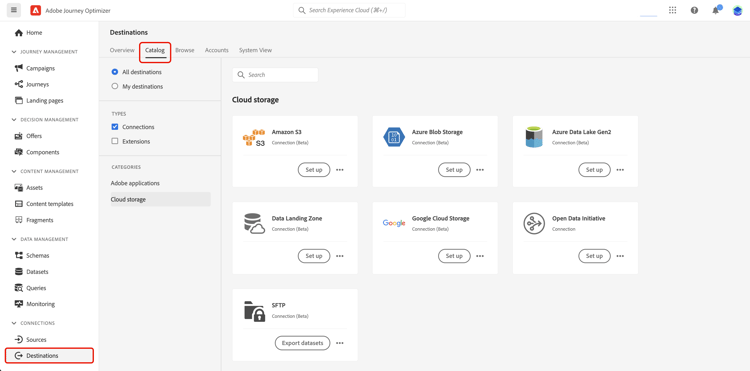
Detailed information on each destination is available in Adobe Experience Platform documentation:
Prerequisites prerequisites
To export datasets, you need the access control permissions listed below. Read the access control overview or contact your product administrator to obtain the required permissions.
Key steps to export datasets main-steps
The main steps to export a dataset to a cloud storage location are as follows:

Detailed information on each step is available in Adobe Experience Platform documentation.
-
Setup your cloud storage destination. If you have not done so already, connect to a cloud storage destination from the destinations catalog. Learn how to create a new destination connection in Adobe Experience Platform documentation.
-
Select the cloud storage destination where you want to export your datasets. In the destinations catalog, click the Export datasets button on the desired card and select the connection to use.
note NOTE If you are using Adobe Journey Optimizer along with Real-Time Customer profiles, destination cards will display an Activate button, allowing you to both export datasets and activate audiences for this destination, depending on the permissions you have enabled. -
Select the dataset(s) that you want to export to the selected destination. Learn more about Journey Optimizer datasets available for exporting
-
Schedule the export of your dataset. Specify when the export should start and at which frequency it should occur.
-
Review and confirm the export by checking the summary that displays at the end of the configuration.
Once the export is complete, the content of your dataset is deposited on your cloud storage location according to the schedule you have configured. Learn how to verify successful dataset export.
Available datasets for exporting datasets
Understand from the table below which Journey Optimizer datasets you can export. For the fields of each schema, see the Adobe Journey Optimizer Schema Reference.
After adding new custom attributes fields to the offer item schema, there may be a delay of up to an hour before these new attributes become visible in the dataset. To avoid potential data loss or inconsistencies, it is recommended to wait at least an hour before making any changes or updates that rely on the newly added attributes.
Reporting datasets and payload metadata mapping reporting-payload-metadata-mapping
For custom reporting on code-based experience and decisioning responses, use scopeDetails.correlationID to join interaction or feedback data to the AJO Entity Dataset and retrieve campaign, journey, and message metadata. Use exdRequestID to tie a single decision request to analytics events.
If correlationID is missing (for example, holdout audiences), use exported datasets and documented join keys instead of decoding undocumented payload fields. Entity dataset query examples show how to join on correlationID.
This section contains structured knowledge intended to support interpretation, retrieval, and question answering related to this topic.
For complete understanding, this information should be combined with the documentation on this page. Neither source is intended to stand alone; the page describes the feature, while this section provides additional context that helps disambiguate terminology, intent, applicability, and constraints.
- TL;DR: This page explains how to set up a live connection to cloud storage destinations so you can export Journey Optimizer datasets for reporting, archival, and external data analysis.
Intents:
- Export Journey Optimizer datasets to a cloud storage destination on a schedule.
- Identify which cloud storage destinations are available.
- Determine which datasets can be exported.
- Obtain the access control permissions required to export datasets.
- Join exported data for custom reporting using documented join keys.
Glossary:
- Dataset export: establishing a live connection with a cloud storage location to export dataset content (product-specific)
- Cloud storage destination: an export target such as Amazon S3, Azure Blob, Azure Data Lake Gen 2, Data Landing Zone, Google Cloud Storage, or SFTP
- AJO Message Export Dataset: stores sent email and SMS message content marked for export; data is retained for seven calendar days from ingestion (product-specific)
scopeDetails.correlationID: used to join interaction or feedback data to the AJO Entity Dataset and retrieve campaign, journey, and message metadata (product-specific)exdRequestID: used to tie a single decision request to analytics events (product-specific)
Guardrails:
- Datasets can be exported to the 6 cloud storage destinations: Amazon S3, Azure Blob, Azure Data Lake Gen 2, Data Landing Zone, Google Cloud Storage, and SFTP.
- Required access control permissions: Manage and Activate Dataset Destinations (Destinations), View Datasets (Data Management), and View Destinations (Destinations).
- AJO Message Export Dataset data is retained for 7 calendar days from ingestion.
- The AJO Message Feedback Event Dataset uses batch ingestion; expect a data latency of up to 2 hours.
- Cloud storage destinations are accessed from the Destinations menu, in the Catalog tab.
Terminology:
- Do not confuse: the Export datasets button (dataset export) ≠ the Activate button (which, when Real-Time Customer profiles are used, exports datasets and activates audiences)
FAQ:
- Q: Which cloud storage destinations can I export to? — Amazon S3, Azure Blob, Azure Data Lake Gen 2, Data Landing Zone, Google Cloud Storage, and SFTP.
- Q: What permissions do I need to export datasets? — Manage and Activate Dataset Destinations, View Datasets, and View Destinations.
- Q: How long is AJO Message Export Dataset data kept? — Seven calendar days from ingestion.
- Q: Where do I start a dataset export? — From the Destinations menu, Catalog tab; select Export datasets on the destination card and choose the connection.
- Q: How do I join exported data for reporting? — Use
scopeDetails.correlationIDto join to the AJO Entity Dataset, andexdRequestIDto tie a single decision request to analytics events.