On this page: Connect Journey Optimizer to Adobe Campaign v7 or v8 so your journeys can send emails, push notifications, and SMS through Campaign transactional messaging.
If you have Adobe Campaign Classic v7 or Campaign v8, a specific custom action is available in your journeys to integrate Adobe Journey Optimizer and Adobe Campaign. This integration allows you to send emails, push notifications and SMS using Adobe Campaign Transactional Messaging capabilities. Learn more in this end-to-end use case.
For each action configured, a Campaign action activity is available in the journey designer palette.
Activation access
When requested, the connection between the Journey Optimizer and Adobe Campaign environments is setup by Adobe at provisioning time. If you have not requested the connection at provisioning time, contact Adobe Journey Optimizer support to request the activation. You must provide the following details:
- Organisation ID (Adobe OrgID)
- Sandbox Name
- Campaign Server URL
- Real-Time Server URL
- Your Adobe Campaign version
Guardrails and limitations important-notes
-
There is no throttling of messages. The system caps the number of messages that can be sent over to 4,000 per 5 minutes, based on the current Campaign SLA. For this reason, Journey Optimizer should only be used in unitary use cases (individual events, not audiences).
-
You must configure one action on the canvas per template to use. You need to configure one action in Journey Optimizer for each template you wish to use from Adobe Campaign.
-
We recommend that you use a dedicated Message Center hosted or Managed Services instance for this integration to avoid impacting any other Campaign operations that you may have going on. The marketing server can be hosted or on-premise.
-
There is no validation that the payload or Campaign message is correct.
-
You cannot use a Campaign action with an audience qualification event.
Prerequisites prerequisites
In Adobe Campaign, you must create and publish a transactional message and its associated event. Refer to the Adobe Campaign documentation.
You can build your JSON payload corresponding to each message following the pattern below. You will then paste this payload when configuring the action in Journey Optimizer (see below).
| code language-json |
|---|
|
- channel: the channel defined for your Campaign transactional template
- eventType: the internal name of your Campaign event
- ctx: variable based on the personalization you have in your message
Configure the action configure-action
In Journey Optimizer, you must configure one action per transactional message.
To create a Campaign action, follow these steps:
- Create a new action. Learn how to create custom actions.
- Enter a name and description.
- In the Action type field, select Adobe Campaign Classic.
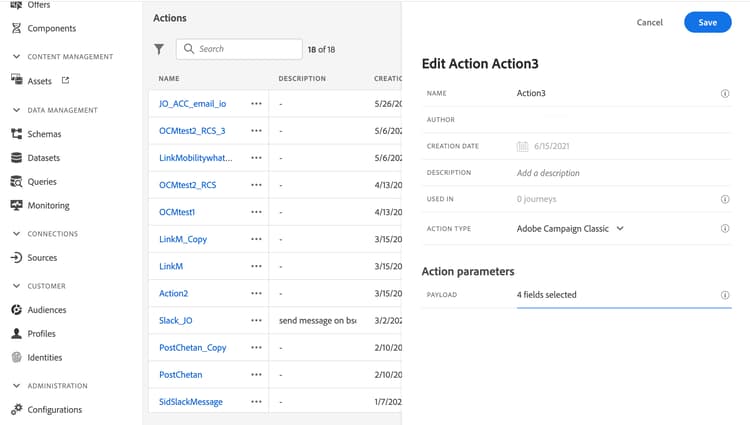
- Click in the Payload field and paste an example of the JSON payload corresponding to the Campaign message. Contact Adobe to get this payload.
- Set each field as either static or variable based on whether you want it to be mapped on the Journey canvas. For example, fields like email channel parameters and personalization fields (
ctx) should typically be set as variables so they can dynamically adapt within the journey. - Click Save.
Update an existing action update-action
If you need to update an existing Campaign v7/v8 custom action, for example when the Real-Time (RT) endpoint changes after initial setup, follow these steps:
- From the Administration menu, select Configurations, then go to Actions.
- Locate and select the Campaign action you want to update from the actions list.
- Click Edit to open the action configuration.
- Update the URL field with the new RT endpoint URL. Ensure the endpoint format is correct and reachable.
- If needed, update the Payload configuration to match any changes in the Campaign transactional message structure.
- Click Test to validate the connection to the new endpoint. Verify that the test returns a successful response before proceeding.
- Once validated, click Save to apply your changes.
This section contains structured knowledge intended to support interpretation, retrieval, and question answering related to this topic.
For complete understanding, this information should be combined with the documentation on this page. Neither source is intended to stand alone; the page describes the feature, while this section provides additional context that helps disambiguate terminology, intent, applicability, and constraints.
- TL;DR: This page explains how to integrate Journey Optimizer with Adobe Campaign v7 or v8 so journeys can send emails, push notifications, and SMS through Adobe Campaign Transactional Messaging.
Intents:
- Request activation of the connection between Journey Optimizer and Adobe Campaign environments
- Prepare the transactional message, its associated event, and the JSON payload in Adobe Campaign
- Configure a Campaign action of type Adobe Campaign Classic in Journey Optimizer
- Set payload fields as static or variable for mapping on the journey canvas
- Update an existing Campaign action when the Real-Time endpoint changes
Glossary:
- Campaign action: The action available in the journey designer palette for each configured Adobe Campaign v7/v8 action (product-specific)
- Transactional Messaging: The Adobe Campaign capability used to send emails, push notifications, and SMS triggered from Journey Optimizer (product-specific)
- eventType: The internal name of the Adobe Campaign event referenced in the JSON payload (product-specific)
- ctx: The payload object holding variables based on the personalization present in the Campaign message (product-specific)
Guardrails:
- There is no throttling of messages; the system caps the number of messages that can be sent to 4,000 per 5 minutes, based on the current Campaign SLA.
- Because of that cap, Journey Optimizer should only be used in unitary use cases (individual events, not audiences).
- You must configure one action on the canvas per template, meaning one action in Journey Optimizer for each Adobe Campaign template you wish to use.
- There is no validation that the payload or Campaign message is correct.
- You cannot use a Campaign action with an audience qualification event.
- Adobe recommends using a dedicated Message Center hosted or Managed Services instance to avoid impacting other Campaign operations.
Terminology:
- Canonical name: Adobe Campaign v7/v8 integration — Acronym: n/a — variants: Campaign action, Adobe Campaign Classic action, Campaign v7/v8 custom action
- Synonyms: “Adobe Campaign Classic” = “Adobe Campaign v7”
- Do not confuse: “Campaign action” (Adobe Campaign v7/v8 integration) ≠ other custom actions (created through the generic action creation procedure that the page links to)
FAQ:
- Q: How is the connection between Journey Optimizer and Adobe Campaign established? — It is set up by Adobe at provisioning time; if it was not requested then, contact Adobe Journey Optimizer support and provide the Org ID, Sandbox Name, Campaign Server URL, Real-Time Server URL, and Campaign version.
- Q: What is the message sending cap for this integration? — There is no throttling, but the system caps messages to 4,000 per 5 minutes based on the current Campaign SLA.
- Q: Why should this integration be used only for unitary use cases? — Because there is no throttling and messages are capped to 4,000 per 5 minutes, it suits individual events rather than audiences.
- Q: Can a Campaign action be used with an audience qualification event? — No, you cannot use a Campaign action with an audience qualification event.
- Q: How do I update a Campaign action when the Real-Time endpoint changes? — Edit the action, update the URL field with the new RT endpoint, adjust the Payload if needed, click Test to validate the connection, then Save.