On this page: Learn how to use the Read audience activity to retrieve an existing saved or imported audience and reuse it in an Orchestrated campaign, optionally enriching it with profile attributes for targeting, personalization, or reporting.
The Read audience activity allows you to retrieve an existing audience—previously saved or imported—and reuse it within an Orchestrated campaign. This activity is especially useful for targeting a predefined set of profiles without the need to execute a new segmentation process.
Once the audience is loaded, you can optionally refine it by selecting a unique identity field and enriching the audience with additional profile attributes for targeting, personalization, or reporting purposes.
Read audience cache cache
When testing an Orchestrated campaign, the Read Audience activity typically takes some time to fetch data, which can make test runs longer. To speed this up, a Read Audience cache is available.
The cache stores the audience along with the selected attributes for up to two hours. During this time, any subsequent test runs can use the cached results, avoiding the need to fetch the data again. Once the two-hour period has passed, the data must be retrieved anew.
The cache is saved for each orchestrated campaign, not for the audience itself. If the same audience is used in a Read Audience activity inside another Orchestrated campaign, the system will still need to fetch the data again.
The cache is not retained in the following cases:
-
When the Read Audience activity is updated with new attributes, the cache is refreshed with the new attributes data. Consequently, the first test run after the update will take longer, as the data needs to be retrieved again.
-
When the Orchestrated campaign is published, as the latest data is fetched when executing the live Orchestrated campaign.
Configure the Read audience activity read-audience-configuration
Follow these steps to configure the Read audience activity:
-
Before adding your Read audience activity, make sure to select a Merge policy in your Campaign settings.

-
Add a Read audience activity to your Orchestrated campaign.

-
Enter a Label to your activity. This label will serve as the name of your audience.
-
Click


-
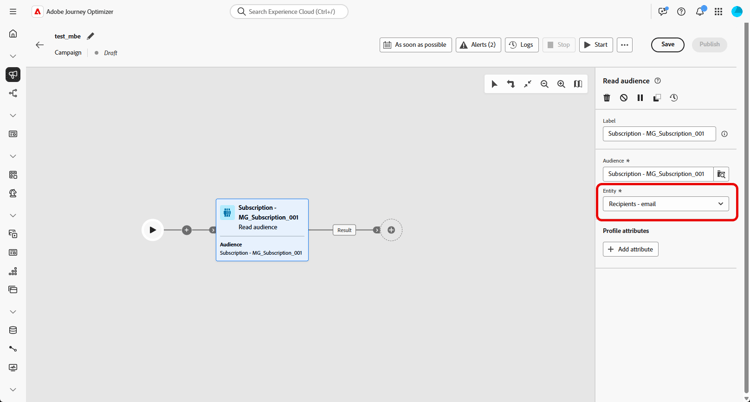
Choose an Entity from your Campaign Targeting dimension. This setting defines the target entity and the attribute used to reconcile the audience with the target dimension.
➡️ Follow the steps detailed in this page to create your Campaign Targeting dimension
-
Select Add attribute to enrich your selected audience with additional data. This step lets you add profile attributes to the audience, resulting in a list of recipients enhanced with those attributes.
-
Choose the Attributes you want to add to your audience. The attribute picker displays fields from the Union Profile Schema:
-
For CSV-based audiences, this includes both Profile attributes and custom audience-level attributes. These attributes can be found under the following schema path:
<audienceid> > _ajobatchjourneystage > audienceEnrichment > CustomerAudienceUpload > <audienceid> -
For standard AEP audiences, only Profile attributes are available, as they don’t carry embedded audience-specific fields.
note NOTE While some attributes may appear in the picker, their availability at runtime depends on whether the audience data has been successfully reconciled and merged with the Adobe Experience Platform Profile. 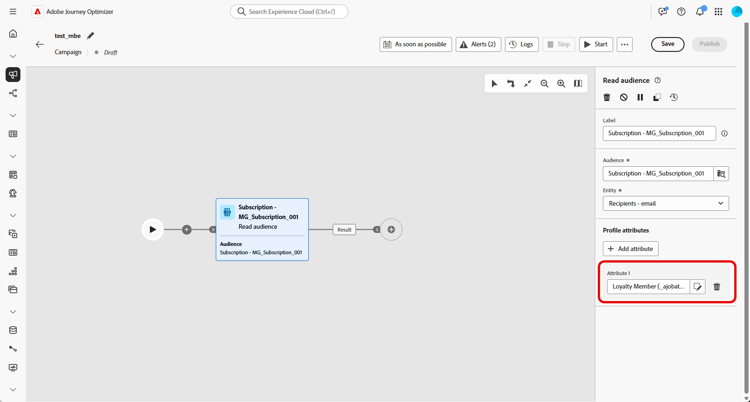
-
Once an audience is created, it is available in read-only and can no longer be edited. It can only be used after the creation process is fully completed.
Example
In the example below, the Read audience activity is used to retrieve a previously created and saved audience of profiles who subscribed to the newsletter. The audience is then enriched with the Loyalty membership attribute to enable targeting of users who are registered members of the loyalty program.

This section contains structured knowledge intended to support interpretation, retrieval, and question answering related to this topic.
For complete understanding, this information should be combined with the documentation on this page. Neither source is intended to stand alone; the page describes the feature, while this section provides additional context that helps disambiguate terminology, intent, applicability, and constraints.
- TL;DR: This page explains how to configure the Read audience activity in an Orchestrated campaign to retrieve an existing saved or imported audience and optionally enrich it with profile attributes.
Intents:
- Retrieve an existing saved or imported audience to use as the entry audience for an Orchestrated campaign.
- Select a Merge policy before adding the Read audience activity.
- Choose an Entity from the Campaign Targeting dimension to reconcile the audience with the target dimension.
- Enrich the selected audience with additional profile attributes for targeting, personalization, or reporting.
- Understand when the Read audience cache speeds up test runs and when it is refreshed.
Glossary:
- Read audience activity: an activity that retrieves an existing audience, previously saved or imported, and reuses it within an Orchestrated campaign, without executing a new segmentation process (product-specific)
- Read audience cache: a cache that stores the audience and selected attributes retrieved by the Read audience activity, used to speed up subsequent test runs of an Orchestrated campaign (product-specific)
- Merge policy: a Campaign setting that must be selected before adding a Read audience activity (product-specific)
- Entity: a setting chosen from the Campaign Targeting dimension that defines the target entity and the attribute used to reconcile the audience with the target dimension (product-specific)
- Union Profile Schema: the schema whose fields are displayed in the attribute picker when enriching an audience with the Add attribute step (product-specific)
Guardrails:
- The Read audience cache stores the audience and selected attributes for up to two hours; after this two-hour period, the data must be retrieved anew.
- The cache is saved per Orchestrated campaign, not per audience: using the same audience in a Read audience activity inside another Orchestrated campaign still requires the data to be fetched again.
- The cache is refreshed when the Read audience activity is updated with new attributes, so the first test run after the update takes longer because the data must be retrieved again.
- The cache is not retained when the Orchestrated campaign is published, because the latest data is fetched when executing the live Orchestrated campaign.
- For CSV-based audiences, the attribute picker includes both Profile attributes and custom audience-level attributes, found under the schema path
<audienceid> > _ajobatchjourneystage > audienceEnrichment > CustomerAudienceUpload > <audienceid>. - For standard AEP audiences, only Profile attributes are available in the attribute picker, because these audiences do not carry embedded audience-specific fields.
- The availability of an attribute at runtime depends on whether the audience data has been successfully reconciled and merged with the Adobe Experience Platform Profile, even if the attribute appears in the picker.
- Once an audience is created, it is available in read-only and can no longer be edited; it can only be used after the creation process is fully completed.
Terminology:
- Canonical name: Adobe Experience Platform — Acronym: AEP
- Canonical name: Read audience activity — variants: Read Audience
- Do not confuse: “Adobe Experience Platform” (the platform) ≠ “Adobe Experience Platform Profile” (the profile component with which audience data must be reconciled and merged for an attribute to be available at runtime)
FAQ:
- Q: What does the Read audience activity do? — It retrieves an existing audience, previously saved or imported, and reuses it within an Orchestrated campaign, targeting a predefined set of profiles without executing a new segmentation process.
- Q: How long does the Read audience cache store data? — Up to two hours; after this two-hour period, the data must be retrieved anew.
- Q: Does the cache carry over to another Orchestrated campaign using the same audience? — No, the cache is saved for each Orchestrated campaign, not for the audience itself, so the system still needs to fetch the data again.
- Q: What happens to the cache when the Read audience activity is updated with new attributes? — The cache is refreshed with the new attributes data, so the first test run after the update takes longer.
- Q: What must be selected before adding a Read audience activity? — A Merge policy in the Campaign settings.
- Q: What attributes are available for CSV-based audiences versus standard AEP audiences? — CSV-based audiences offer both Profile attributes and custom audience-level attributes; standard AEP audiences offer only Profile attributes, since they do not carry embedded audience-specific fields.
- Q: Can a created audience be edited afterward? — No, once an audience is created it is available in read-only and can no longer be edited; it can only be used after the creation process is fully completed.
Examples:
- Example: The Read audience activity retrieves a previously created and saved audience of profiles who subscribed to the newsletter, then enriches it with the Loyalty membership attribute to enable targeting of users who are registered members of the loyalty program.
Related pages:
- To generate and target the audience selected in the Read audience activity: Learn more about how to generate and target audiences in Journey Optimizer (audience/about-audiences.md)
- To create the Campaign Targeting dimension used to choose the Entity setting: Create your Targeting dimension (orchestrated/target-dimension.md)
Personas:
- marketer: Can retrieve an existing saved or imported audience and reuse it within an Orchestrated campaign. Can select a Merge policy, enter a Label, choose an Entity from the Campaign Targeting dimension, and select Add attribute to enrich the audience. The page states that once an audience is created, it is available in read-only and can no longer be edited. Where: “Configure the Read audience activity”.
Onboarding:
- Level: Intermediate
- First minimal step: Select a Merge policy in your Campaign settings before adding the Read audience activity.
- Success check: The selected audience is enriched with the chosen attribute, as shown by the example enriching a newsletter audience with the Loyalty membership attribute.
- Previous: Generate and target an audience in Journey Optimizer: About Adobe Experience Platform audiences (audience/about-audiences.md); Create the Campaign Targeting dimension: Create your Targeting dimension (orchestrated/target-dimension.md)