[AEM Forms]{class="badge positive" title="Applies to AEM Forms)."}
AEM Forms Early Access Program
The AEM Forms Early Access Program program offers a unique opportunity to you to get exclusive access to cutting-edge features before anyone else, and help shape their development. The program offers you to:
- Be among the first to get access to cutting-edge technology before it hits the mainstream.
- Co-innovate with the product team, shaping the future of the product together. Use your use cases to guide development, ensuring the innovation is mature and address your real-world challenges.
- Provide feedback and help us squash issues before launch, leading to a smoother user experience upon full release.
How to join the Early Access program?
If you’re interested in joining our Early Access program for any Early Access innovation, simply send an email from your official address to aem-forms-ea@adobe.com to request access. You can request access to all or any specific innovation.
Early Access Innovations
Conversational Forms
The Conversational Forms innovation lets you interact with forms like a friendly chatbot on any AEM Sites page.
You can simply drag and drop the Conversational Forms component onto your AEM Sites page and get started. There’s no coding required, so anyone can create engaging and user-friendly Conversational Forms experiences quickly.
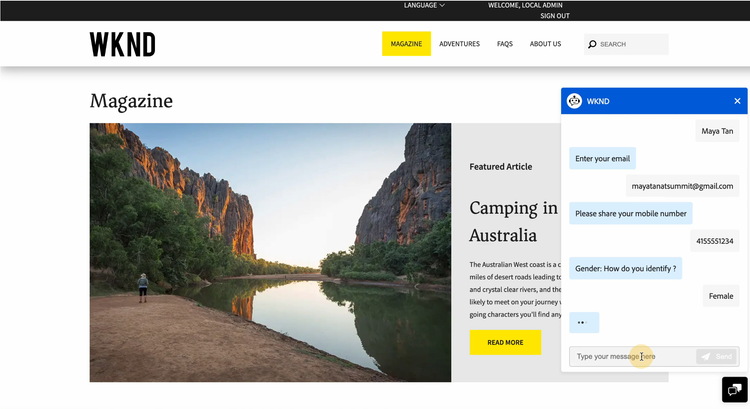
Here’s what more Conversational Forms bring:
- Easy form discovery: Find the exact form that you need through a clear, conversational interface, on any AEM Sites page.
- Chat-style completion: Answer questions one at a time, just like chatting with a virtual assistant. It’s fast, intuitive, and feels like a conversation.
- Preview before you submit: Double-check everything before hitting submit. Preview your completed form to ensure accuracy and avoid any last-minute mistakes.
Conversational Forms are more than just a new look – they’re a game-changer for user experience. Boost engagement, reduce form abandonment, and make interacting with your website a more enjoyable experience for everyone.
AEM Forms Scaffolder CLI for Custom Components
Accelerate your AEM Forms Edge Delivery Services development with the AEM Forms CLI tool. This command-line interface enables you to instantly generate the code and wiring needed to kickstart custom component development—no boilerplate, no hassle.
Key capabilities:
- Rapid scaffolding: Instantly generate the structure and code for new custom components, reducing manual setup time.
- Best practices built-in: The tool follows recommended patterns for AEM Forms Edge Delivery Services, ensuring consistency and maintainability.
- Developer productivity: Focus on building business logic and UI, while the CLI handles repetitive setup tasks.
- Seamless integration: Generated components are ready to use and integrate with your existing AEM Forms projects.
Ready to start? The AEM Forms CLI tool is available under the Early Access program for Forms as a Cloud Service deployments. To request access, email your organization ID and program details to aem-forms-ea@adobe.com from your official address.
File Attachment Virus Scanner / Validator
Adaptive Forms can now pass every uploaded file attachment to a virus scanner or validator of your choice before it’s persisted, giving you a server-side check that blocks malicious or non-compliant files at submission time, before they ever reach the repository.
Key capabilities:
- Bring your own scanning engine: Implement a
FileAttachmentValidatorservice and connect any antivirus engine, malware scanner, or custom validation logic you already use — the interface is engine-agnostic. - Scan before persist: Files are evaluated from memory before they’re written to the repository, so a rejected file is never stored.
- Multiple configurations: Register more than one validator — one per antivirus engine, or several differently configured instances of the same engine — and choose which one (or none) applies per form.
Ready to start? Scan file attachments in Adaptive Forms with a custom validator covers the concepts and the interface reference, and Tutorial: Scan file attachments with ClamAV walks through a complete, working example end to end.
Additional Early Access Innovations
Forms Service APIs
Forms service generates interactive PDF forms for data capture. It can also be used to import/export data to/from an existing interactive PDF form and validate submitted data. Here’s a breakdown of its functionalities:
-
Rendering Forms: Generate an interactive PDF form from a template created using AEM Forms Designer and, optionally, XML data. This essentially produces a fillable PDF form optionally pre-filled with data.
-
Data Extraction and Import: Import data into an existing PDF form as well as extract data from a filled PDF form. Both XDP and XML data formats are supported, and importing to non-XFA PDF forms (also known as AcroForms) additionally supports FDF and XFDF data.
-
Data Validation: : Validate submitted data, in XDP or XML format, against a template created using AEM Forms Designer.
Doc Generation API
The document generation API includes an optional feature that allows the direct upload of generated PDFs to Azure Blob Storage. Some key benefits of uploading PDFs directly to Azure Blob Storage using the document generation API are:
-
Seamless Integration with Cloud Storage:
Directly uploading generated PDFs to Azure Blob Storage eliminates the need for additional manual or programmatic steps to transfer files, streamlining workflows and enhancing efficiency. -
Centralized Document Management:
Storing PDFs in Azure Blob Storage allows for centralized management of documents, making it easier to organize, retrieve, and manage generated files across various use cases. -
Improved Security: By leveraging Azure’s built-in security features, such as encryption at rest and role-based access control (RBAC), sensitive documents remain protected during storage.
-
Customizable Storage Paths: The ability to define custom directory paths ensures generated PDFs are stored in organized and application-specific locations, improving file management.
Document Conversion APIs
The Document Conversion APIs provide synchronous services to convert documents between supported formats while preserving their fidelity. These APIs support OAuth authentication and help you integrate document conversion capabilities into custom applications and automated workflows.
Key benefits of using the Document Conversion APIs include:
-
Support for multiple document formats: Convert documents between supported formats, including HTML, PostScript (PS), PDF, and image formats.
-
Simplified document processing workflows: Integrate document conversion capabilities into business applications and automate document processing without relying on external tools.
-
High-quality document conversion: Preserve document layout, formatting, and content during conversion to ensure consistent output across supported formats.
-
Support for print and archival workflows: Convert documents to formats such as PostScript or flatten PDF transparency to improve compatibility with printing systems and downstream document processing.
The Document Conversion APIs offer the following features:
-
Convert HTML to PDF: Convert an HTML document to PDF while preserving its layout and styling.
-
Convert PostScript to PDF: Convert a PostScript (PS) document to PDF.
-
Convert PDF to images: Convert a PDF document into one or more image files.
-
Convert PDF to PostScript: Convert a PDF document to a PostScript (PS) document.
-
Flatten PDF transparency: Flatten transparency in a PDF document to improve compatibility with print and document processing workflows.
Enhancements in Visual Rule Editor
-
Direct API integration: The Visual Rule Editor in Adaptive Forms now supports direct API integration without requiring a Form Data Model. You can connect to an API endpoint by entering its JSON URL or by importing the configuration using a cURL command. After integration, the API can be invoked using the
Invoke Serviceaction. -
Enhanced Navigation with Event Payload Support: The Navigate To action in the Invoke Service handlers supports
EVENT_PAYLOAD, allowing form authors to configure follow-up actions based on event responses. -
Function and Mathematical Expression Support in Input Parameters: Input parameters now support both function calls and mathematical expressions, enabling form authors to pass dynamically computed values directly.
-
Retrieve property values from a JSON array: Invoke an API with a custom function to extract values from a JSON array and bind them directly to form fields.
Improved accessibility for form components
Adaptive Forms Core Components introduce WCAG-compliant semantic markup for checkbox groups, radio button groups, and panels. These components now leverage <fieldset> and <legend> elements to establish meaningful relationships between group labels and their options for assistive technologies. See Fieldset and legend support in Adaptive Forms.
Configurable tables for Adaptive Forms
Create configurable tables in Adaptive Forms based on Core Components to collect structured and tabular data. Authors can customize table rows and columns to design forms that efficiently capture grid-based information.
Benefits
- Simplifies the collection of structured and tabular data in a single form.
- Reduces form complexity by grouping related information in a table.
- Supports dynamic data entry scenarios where users need to provide multiple records, such as educational qualifications, employment history, or expense details.
- Improves form usability and readability by organizing repeated information in a structured layout.
- Reduces authoring effort by providing a reusable and configurable table component.
Locale support for Interactive Communication
Configure locale settings directly in the Interactive Communication Editor to create region-specific communications. Authors can select a supported locale to apply language and regional formatting conventions for dates, numbers, currencies, and other locale-sensitive content, helping deliver consistent and localized customer communications.
Key benefits include:
- Configure locale settings directly from the Interactive Communication Editor.
- Support language and region-specific formatting for dates, numbers, currencies, and other locale-sensitive content.
- Deliver localized Interactive Communications tailored to regional audiences.
- Ensure consistent formatting and presentation across generated communications.