Auf dieser Seite: Verbinden Sie Journey Optimizer mit Adobe Campaign Standard, damit Ihre Journey E-Mails, Push-Benachrichtigungen und mobile Nachrichten über die Transaktionsnachrichten-Funktionen senden können.
Wenn Sie über Adobe Campaign Standard verfügen, haben Sie Zugriff auf eine integrierte Aktion, die die Verbindung zu Adobe Campaign Standard ermöglicht. Mit den Transaktionsnachrichten-Funktionen von Adobe Campaign Standard können Sie E-Mails, Push-Benachrichtigungen und mobile Nachrichten senden.
Die Transaktionsnachricht in Campaign Standard und das zugehörige Ereignis müssen veröffentlicht werden, damit sie in Journey Optimizer verwendet werden können. Wenn das Ereignis veröffentlicht wird, die Nachricht jedoch nicht, wird sie nicht in der Benutzeroberfläche von Journey Optimizer angezeigt. Wenn die Nachricht veröffentlicht wird, das zugehörige Ereignis jedoch nicht, wird sie in der Benutzeroberfläche von Journey Optimizer angezeigt, sie kann jedoch nicht verwendet werden.
Leitlinien und Einschränkungen important-notes
-
Für Adobe Campaign Standard-Aktionen ist automatisch eine Begrenzungsregel von 4.000 Aufrufen pro 5 Minuten definiert. Lesen Sie mehr über Service-Level-Vereinbarungen für Transaktionsnachrichten in der Produktbeschreibung von Adobe Campaign Standard.
-
Die Adobe Campaign Standard-Integration wird über eine dedizierte integrierte Aktion in der Aktionsliste eingerichtet. Dies muss für jede Sandbox konfiguriert werden.
-
Sie können eine Campaign Standard-Aktion nicht mit den Aktivitäten „Zielgruppen-Qualifizierung“ oder „Zielgruppe lesen“ verwenden.
-
Eine Journey kann nicht sowohl integrierte Kanalaktionen als auch Campaign Standard-Aktionen verwenden.
Konfigurieren der Aktion configure-action
In Journey Optimizer muss eine Aktion pro Transaktionsnachricht konfiguriert werden.
Gehen Sie wie folgt vor, um Campaign Standard-Aktion zu konfigurieren:
-
Wählen SIe Konfigurationen im Menüabschnitt ADMINISTRATION aus.
-
Klicken Sie im Abschnitt Aktionen auf Verwalten. Die Liste der Aktionen wird angezeigt.
-
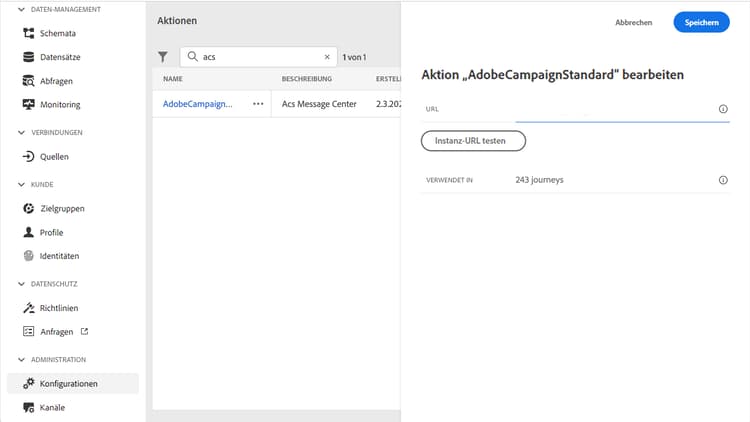
Wählen Sie die integrierte AdobeCampaignStandard-Aktion aus. Der Bereich für die Aktionskonfiguration wird auf der rechten Seite des Bildschirms geöffnet.
-
Kopieren Sie die URL der Adobe Campaign Standard-Instanz und fügen Sie sie in das Feld URL ein.
-
Klicken Sie auf Instanz-URL testen, um die Gültigkeit der Instanz zu testen.
note NOTE Dieser Test bestätigt Folgendes: -
Der Host ist „.campaign.adobe.com“, „.campaign-sandbox.adobe.com“, „.campaign-demo.adobe.com“, „.ats.adobe.com“ oder „.adls.adobe.com“.
-
Die URL beginnt mit „https“
-
Die mit dieser Adobe Campaign Standard-Instanz verknüpfte Organisation ist identisch mit der Journey Optimizer-Organisation
-
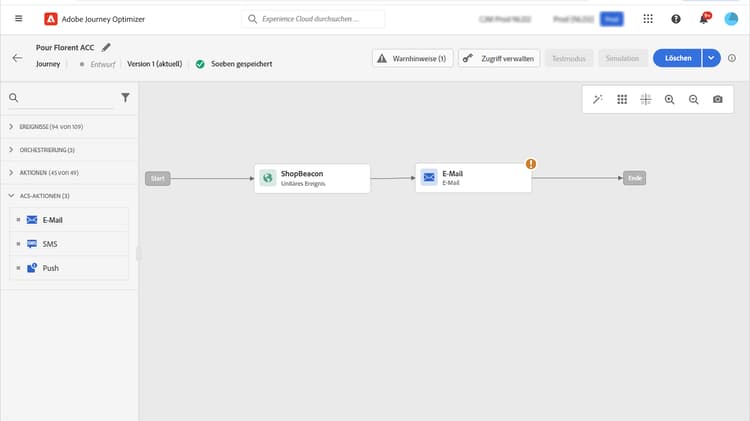
Sobald diese Konfiguration abgeschlossen ist, stehen in der Kategorie Aktion beim Entwerfen einer Journey drei Aktionen zur Verfügung: E-Mail, Push, Mobile-Nachricht. Erfahren Sie mehr über die Verwendung.
Das Ereignis Reaktionen wird verwendet, um auf Tracking-Daten zu reagieren, die sich auf eine Campaign Standard-Nachricht beziehen, die innerhalb derselben Journey gesendet wurde:
-
Bei Push-Benachrichtigungen können Journeys auf angeklickte, gesendete oder fehlgeschlagene Nachrichten reagieren.
-
Bei mobilen Nachrichten können Journey auf gesendete oder fehlgeschlagene Nachrichten reagieren.
-
Bei E-Mails können Journeys auf angeklickte, gesendete, geöffnete oder fehlgeschlagene Nachrichten reagieren. Erfahren Sie mehr zu Reaktionsereignissen.
Wenn zum Senden von Nachrichten ein Drittanbietersystem verwendet wird, muss eine benutzerdefinierte Aktion hinzugefügt und konfiguriert werden. Erfahren Sie mehr zur Konfiguration benutzerdefinierter Aktionen.
This section contains structured knowledge intended to support interpretation, retrieval, and question answering related to this topic.
For complete understanding, this information should be combined with the documentation on this page. Neither source is intended to stand alone; the page describes the feature, while this section provides additional context that helps disambiguate terminology, intent, applicability, and constraints.
- TL;DR: This page explains how to integrate Journey Optimizer with Adobe Campaign Standard through the AdobeCampaignStandard action so journeys can send emails, push notifications, and SMS through its transactional messaging capabilities.
Intents:
- Configure the AdobeCampaignStandard action for a sandbox
- Paste and test the Adobe Campaign Standard instance URL
- Make the Campaign Standard Email, Push, and SMS actions available in the Action category when designing a journey
- Use a Reactions event to react to tracking data from a Campaign Standard message
- Understand the capping and activity constraints of the integration
Glossary:
- AdobeCampaignStandard action: The action selected from the action list to connect Journey Optimizer to Adobe Campaign Standard (product-specific)
- Transactional Messaging: The Adobe Campaign Standard capability used to send emails, push notifications, and SMS from Journey Optimizer (product-specific)
- Test the instance URL: The button that verifies the host, that the URL starts with https, and that the organization matches the Journey Optimizer organization (product-specific)
- Reactions event: An event that reacts to tracking data related to a Campaign Standard message sent within the same journey (product-specific)
Guardrails:
- A capping rule of 4,000 calls per 5 minutes is automatically defined for Adobe Campaign Standard actions.
- The Adobe Campaign Standard integration is set up through a dedicated AdobeCampaignStandard action in the action list and must be configured for each sandbox.
- You cannot use a Campaign Standard action with an Audience qualification or Read audience activity.
- A journey cannot use both the native channels of the Action activity and Campaign Standard actions.
- The transactional message and its associated event must both be published: if only the event is published the message is not visible, and if only the message is published it is visible but not usable.
Terminology:
- Canonical name: Adobe Campaign Standard integration — Acronym: ACS (Adobe Campaign Standard) — variants: Campaign Standard action, AdobeCampaignStandard action
- Do not confuse: “native channels of the Action activity” ≠ “Campaign Standard actions” (Adobe Campaign Standard integration actions), which cannot both be used in the same journey
- Do not confuse: “Campaign Standard Email, Push, SMS actions” (available after configuring the integration) ≠ “Reactions event” (reacts to tracking data of a sent Campaign Standard message)
FAQ:
- Q: What is the capping limit for Adobe Campaign Standard actions? — A capping rule of 4,000 calls per 5 minutes is automatically defined.
- Q: Why is a Campaign Standard message not visible or not usable in Journey Optimizer? — If the event is published but the message is not, it is not visible; if the message is published but the event is not, it is visible but not usable.
- Q: Does the integration need to be configured once for the whole organization? — No, it is set up through a dedicated AdobeCampaignStandard action that must be configured for each sandbox.
- Q: Which tracking reactions are available per channel? — Push can react to clicked, sent, or failed; SMS to sent or failed; email to clicked, sent, opened, or failed.
- Q: Can a journey use both the native channels of the Action activity and Campaign Standard actions? — No, a journey cannot use both.