Auf dieser Seite: Erfahren Sie, wie Sie statische oder personalisierte PDF-Dateien an E-Mails anhängen, und lernen Sie die unterstützten Kampagnentypen und die Beschränkungen bezüglich Anzahl, Größe und Volumen kennen.
Sie können eine statische PDF-Datei an die E-Mail-Nachrichten anhängen, die Sie mit Journey Optimizer senden. Wenn Sie durch API ausgelöste Kampagnen verwenden, können Sie auch für jede empfangende Person eine personalisierte PDF-Datei anhängen.
Beachten Sie, dass personalisierte PDF-Anhänge zusätzliche Abrufe und Verarbeitungen von Dateien erfordern. In Kampagnen mit personalisierten PDF-Anhängen kann es daher zu einer höheren Verarbeitungslatenz und einem niedrigeren Durchsatz kommen als in Kampagnen ohne Anhänge, insbesondere wenn mehrere oder größere PDF-Dateien verwendet werden.
-
Sie können pro Profil und Jahr bis zu 6 Nachrichten mit einem PDF-Anhang senden, unabhängig davon, ob es sich um einen statischen oder personalisierten Anhang handelt.
-
Die maximale Dateigröße pro Anhang beträgt 5 MB. Bei E-Mails mit personalisierten Anhängen gilt für alle statischen und personalisierten PDF-Anhänge standardmäßig ein kombiniertes Limit von 5 MB.
Gehen Sie wie folgt vor, um eine PDF-Datei an eine E-Mail-Nachricht anzuhängen.
-
Erstellen Sie eine E-Mail in einer Journey oder Kampagne. Weitere Informationen
-
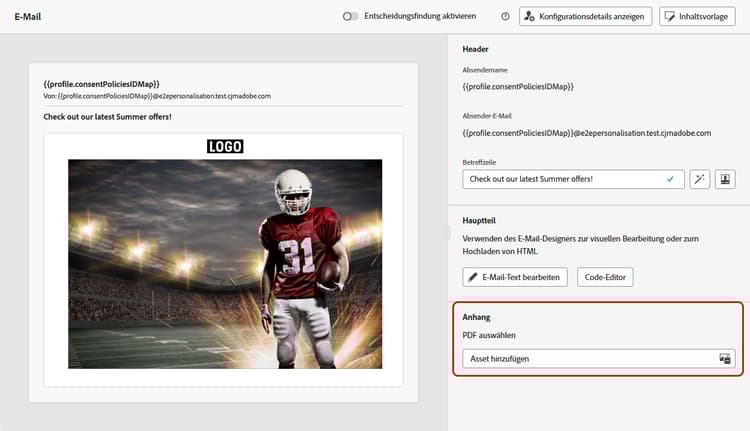
Wählen Sie auf der Registerkarte Inhalt der Journey oder Kampagne im Abschnitt Anhang die Option Asset hinzufügen aus.
-
Das Assets Essentials-Repository wird angezeigt.
note NOTE Beim Entwerfen von Nachrichten greifen Sie über die Journey Optimizer-Benutzeroberfläche direkt auf das Assets Essentials-Repository zu. Weitere Informationen zur eingebetteten Assets Essentials-Benutzeroberfläche finden Sie in der Dokumentation zu Experience Manager Assets Essentials. -
Verwenden Sie den PDF-Filter im Abschnitt MIME-Typ, um die Auswahl auf das richtige Dateiformat zu beschränken.
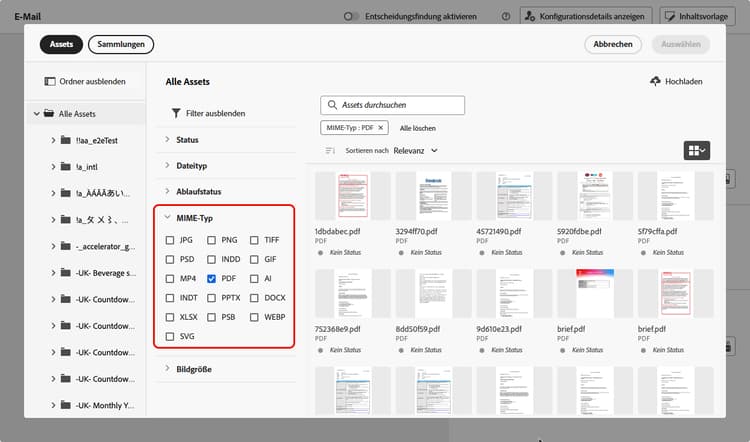
note NOTE Für Anlagen ist nur das PDF-Format zulässig. -
Wählen Sie die gewünschte Datei aus.
- Sie können jeweils nur eine Datei auswählen.
- Die maximale Dateigröße pro Anhang beträgt 5 MB.
-
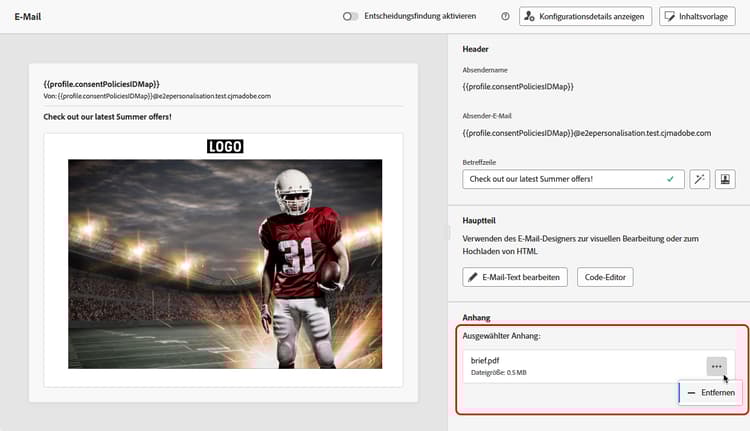
Anschließend werden Name und Größe der ausgewählten Datei im Abschnitt Anlage angezeigt.
Sie können die ausgewählte Datei mithilfe des Symbols „Weitere Aktionen“ neben dem Dateinamen entfernen.
Anhängen personalisierter PDF-Dateien in durch API ausgelösten Kampagnen personalized-attachments
Sie können auch empfängerspezifische PDF-Dateien an eine einzelne E-Mail anhängen, die über eine durch API ausgelöste Kampagne gesendet wird. Im Gegensatz zu statischen Anhängen kann jede empfangende Person eine andere Datei erhalten, z. B. eine Rechnung, eine Bordkarte, einen Vertrag oder einen Versandaufkleber.
Die Gesamtgröße aller statischen und personalisierten PDF-Anhänge in einer E-Mail ist standardmäßig auf 5 MB beschränkt. Unternehmen mit dem entsprechenden Zusatzpaket für PDF-Anhänge können das kombinierte Limit auf bis zu 10 MB erweitern.
-
Personalisierte PDF-Anhänge werden nur in durch API ausgelösten Transaktions-E-Mail-Kampagnen unterstützt.
-
Sie können bis zu fünf PDF-Anhänge in eine E-Mail aufnehmen. Diese Beschränkung umfasst sowohl statische als auch personalisierte Anhänge. Eine E-Mail mit einer statischen PDF kann beispielsweise bis zu vier personalisierte PDFs enthalten. Wenn Sie mehr Anhänge versenden müssen, teilen Sie sie auf mehrere Kommunikationen auf.
-
Personalisierte und statische PDF-Anhänge werden auf dasselbe Kontingent angerechnet. Weitere Informationen
Personalisierte PDF-Anhänge müssen in den für Anhänge spezifischen Container Data Landing Zone hochgeladen und dann in der API-Payload referenziert werden. Data Landing Zone ist derzeit der einzige unterstützte Speicherort für personalisierte PDF-Anhänge.
-
Rufen Sie die Anmeldedaten für die Data Landing Zone für Ihre Sandbox ab, indem Sie
type=ajoemailattachmentsfür dieselbe IMS-Organisation und Sandbox wie die Ausführungsanfrage verwenden (siehe die Dokumentation zu Adobe Experience Platform). Verwenden Sie je nach Cloud-Anbieter den von der API zurückgegebenen Azure-Container oder den AWS-Bucket und -Ordner. -
Generieren Sie die PDF-Dateien mit dem Tool Ihrer Wahl und laden Sie sie in Ihren Data Landing Zone-Container hoch.
Beachten Sie, dass Data Landing Zone Dateien nach sieben Tagen automatisch löscht. Stellen Sie sicher, dass die PDF-Dateien im Container verfügbar bleiben, bis der Nachrichtenversand abgeschlossen ist und alle weiteren Zustellversuche abgeschlossen sind.
-
Fügen Sie in der API-Payload für jede Empfängerin und jeden Empfänger ein
attachments-Array hinzu, das den Dateinamen, den Inhaltstyp und den Data Landing Zone-Pfad der zu sendenden PDF enthält. Erfahren Sie, wie Sie die Inhalte von durch API ausgelösten Kampagnen personalisieren könnencode language-json "attachments": [ { "name": "invoice-12345.pdf", "contentType": "application/pdf", "source": { "type": "dlzPath", "path": "attachments/invoice-12345.pdf" } } ]Beachten Sie, dass
source.pathder Objektpfad relativ zum für den Anhang spezifischen Data Landing Zone-Container ist, der mittype=ajoemailattachmentsabgerufen wurde. Geben Sie keinen Azure-Container-Namen, den AWS-Bucket oder -Ordner, Anmeldedaten oder eine vollständige URL des Speicherorts an.
Zum Versandzeitpunkt ruft Journey Optimizer die Datei vom angegebenen Speicherort ab und hängt sie an die Nachricht für die empfangende Person an. Personalisierte PDF-Anhänge werden für Kampagnen mit hohem Durchsatz in der primären Region unterstützt. Während eines regionalen Failovers werden sie nicht unterstützt.
Die vollständige API-Payload-Referenz finden Sie in der Dokumentation zur Interactive Message Execution API.
This section contains structured knowledge intended to support interpretation, retrieval, and question answering related to this topic.
For complete understanding, this information should be combined with the documentation on this page. Neither source is intended to stand alone; the page describes the feature, while this section provides additional context that helps disambiguate terminology, intent, applicability, and constraints.
- TL;DR: This page explains how to attach static PDF files to Journey Optimizer emails, and recipient-specific (personalized) PDF files for API-triggered campaigns, along with the applicable format, count, size, and per-profile volume limits.
Intents:
- Attach a static PDF file to an email in a journey or campaign
- Attach recipient-specific (personalized) PDF files through an API-triggered campaign
- Understand the PDF attachment count, size, and per-profile volume limits
- Set up the Data Landing Zone container and API payload for personalized attachments
- Raise the attachment size limit with the PDF Attachments add-on
Glossary:
- Static PDF attachment: A single PDF file attached to an email that is the same for every recipient (product-specific)
- Personalized PDF attachment: A recipient-specific PDF file (for example an invoice, boarding pass, contract, or shipping label) attached per recipient in an API-triggered campaign (product-specific)
- Data Landing Zone (DLZ): The attachment-specific cloud storage container (retrieved with
type=ajoemailattachments) where personalized PDFs are uploaded and then referenced from the API payload; the only supported storage location for them (product-specific) - PDF Attachments add-on: A purchasable add-on that raises the combined personalized-attachment size limit from 5 MB to 10 MB (product-specific)
Guardrails:
- Up to 6 messages with a PDF attachment per profile per year, whether the attachment is static or personalized.
- Maximum 5 MB per attachment; for emails with personalized attachments, all static and personalized PDFs share a combined 5 MB limit by default. The PDF Attachments add-on raises the combined personalized limit to 10 MB.
- Up to five PDF attachments per email, counting static and personalized together — for example, one static PDF plus up to four personalized PDFs.
- Only the PDF format is allowed for attachments.
- Personalized PDF attachments are supported only for transactional API-triggered email campaigns.
- Personalized PDFs must be uploaded to the attachment-specific Data Landing Zone container; it is currently the only supported storage location for them.
- Data Landing Zone automatically deletes files after seven days — keep the files available until delivery and any retries are complete.
- Personalized PDF attachments are supported for High Throughput campaigns in the primary region and are not supported during regional failover.
- A PDF attachment is not retained when the message is saved as a content template — reattach the file on any new email created from that template.
Terminology:
- Canonical name: PDF attachment — Acronym: n/a — variants: static PDF attachment, personalized PDF attachment
- Synonyms: “Data Landing Zone” = “DLZ”
- Do not confuse: “static PDF attachment” (same file for all recipients) ≠ “personalized PDF attachment” (per-recipient file, API-triggered campaigns only)
FAQ:
- Q: How many PDF attachments can one email include? — Up to five, counting static and personalized together (for example, one static plus up to four personalized).
- Q: What is the maximum PDF attachment size? — 5 MB per attachment; with personalized attachments, all static and personalized PDFs share a combined 5 MB limit by default, which the PDF Attachments add-on raises to 10 MB.
- Q: How many PDF-attachment messages can a single profile receive? — Up to 6 per profile per year, whether the attachments are static or personalized.
- Q: Are personalized PDF attachments available for any email? — No. They are supported only for transactional API-triggered email campaigns, and for High Throughput campaigns in the primary region; they are not supported during regional failover.
- Q: Where must personalized PDF files be stored? — In the attachment-specific Data Landing Zone container (retrieved with
type=ajoemailattachments) and referenced in the API payload; it is the only supported storage location, and files are automatically deleted after seven days. - Q: Is the PDF attachment kept when I save the email as a content template? — No, it is not retained; you must reattach the file on any new email created from the template.