在此頁面上:瞭解如何仰賴Adobe Campaign Standard異動訊息範本,在歷程中使用內建的Campaign Standard電子郵件、推播和行動訊息動作活動。
如果您有Adobe Campaign Standard,則可使用下列內建動作活動: 電子郵件、推播以及行動訊息。
針對這些管道中的每一個,您選取Adobe Campaign標準異動訊息範本。 對於內建電子郵件、行動訊息和推播頻道,我們仰賴「交易式訊息」來執行訊息傳送。 這表示如果您想在歷程中使用特定訊息範本,則必須以Adobe Campaign Standard發佈。 請參閱此頁面以瞭解如何使用此功能。
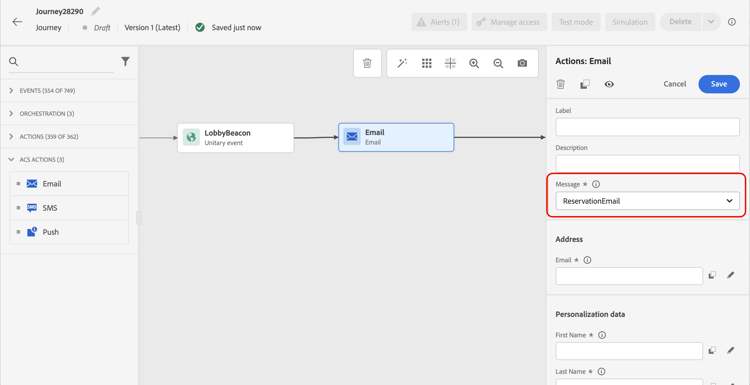
您可以使用事件(也稱為即時)或設定檔交易式訊息範本。
當您選取範本時,訊息裝載中預期的所有欄位都會顯示在活動設定窗格的 位址 和 Personalization資料 下。 您需要將每個欄位與您要使用的欄位相對應,無論是從事件還是從資料來源進行。 您也可以使用進階運算式編輯器以手動方式傳遞值、對擷取的資訊執行資料操作(例如將字串轉換為大寫)或使用函式,例如「if, then, else」。 請參閱此頁面。
電子郵件和行動訊息 section_asc_51g_nhb
對於 電子郵件 和行動訊息,引數相同。
在交易式電子郵件範本中包含 取消訂閱連結 內容區塊。
如果您使用以事件為基礎的範本(rtEvent),請在訊息中納入連結,將收件者的電子郵件當作URL引數傳遞,並將它們導向至取消訂閱的登陸頁面。
建立登入頁面,並確保將收件者的取消訂閱決定傳輸至Adobe。
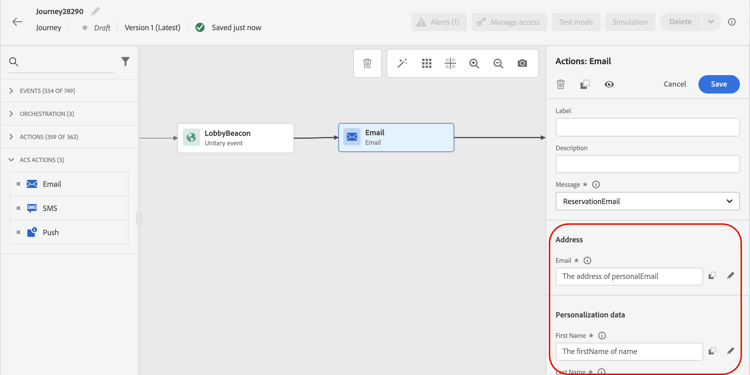
首先,您需要選擇異動訊息範本。
有兩個類別可供使用: 位址和Personalization資料。
您可以使用介面輕鬆定義在何處擷取 位址 或Personalization資料。 您可以瀏覽事件和可用資料來源的欄位。 您也可以將進階運算式編輯器用於更進階的使用案例,例如使用需要傳遞引數或執行操作的資料來源。 請參閱此頁面。
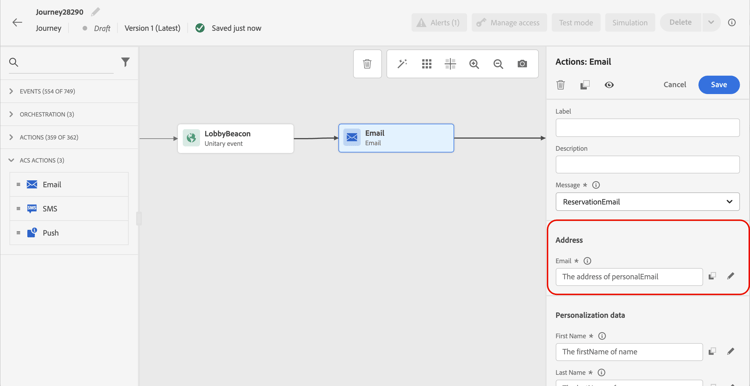
位址
這些是系統需要知道將訊息傳送到何處的欄位。 如果是電子郵件範本,則為電子郵件地址。 若為行動訊息,則為行動電話號碼。
用於Campaign Standard整合的
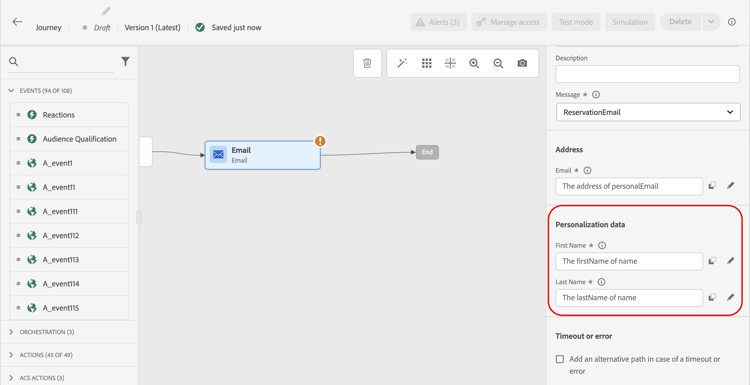
Personalization資料
這些是Adobe Campaign標準訊息預期的欄位。 這些欄位可用於個人化訊息、套用條件式格式或挑選特定訊息變體。
推播 section_im3_hvf_nhb
在使用推播活動之前,您的行動應用程式需要與Campaign Standard一起設定以傳送推播通知。 使用此文章針對行動裝置採取必要的實作步驟。
首先,您需要從下拉式清單中選擇行動應用程式和交易式訊息。
適用於Campaign Standard引數對應的進階運算式編輯器
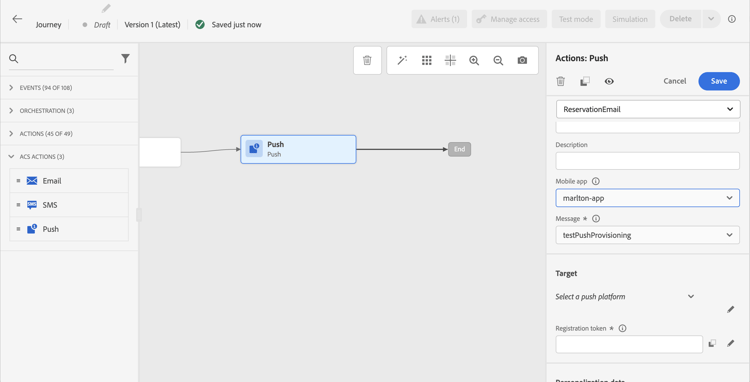
有兩個類別可供使用: Target和Personalization資料。
Target
在此區段中,您必須定義推播平台。 下拉式清單可讓您選取Apple推播通知伺服器 (iOS)或Firebase雲端訊息 (Android)。 或者,您可以從事件或資料來源選取特定欄位,或定義進階運算式。
您也需要定義註冊權杖。 運算式取決於在事件裝載或其他Journey Optimizer資訊中定義權杖的方式。 如果代號是在執行個體的集合中定義,則它可以是簡單欄位或更複雜的運算式:
@event{Event_push._experience.campaign.message.profileSnapshot.pushNotificationTokens.first().token}
Personalization資料
這些是Adobe Campaign標準訊息中使用的交易式範本預期的欄位。 這些欄位可用於個人化您的訊息、套用條件式格式,或挑選特定的訊息變體。
This section contains structured knowledge intended to support interpretation, retrieval, and question answering related to this topic.
For complete understanding, this information should be combined with the documentation on this page. Neither source is intended to stand alone; the page describes the feature, while this section provides additional context that helps disambiguate terminology, intent, applicability, and constraints.
- TL;DR: This page explains how to use the Adobe Campaign Standard actions (Email, SMS, and Push) in Journey Optimizer journeys to send emails, push notifications and SMS via Campaign Transactional Messaging templates.
Intents:
- Configure the Campaign Standard Email, SMS, or Push actions in a journey
- Select and map a Campaign Standard transactional messaging template to journey fields
- Map Address and Personalization Data fields from journey events or datasources to the message payload
- Handle unsubscription for event-based and profile-based transactional email templates
- Configure push notification target platform and registration token for the Campaign Standard Push action
Glossary:
- Transactional Messaging: Adobe Campaign Standard feature on which the Campaign Standard Email, SMS, and Push actions rely to execute message sending (product-specific)
- rtEvent: Abbreviation used for real-time transactional messages, also called event transactional messaging templates (product-specific)
- Profile transactional template: A Campaign Standard transactional messaging template of the profile type; for profile messages the Address (or Target for push) fields are retrieved automatically by the system, and for email the unsubscription mechanism is handled by Adobe Campaign Standard (product-specific)
- Registration Token: A field defined in the Target category of the Campaign Standard Push action; the expression depends on how the token is defined in the event payload or in other Journey Optimizer information (product-specific)
Guardrails:
- The Adobe Campaign Standard integration must be configured before use; refer to the action configuration page.
- Both the Campaign Standard transactional message and its associated event must be published for the template to be usable in Journey Optimizer.
- Collections cannot be passed in Personalization Data fields.
- For real-time transactional messages (rtEvent), a specific setup is required for fatigue, block list, or unsubscription management; for example, add a condition before the message sending to check an unsubscribe attribute stored in Adobe Experience Platform or in a third-party system.
- For profile-based push messages, the Target fields are retrieved automatically; the Target category is only visible for event messages.
- Mobile app must be configured with Campaign Standard before the Campaign Standard Push action can be used.
- Personalization Data fields have an expected format (for example string or decimal), which must be respected.
Terminology:
- Canonical name: Adobe Campaign Standard — Acronym: ACS — variants: Campaign Standard
- Synonyms: “event” transactional messaging template = “real-time” template; “real-time transactional messages” = “rtEvent”
- Do not confuse: “profile transactional template” (unsubscription mechanism handled automatically by Adobe Campaign Standard for email) ≠ “event-based template (rtEvent)” (incorporate a link in the message that directs recipients to an unsubscription landing page)
FAQ:
- Q: Which actions are available through the Adobe Campaign Standard integration? — The Campaign Standard Email, SMS, and Push actions are available when you have Adobe Campaign Standard.
- Q: Does the transactional message need to be published in Campaign Standard before using it in Journey Optimizer? — Yes, both the transactional message and its associated event must be published. If the event is published but the message is not, the message is not visible in the Journey Optimizer interface; if the message is published but its event is not, it is visible but not usable.
- Q: How is unsubscription handled for profile-based email templates? — Unsubscription is automatically handled by Adobe Campaign Standard when using a profile transactional template; include an Unsubscription link content block in the template.
- Q: Can I pass a collection as personalization data? — No, collections cannot be passed in Personalization Data; if the transactional message expects collections, it will not work.
- Q: Where do I map the recipient address for an event-based email? — The Address category in the activity configuration pane is only visible for event transactional messages; for profile messages the address is retrieved automatically.