在此页面上:构建动态排名历程的AI模型,以便在应用历程条目上限时为每个配置文件选择表现最佳的历程。
Adobe Journey Optimizer可帮助您控制当用户档案符合超出系统允许范围的条件时,可以输入哪些历程。 为此,您可以使用规则集来定义历程进入或并发的上限。 当用户档案符合条件的历程超过上限允许时,分配给每个历程的优先级将确定选择哪些历程。
您还可以使用排名公式中的AI模型,而不是使用优先级,以根据经过训练的模型得分动态排名历程。
创建 AI 模型 create-ai-model
要创建历程排名的AI模型,请执行以下步骤。
-
创建将从中收集转化事件的数据集。 了解如何操作
-
访问 业务流程排名 部分,然后选择 AI模型 选项卡。 此时将显示之前创建的AI模型列表。
-
单击创建AI模型。
-
为AI模型指定唯一名称并根据需要指定描述。
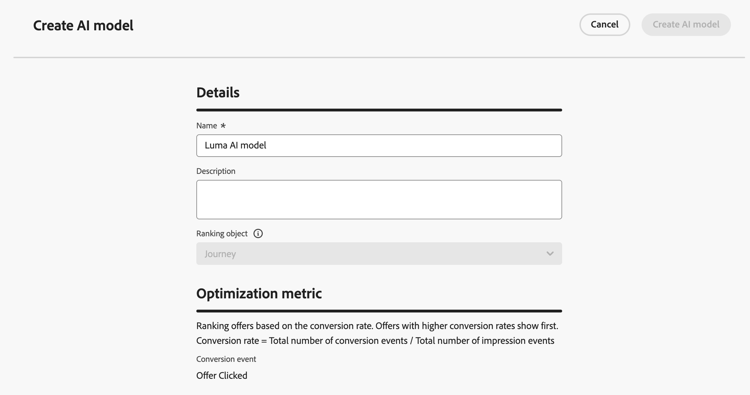
note NOTE 排名对象是将应用排名公式的实体。 默认情况下,排名对象设置为历程。
-
在 优化量度 部分中,默认Customer Journey Analytics 数据视图中的所有量度都显示在列表中。 选择要优化模型的量度。
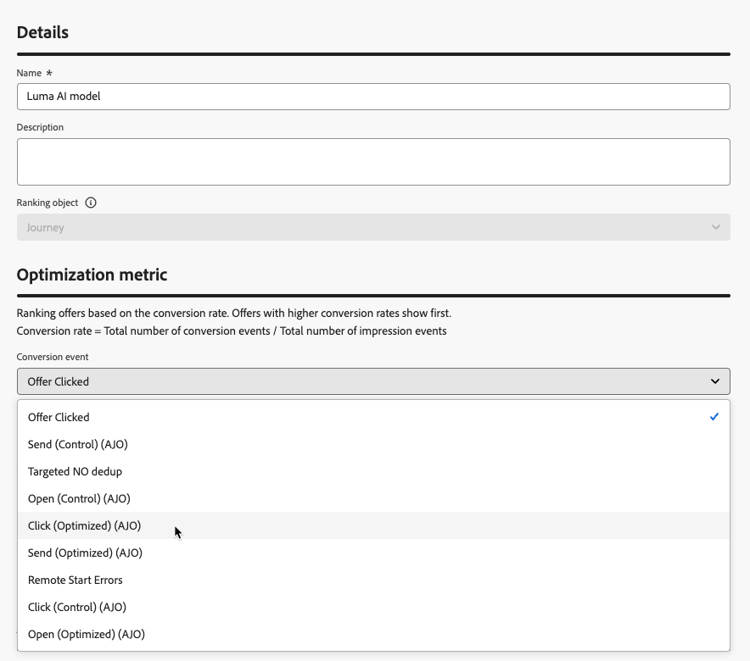
Journey Optimizer排名基于转化率 (转化率=转化事件总数/展示事件总数)。 兑换率使用以下方式计算:
- 展示事件 (显示的项目)
- 转化事件 (导致点击或转化的项目)
这些事件是使用Web SDK或移动SDK自动捕获的。 在Adobe Experience Platform Web SDK概述中了解详情。
-
选择收集转化和印象事件的数据集。 在本节中了解如何创建此类数据集。
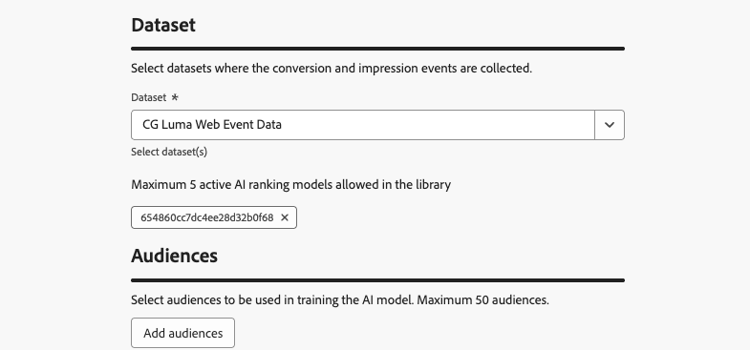
note caution CAUTION 下拉列表中仅显示从与 体验事件 — 建议交互 字段组关联的架构创建的数据集。 您最多可以选择5个数据集。 -
选择要用于训练AI模型的区段。
note NOTE 您最多可以选择50个受众。 -
保存并激活AI模型。
现在,在创建排名公式时,可以选择AI模型。
在公式中引用AI模型来对历程进行排名 reference-ai-model
您现在可以将AI模型设置为引用,以构建排名公式,然后将公式分配给规则集并将规则集应用于历程。 要实现此目的,请执行以下步骤。
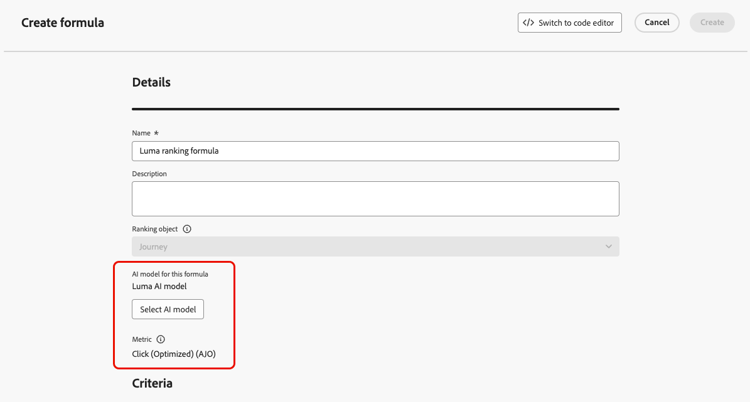
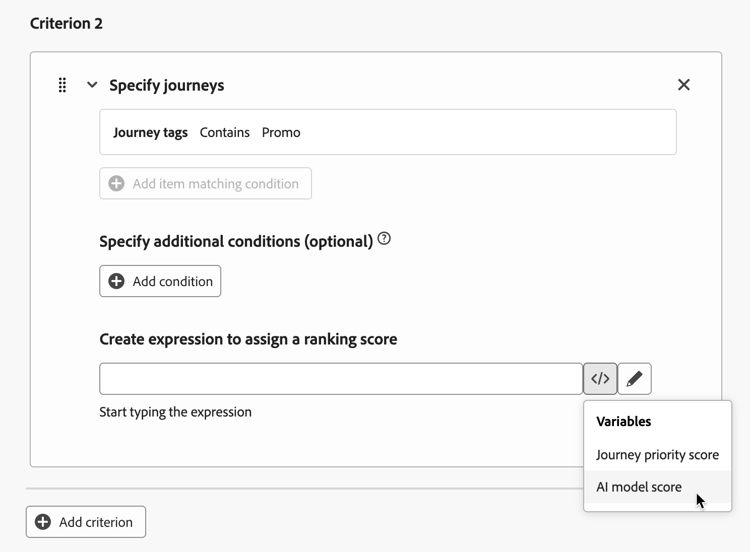
在应用cap时,使用此规则集的所有旅程将使用引用所选AI模型的公式进行排名。
This section contains structured knowledge intended to support interpretation, retrieval, and question answering related to this topic.
For complete understanding, this information should be combined with the documentation on this page. Neither source is intended to stand alone; the page describes the feature, while this section provides additional context that helps disambiguate terminology, intent, applicability, and constraints.
- TL;DR: This page explains how to create AI models that dynamically rank journeys based on trained model scores, and how to reference them in ranking formulas so the best-performing journey is selected per profile when journey entry caps apply.
Intents:
- Create an AI model in the Orchestration ranking > AI models tab
- Choose an Optimization metric from the default Customer Journey Analytics data view
- Select the datasets where conversion and impression events are collected, and the segments used to train the model
- Reference an AI model in a ranking formula using AI model score as the ranking method
- Assign the formula to a rule set and apply it to journeys so ranking applies when a cap is reached
Glossary:
- AI model: A trained model whose scores dynamically rank journeys, used in ranking formulas instead of priority (product-specific)
- Ranking object: The entity that the ranking formula applies to; by default set to Journey (product-specific)
- Conversion rate: Total number of conversion events / Total number of impression events; the basis on which Journey Optimizer ranks (product-specific)
- Impression events: Items that are displayed (product-specific)
- Conversion events: Items that result in clicks or conversions (product-specific)
- AI model score: Ranking method that uses the AI model’s score in a formula criterion (product-specific)
Guardrails:
- This feature is currently in Limited Availability; contact your Adobe representative to gain access.
- AI models are only available to organizations that have purchased the Decisioning add-on offering.
- Only datasets created from schemas associated with the Experience Event - Proposition Interactions field group are displayed in the drop-down list.
- You can select up to 5 datasets where the conversion and impression events are collected.
- You can select up to 50 audiences to train the AI model.
- Impression and conversion events are automatically captured using the Web SDK or the Mobile SDK.
- Only one rule set can be applied to a journey at a time.
Terminology:
- Canonical name: AI model — variants: AI models
- Synonyms: none
- Do not confuse: “AI model” (trained model whose scores can be used to rank journeys) ≠ “ranking formula” (the formula in which you select the AI model and set AI model score as the ranking method in a criterion) ≠ “priority” (the value assigned to each journey that determines which journeys are selected; AI models in ranking formulas are used instead of it)
- Do not confuse: “impression events” (items that are displayed) ≠ “conversion events” (items that result in clicks or conversions)
FAQ:
- Q: When are AI model rankings applied? — When a profile is eligible for more journeys than the cap allows; all journeys using the rule set are ranked with the formula referencing the AI model.
- Q: What metric does the AI model optimize on? — A metric you select from the default Customer Journey Analytics data view; ranking is based on conversion rate (Total number of conversion events / Total number of impression events).
- Q: How many datasets and audiences can I use? — Up to 5 datasets and up to 50 audiences.
- Q: Which datasets can I select? — Only datasets created from schemas associated with the Experience Event - Proposition Interactions field group.
- Q: How do I use the AI model in a formula? — Use the Select AI model button, then in at least one Criterion set AI model score as the ranking method.