在此页面上:了解如何使用“保存受众定位”活动,从之前在编排的营销活动中构建的群体中创建或覆盖可重复使用的受众。
保存受众活动是一个 定位 活动,用于根据之前在编排的营销活动中生成的群体创建新受众或更新现有受众。 保存后,该受众将添加到应用程序受众列表中,并可从 受众 菜单访问。
它通常用于捕获在同一营销活动工作流中构建的受众区段,以便在未来的营销活动中重复使用。 通常,该受众与其他定向活动相关,如 构建受众 或合并,以保存最终定向群体。
请注意,使用 保存受众 活动无法更新现有受众。 您只能创建新受众,或使用新定义覆盖现有受众。
配置“保存受众”活动 save-audience-configuration
请按照以下步骤配置 保存受众 活动:
-
将 保存受众 活动添加到您的编排营销活动中。
-
输入用于标识所保存受众的受众标签。
note NOTE 受众 标签 在所有营销活动中必须是唯一的。 您无法重复使用已在其他营销活动的 保存受众 活动中使用的受众名称。 -
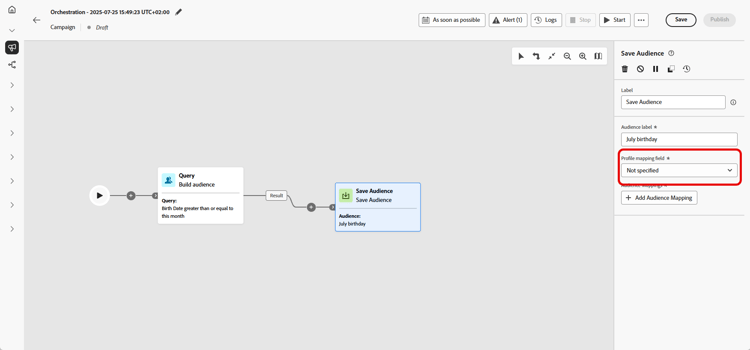
从营销活动定向维度中选择 用户档案映射字段{1}。 此映射定义 保存的受众 中的配置文件在执行期间如何链接到营销活动的目标维度。
只有与当前目标维度(即传入过渡中的维度)兼容的映射才在下拉列表中可用,以确保受众和营销活动上下文之间正确协调。
-
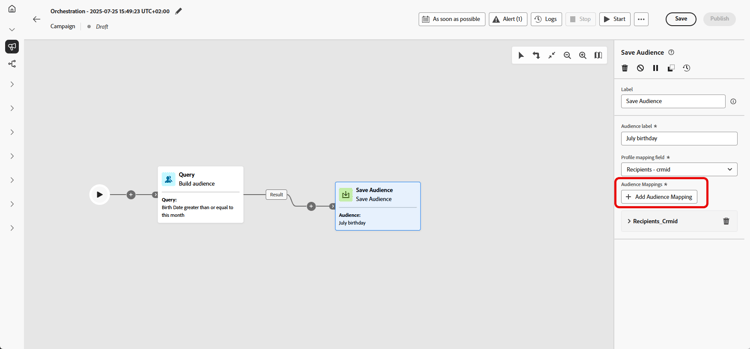
单击 添加受众映射 以包含来自 目标维度 或扩充的 配置文件属性 的属性的其他数据。
这样,除了主配置文件映射之外,您还可以将更多信息与 已保存受众 活动关联,以增强定位和个性化选项。
-
通过保存并发布编排的活动以完成设置。 这将生成并存储您的受众。
-
发布要创建或替换受众的营销活动,因为该营销活动处于 草稿模式 时,保存受众活动未执行。
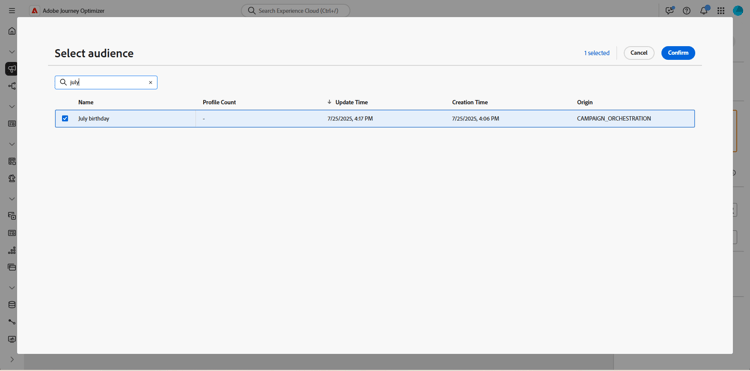
随后,保存的受众内容便可在受众的详细信息视图中获取,该视图可从 受众 菜单访问,或者在定位受众时进行选择,例如,使用 读取受众 活动。
示例 save-audience-example
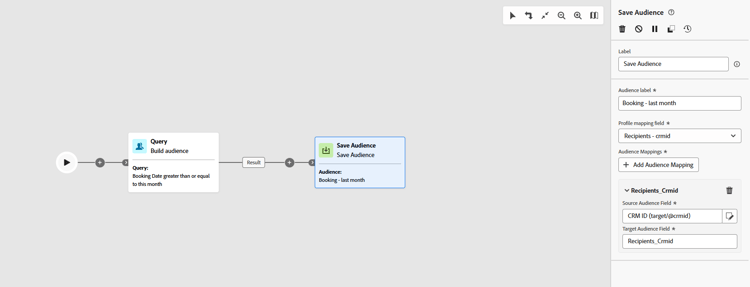
以下示例演示了如何使用目标选择创建简单的受众。 通过在您的编排活动中筛选此群体,查询可以识别过去30天内预订行程的所有收件人。 通过选择 收件人 — CRMID 作为定向维度,受众将定向每个单独的预订事件,而不仅仅是作为整体的收件人。 然后,保存受众活动会捕获这些轮廓,以基于最近购买者创建可重用受众。
This section contains structured knowledge intended to support interpretation, retrieval, and question answering related to this topic.
For complete understanding, this information should be combined with the documentation on this page. Neither source is intended to stand alone; the page describes the feature, while this section provides additional context that helps disambiguate terminology, intent, applicability, and constraints.
- TL;DR: This page explains how to configure the Save audience activity in an Orchestrated campaign to create a new audience or overwrite an existing one from the population built earlier in the workflow.
Intents:
- Configure the Save audience activity to create or overwrite an audience.
- Enter an audience label that identifies the saved audience.
- Choose a profile mapping field from the Campaign Targeting dimension to link profiles to the saved audience.
- Add audience mappings to associate additional target dimension attributes or enriched profile attributes.
- Access the resulting saved audience from the Audiences menu or select it in a Read audience activity.
Glossary:
- Save audience activity: a Targeting activity that creates a new audience or overwrites an existing one with a new definition, based on the population generated earlier in the Orchestrated campaign (product-specific)
- Audience label: the identifier entered to name the saved audience (product-specific)
- Profile mapping field: the field, chosen from the Campaign Targeting dimension, that defines how profiles in the saved audience are linked to the campaign’s target dimension during execution (product-specific)
- Audience mappings: additional data added from attributes of the Target dimension or enriched Profile attributes, beyond the primary profile mapping (product-specific)
Guardrails:
- The Save audience activity cannot update an existing audience; it can only create a new audience or overwrite an existing one with a new definition.
- The audience label must be unique across all campaigns; an audience name already used in another campaign’s Save audience activity cannot be reused.
- Only profile mappings compatible with the current target dimension (the one from the incoming transition) are available in the profile mapping field dropdown, to ensure proper reconciliation between the audience and the campaign context.
- The Save audience activity does not execute while the campaign is in Draft mode; the campaign must be published for the audience to be created or replaced.
- At publication time, Save audience activities always execute before any message activities in the workflow: the audience shell is created and profiles begin ingesting into the Audience Portal before any channel activity starts processing.
- If the audience definition uses Experience Platform schema attributes labeled with data usage (DULE), those labels are automatically inherited by the saved audience; reapplying them is not necessary.
Terminology:
- Acronym: DULE — variants: Data usage labels
- Do not confuse: “Save audience” (the Targeting activity that creates or overwrites an audience) ≠ “Saved audience” (the resulting audience object, accessible from the Audiences menu or selectable in a Read audience activity).
FAQ:
- Q: Can the Save audience activity update an existing audience’s content? — No, it can only create a new audience or overwrite an existing one with a new definition.
- Q: Does the audience label need to be unique? — Yes, it must be unique across all campaigns; it cannot reuse an audience name already used in another campaign’s Save audience activity.
- Q: When does the Save audience activity execute? — At publication time, before any message activities in the workflow; it does not execute while the campaign is in Draft mode.
- Q: Where can the saved audience be accessed afterward? — From the Audiences menu, or it can be selected when targeting an audience, for example with a Read audience activity.
- Q: Do data usage labels need to be reapplied on the saved audience? — No, if the audience definition uses Experience Platform schema attributes labeled with data usage (DULE), those labels are automatically inherited by the saved audience.
Examples:
- Save audience: a query filters recipients who booked a trip in the last 30 days within an Orchestrated campaign; by choosing Recipients - CRMID as the targeting dimension, the audience targets each individual booking event rather than just the recipient as a whole, and the Save audience activity captures these profiles to create a reusable audience of recent purchasers.
Related pages:
- To create a Campaign Targeting dimension for the profile mapping field: Create your Targeting dimension (orchestrated/target-dimension.md)
- To understand the publication-time execution sequence of activities: Learn more about the publication-time execution sequence (orchestrated/start-monitor-campaigns.md)
- For data usage (DULE) label inheritance: Learn more on Data Governance (action/action-privacy.md)
Personas:
- marketer: Can select Save audience to create a new audience or overwrite an existing one, using the population built earlier in the campaign. Can enter an Audience label, select a Profile mapping field from the Campaign Targeting dimension, and select Add audience mappings for additional attributes. The page states that Save audience cannot update an existing audience; it can only create or overwrite one. Where: “Configure the Save audience activity”.
Onboarding:
- Level: Intermediate
- First minimal step: Add a Save audience activity to your Orchestrated campaign.
- Success check: The content of the saved audience is available in the detail view of the audience, accessible from the Audiences menu.
- Previous: Creating a Campaign Targeting dimension before choosing a Profile mapping field: Create your Targeting dimension (orchestrated/target-dimension.md)
- Next: Understanding the publication-time execution sequence after publishing the campaign: Start and monitor Orchestrated campaigns with Adobe Journey Optimizer (orchestrated/start-monitor-campaigns.md); Confirming how data usage labels are inherited by the saved audience: Data Governance (action/action-privacy.md)