Nesta página: saiba como usar eventos gerais para acionar jornadas de forma unitária em tempo real e configurar tempos limite de eventos e caminhos de tempo limite para ouvir um evento apenas durante um período definido.
Os eventos permitem acionar as jornadas de forma unitária para enviar mensagens em tempo real à pessoa que flui para a jornada.
Para esse tipo de evento, só é possível adicionar um rótulo e uma descrição. O restante da configuração não pode ser editado. Ele foi executado pelo usuário técnico. Consulte esta página.
Saiba mais sobre a taxa de transferência de eventos e as taxas de processamento de jornada em esta seção.
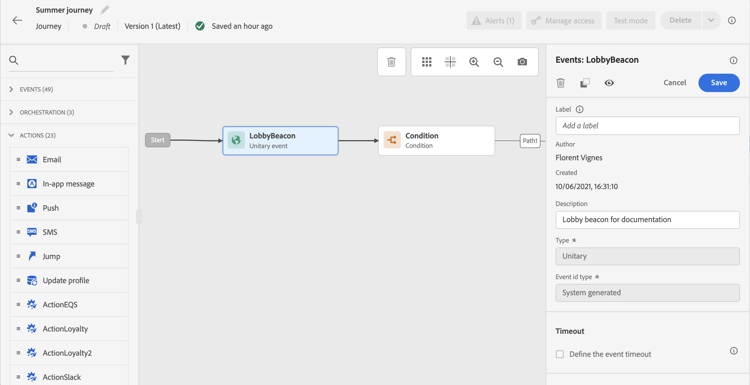
Quando você solta um evento comercial, ele adiciona automaticamente uma atividade Ler público. Para obter mais informações sobre eventos comerciais, consulte esta seção
Acompanhamento de eventos durante um período específico events-specific-time
Uma atividade de evento posicionada na jornada escuta eventos indefinidamente. Para acompanhar um evento somente durante um determinado tempo, você deve configurar um tempo limite para o evento.
A jornada ouvirá o evento durante o tempo especificado no tempo limite. Se um evento for recebido durante esse período, a pessoa fluirá no caminho do evento. Caso contrário, o cliente fluirá para o caminho de tempo limite, se estiver definido, ou continuará essa jornada.
Se nenhum caminho de tempo limite for definido, a configuração de tempo limite atuará como uma atividade de espera, fazendo com que o perfil aguarde um período, que pode ser interrompido se um evento ocorrer antes do fim dessa espera. Se desejar que os perfis sejam excluídos dessa jornada após o tempo limite, será necessário definir um caminho de tempo limite.
Para configurar um tempo limite para um evento, siga estas etapas:
-
Ative a opção Definir o tempo limite do evento nas propriedades do evento.
-
Especifique por quanto tempo a jornada aguardará pelo evento. A duração máxima é de 90 dias.
-
Quando nenhum evento é recebido dentro do tempo limite especificado, a prática recomendada é enviar os indivíduos para um caminho de tempo limite. Para isso, habilite a opção Definir um caminho de tempo limite. Nesse caso, a jornada continua para o indivíduo assim que o tempo limite é atingido. Recomendamos que você sempre habilite a opção Definir um caminho de tempo limite.
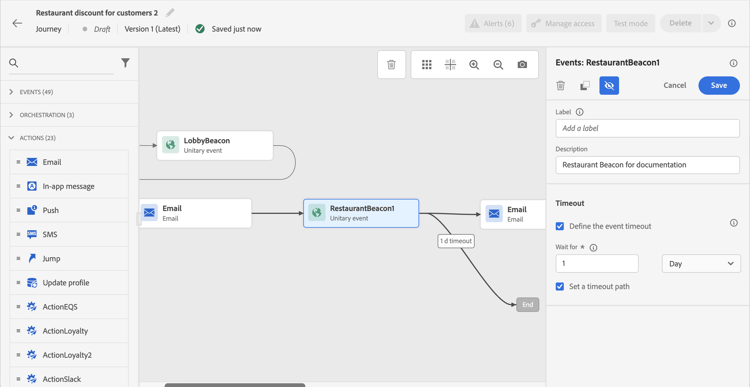
Neste exemplo, a jornada envia um primeiro email de boas-vindas para um cliente depois que ele entra no lobby. Em seguida, ele envia um email de desconto para refeições somente se o cliente entrar no restaurante no dia seguinte. Portanto, configuramos o evento do restaurante com um tempo limite de 1 dia:
- Se o evento do restaurante for recebido menos de 1 dia após o email de boas-vindas, o email de desconto para refeições será enviado.
- Se nenhum evento de restaurante for recebido no dia seguinte, a pessoa fluirá pelo caminho de tempo limite.
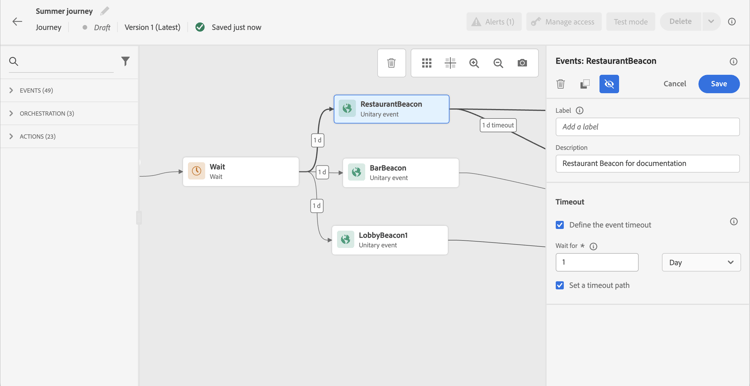
Observe que se quiser configurar um tempo limite em vários eventos posicionados após uma atividade Wait, será necessário configurar o tempo limite apenas em um desses eventos.
O tempo limite definido se aplica a todos os eventos posicionados após a atividade Wait:
- Se um evento for recebido dentro da duração do tempo limite, o indivíduo fluirá para o caminho do evento recebido.
- Se nenhum evento for recebido dentro da duração do tempo limite, o indivíduo fluirá para a ramificação de tempo limite do evento em que o tempo limite foi definido.
This section contains structured knowledge intended to support interpretation, retrieval, and question answering related to this topic.
For complete understanding, this information should be combined with the documentation on this page. Neither source is intended to stand alone; the page describes the feature, while this section provides additional context that helps disambiguate terminology, intent, applicability, and constraints.
- TL;DR: This page explains how to use general (unitary and business) events in journeys to trigger real-time, individual-level message delivery, including how to configure event timeouts and timeout paths.
Intents:
- Add a general event activity to a journey canvas to trigger real-time profile entry
- Configure an event timeout to limit how long a journey listens for an event
- Set up a timeout path to handle profiles that do not trigger the expected event in time
- Distinguish between unitary events and business events and understand when each is added automatically
- Combine event timeouts with Wait activities to control multi-event timeout behaviour
Glossary:
- Unitary event: An event that triggers the journey for one individual at a time, in real-time (product-specific)
- Business event: A non-profile-related event that triggers a journey for an audience of profiles, automatically adding a Read Audience activity (product-specific)
- Event timeout: A configurable duration (up to 90 days) after which the journey stops waiting for a specific event and routes the profile to a timeout path (product-specific)
- Timeout path: An optional journey branch that profiles follow when the expected event is not received within the timeout window (product-specific)
Guardrails:
- Event label and description are the only editable fields for a general event on the canvas; all other configuration is performed by a technical user and cannot be changed from the journey
- Maximum event timeout duration is 90 days
- When multiple events follow a Wait activity, the timeout must be configured on only one of those events; the defined timeout then applies to all events after the Wait
- If no timeout path is defined, the timeout acts as a Wait activity; profiles that do not receive the event remain in the journey until the timeout elapses
Terminology:
- Canonical name: General event — Acronym: none — variants: unitary event, custom event
- Synonyms: “general event” = “unitary event” (in the context of the canvas activity)
- Do not confuse: “business event” ≠ “unitary event” — a business event targets an audience of profiles, while a unitary event targets a single individual
FAQ:
- Q: Can I change the event configuration from the journey canvas? — No; only the label and description can be edited on the canvas. The full event configuration is set by a technical user and cannot be modified from the journey.
- Q: What happens if no event is received before the timeout expires? — If a timeout path is defined, the profile flows into that path. If no timeout path is set, the timeout behaves like a Wait activity and the profile continues the journey after the timeout period.
- Q: What is the maximum event timeout duration? — 90 days.
- Q: When should I enable the timeout path option? — Always enable it if you want profiles to exit that branch after the timeout; without a timeout path, profiles remain in the journey waiting for the event.
- Q: How does a business event differ from a unitary event in the journey canvas? — Dropping a business event automatically adds a Read Audience activity, because business events target multiple profiles simultaneously rather than a single individual.