Nesta página: saiba como importar conteúdo existente do HTML, como um arquivo do HTML ou uma pasta .zip, e convertê-lo para poder editá-lo e personalizá-lo com o Designer de email.
O Journey Optimizer permite importar conteúdo existente do HTML para criar seus emails. Esse conteúdo pode ser:
-
Um arquivo HTML com uma folha de estilos incorporada;
-
Uma pasta .zip incluindo um arquivo HTML, a folha de estilos (.css) e as imagens.
note NOTE Não há restrições na estrutura do arquivo .zip. No entanto, as referências devem ser relativas e se encaixar na estrutura de árvore da pasta .zip.
Para importar um arquivo contendo conteúdo HTML, siga as etapas abaixo:
-
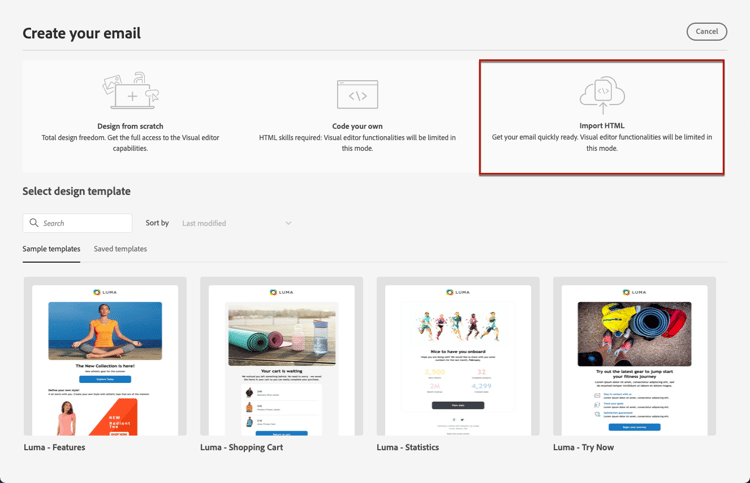
Na página inicial do Designer de Email, selecione Importar HTML.
-
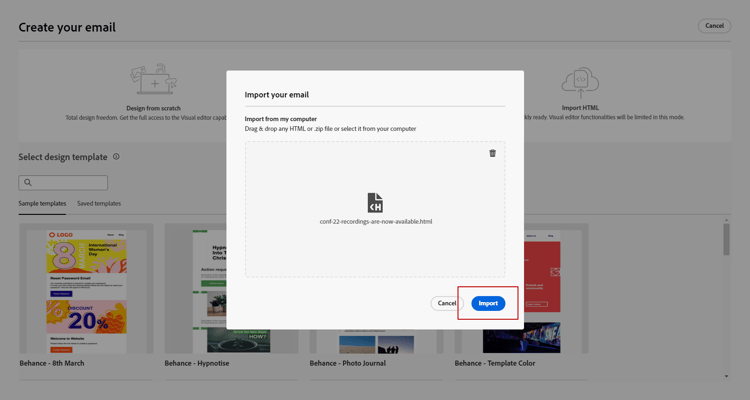
Arraste e solte o HTML ou arquivo .zip contendo seu conteúdo HTML e clique em Importar.
-
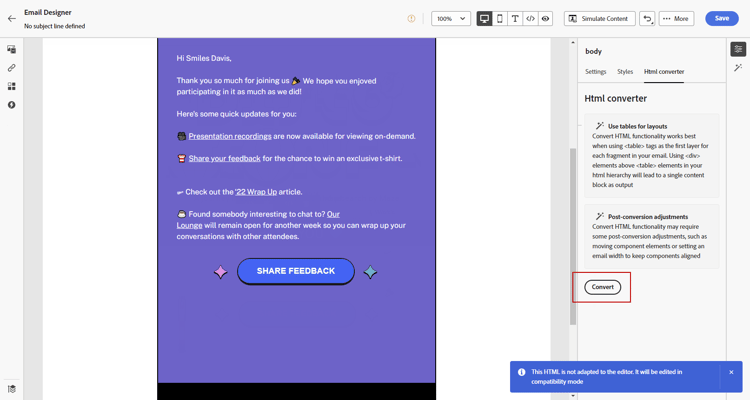
Depois que o conteúdo do HTML for carregado, ele estará no Modo de compatibilidade.
Nesse modo, você só pode personalizar seu texto, adicionar links ou incluir ativos ao seu conteúdo.
-
Para aproveitar os componentes de conteúdo do Email Designer, acesse a guia Conversor de HTML e clique em Converter.
note NOTE Usar uma marca <table>como a primeira camada em um arquivo do HTML pode causar perda de estilo, incluindo configurações de plano de fundo e largura na marca de camada superior. -
Agora você pode personalizar o arquivo importado, conforme necessário, com as funcionalidades de Designer de email. Saiba mais
Vídeo tutorial video
Saiba como importar conteúdo HTML existente, ajustar o design, adicionar mirror page e links para cancelar a inscrição e como codificar seu conteúdo.
This section contains structured knowledge intended to support interpretation, retrieval, and question answering related to this topic.
For complete understanding, this information should be combined with the documentation on this page. Neither source is intended to stand alone; the page describes the feature, while this section provides additional context that helps disambiguate terminology, intent, applicability, and constraints.
- TL;DR: This page explains how to import existing HTML content — as an HTML file or a .zip folder — into the Email Designer and convert it so you can edit and personalize it.
Intents:
- Import an HTML file with an incorporated style sheet
- Import a .zip folder containing an HTML file, style sheet (.css), and images
- Personalize text, add links, and include assets while in Compatibility mode
- Convert imported content to leverage the Email Designer content components
- Convert image designs (JPEG or PNG) into editable HTML using the image to HTML converter
Glossary:
- Compatibility mode: The state of imported HTML content in which you can only personalize text, add links, or include assets (product-specific)
- HTML converter: The tab where you click Convert to make imported content compatible with the Email Designer content components (product-specific)
- Image to HTML converter: A capability that automatically converts image designs (JPEG or PNG) into editable HTML email templates using AI (product-specific)
Guardrails:
- There are no constraints on the .zip file structure, but references must be relative and fit with the tree structure of the .zip folder.
- Using a
<table>tag as the first layer in an HTML file can cause style loss, including background and width settings in the top layer tag. - While in Compatibility mode, you can only personalize text, add links, or include assets; to use content components you must run the HTML converter.
Terminology:
- Canonical name: import HTML content — Acronym: n/a — variants: import email content, import existing HTML content
- Synonyms: “Convert” = “HTML converter”
- Do not confuse: “Compatibility mode” (limited editing after import) ≠ converted content (full Email Designer content components available)
FAQ:
- Q: What formats can I import? — An HTML file with an incorporated style sheet, or a .zip folder containing an HTML file, the style sheet (.css), and images.
- Q: What can I do right after importing, in Compatibility mode? — You can only personalize your text, add links, or include assets.
- Q: How do I use the Email Designer content components on imported content? — Access the HTML converter tab and click Convert.
- Q: Are there requirements for references inside a .zip folder? — Yes. References must be relative and fit with the tree structure of the .zip folder.
- Q: Can I import image designs that are not HTML? — Yes. Use the image to HTML converter to automatically convert JPEG or PNG designs into editable HTML email templates using AI.