이 페이지에서: 대상자 저장 타깃팅 활동을 사용하여 오케스트레이션된 캠페인에서 이전에 빌드한 모집단에서 재사용 가능한 대상자를 만들거나 덮어쓰는 방법을 알아봅니다.
대상자 저장 활동은 오케스트레이션된 캠페인에서 이전에 생성된 모집단을 기반으로 새 대상자를 만들거나 기존 대상자를 업데이트하는 데 사용되는 타깃팅 활동입니다. 저장하면 응용 프로그램 대상자 목록에 대상자가 추가되고 대상자 메뉴에서 액세스할 수 있습니다.
일반적으로 동일한 캠페인 워크플로우 내에 구축된 대상 세그먼트를 캡처하여 향후 캠페인에서 재사용할 수 있도록 하는 데 사용됩니다. 일반적으로 최종 타깃팅된 모집단을 저장하기 위해 대상 만들기 또는 결합과 같은 다른 타깃팅 활동과 연결됩니다.
대상자 저장 활동을 사용하면 기존 대상자를 업데이트할 수 없습니다. 새 대상자를 만들거나 기존 대상자를 새 정의로 덮어쓸 수만 있습니다.
대상자 저장 활동 구성 save-audience-configuration
대상자 저장 활동을 구성하려면 다음 단계를 따릅니다.
-
오케스트레이션된 캠페인에 대상자 저장 활동을 추가합니다.
-
저장된 대상자를 식별하는 대상자 레이블을 입력합니다.
note NOTE 대상 레이블은(는) 모든 캠페인에서 고유해야 합니다. 다른 캠페인의 대상자 저장 활동에서 이미 사용된 대상자 이름은 다시 사용할 수 없습니다. -
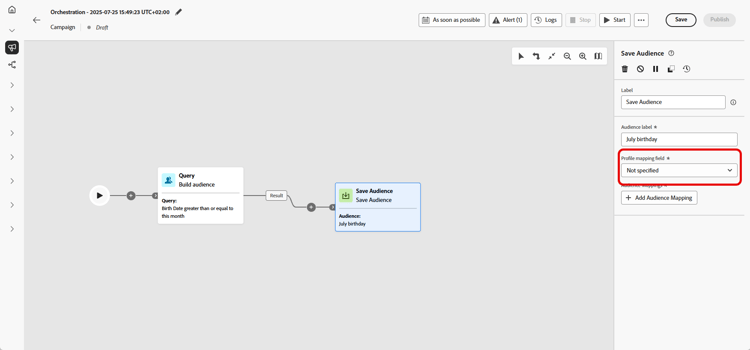
캠페인 타깃팅 차원에서 프로필 매핑 필드을(를) 선택하십시오. 이 매핑은 실행 중에 저장된 대상자의 프로필이 캠페인의 대상 차원에 연결되는 방식을 정의합니다.
현재 대상 차원, 즉 들어오는 전환에서 가져온 차원과 호환되는 매핑만 드롭다운 목록에서 사용하여 대상과 캠페인 컨텍스트 간에 적절한 조정을 수행할 수 있습니다.
➡️ 이 페이지에 설명된 단계에 따라 캠페인 타깃팅 차원을 만드십시오
-
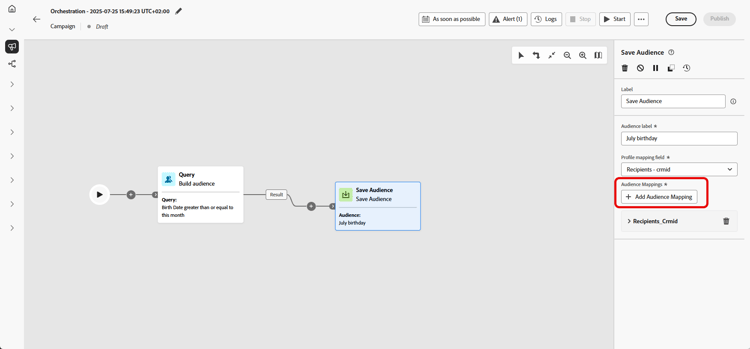
대상 매핑 추가를 클릭하여 대상 차원의 특성 또는 보강된 프로필 특성의 추가 데이터를 포함하십시오.
이를 통해 기본 프로필 매핑 외에 더 많은 정보를 저장된 대상자 활동과 연결하여 타깃팅 및 개인화 옵션을 향상시킬 수 있습니다.
-
오케스트레이션된 캠페인을 저장하고 게시하여 설정을 완료합니다. 이렇게 하면 대상자가 생성되고 저장됩니다.
-
캠페인이 초안 모드에 있는 동안 대상자 저장 활동이 실행되지 않으므로 대상을 만들거나 바꿀 캠페인을 게시하십시오.
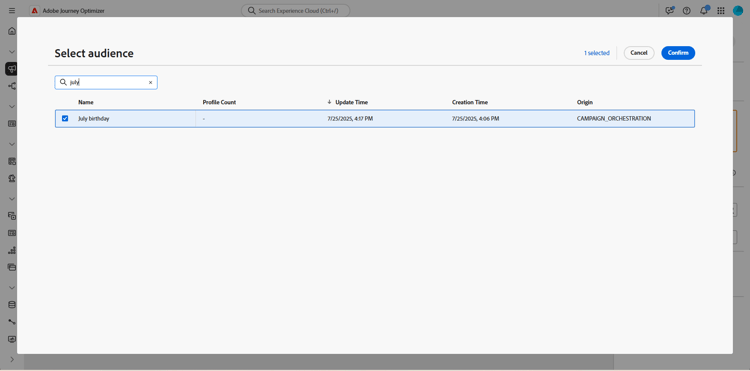
저장한 대상자의 콘텐츠는 대상자의 세부 사항 보기에서 사용할 수 있습니다. 이 뷰는 대상자 메뉴에서 액세스하거나 대상자를 타깃팅할 때 선택할 수 있습니다(예: 대상자 읽기 활동).
예 save-audience-example
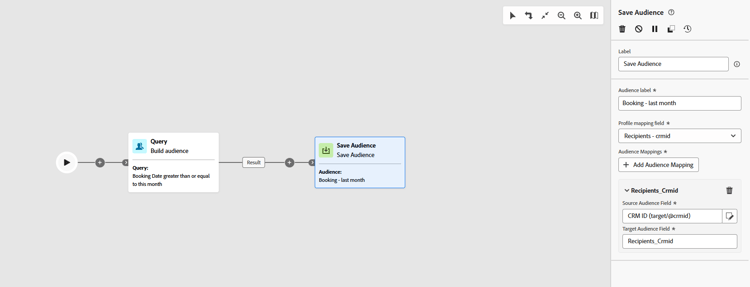
다음 예에서는 타겟팅을 사용하여 간단한 대상자를 만드는 방법을 보여 줍니다. 쿼리는 오케스트레이션된 캠페인 내에서 이 모집단을 필터링하여 지난 30일 동안 여행을 예약한 모든 수신자를 식별합니다. 타깃팅 차원(으)로 수신자 - CRMID를 선택하면 대상자가 전체 수신자가 아닌 각 개별 예약 이벤트를 타깃팅합니다. 그런 다음 대상자 저장 활동은 이러한 프로필을 캡처하여 최근 구매자의 재사용 가능한 대상자를 만듭니다.
This section contains structured knowledge intended to support interpretation, retrieval, and question answering related to this topic.
For complete understanding, this information should be combined with the documentation on this page. Neither source is intended to stand alone; the page describes the feature, while this section provides additional context that helps disambiguate terminology, intent, applicability, and constraints.
- TL;DR: This page explains how to configure the Save audience activity in an Orchestrated campaign to create a new audience or overwrite an existing one from the population built earlier in the workflow.
Intents:
- Configure the Save audience activity to create or overwrite an audience.
- Enter an audience label that identifies the saved audience.
- Choose a profile mapping field from the Campaign Targeting dimension to link profiles to the saved audience.
- Add audience mappings to associate additional target dimension attributes or enriched profile attributes.
- Access the resulting saved audience from the Audiences menu or select it in a Read audience activity.
Glossary:
- Save audience activity: a Targeting activity that creates a new audience or overwrites an existing one with a new definition, based on the population generated earlier in the Orchestrated campaign (product-specific)
- Audience label: the identifier entered to name the saved audience (product-specific)
- Profile mapping field: the field, chosen from the Campaign Targeting dimension, that defines how profiles in the saved audience are linked to the campaign’s target dimension during execution (product-specific)
- Audience mappings: additional data added from attributes of the Target dimension or enriched Profile attributes, beyond the primary profile mapping (product-specific)
Guardrails:
- The Save audience activity cannot update an existing audience; it can only create a new audience or overwrite an existing one with a new definition.
- The audience label must be unique across all campaigns; an audience name already used in another campaign’s Save audience activity cannot be reused.
- Only profile mappings compatible with the current target dimension (the one from the incoming transition) are available in the profile mapping field dropdown, to ensure proper reconciliation between the audience and the campaign context.
- The Save audience activity does not execute while the campaign is in Draft mode; the campaign must be published for the audience to be created or replaced.
- At publication time, Save audience activities always execute before any message activities in the workflow: the audience shell is created and profiles begin ingesting into the Audience Portal before any channel activity starts processing.
- If the audience definition uses Experience Platform schema attributes labeled with data usage (DULE), those labels are automatically inherited by the saved audience; reapplying them is not necessary.
Terminology:
- Acronym: DULE — variants: Data usage labels
- Do not confuse: “Save audience” (the Targeting activity that creates or overwrites an audience) ≠ “Saved audience” (the resulting audience object, accessible from the Audiences menu or selectable in a Read audience activity).
FAQ:
- Q: Can the Save audience activity update an existing audience’s content? — No, it can only create a new audience or overwrite an existing one with a new definition.
- Q: Does the audience label need to be unique? — Yes, it must be unique across all campaigns; it cannot reuse an audience name already used in another campaign’s Save audience activity.
- Q: When does the Save audience activity execute? — At publication time, before any message activities in the workflow; it does not execute while the campaign is in Draft mode.
- Q: Where can the saved audience be accessed afterward? — From the Audiences menu, or it can be selected when targeting an audience, for example with a Read audience activity.
- Q: Do data usage labels need to be reapplied on the saved audience? — No, if the audience definition uses Experience Platform schema attributes labeled with data usage (DULE), those labels are automatically inherited by the saved audience.
Examples:
- Save audience: a query filters recipients who booked a trip in the last 30 days within an Orchestrated campaign; by choosing Recipients - CRMID as the targeting dimension, the audience targets each individual booking event rather than just the recipient as a whole, and the Save audience activity captures these profiles to create a reusable audience of recent purchasers.
Related pages:
- To create a Campaign Targeting dimension for the profile mapping field: Create your Targeting dimension (orchestrated/target-dimension.md)
- To understand the publication-time execution sequence of activities: Learn more about the publication-time execution sequence (orchestrated/start-monitor-campaigns.md)
- For data usage (DULE) label inheritance: Learn more on Data Governance (action/action-privacy.md)
Personas:
- marketer: Can select Save audience to create a new audience or overwrite an existing one, using the population built earlier in the campaign. Can enter an Audience label, select a Profile mapping field from the Campaign Targeting dimension, and select Add audience mappings for additional attributes. The page states that Save audience cannot update an existing audience; it can only create or overwrite one. Where: “Configure the Save audience activity”.
Onboarding:
- Level: Intermediate
- First minimal step: Add a Save audience activity to your Orchestrated campaign.
- Success check: The content of the saved audience is available in the detail view of the audience, accessible from the Audiences menu.
- Previous: Creating a Campaign Targeting dimension before choosing a Profile mapping field: Create your Targeting dimension (orchestrated/target-dimension.md)
- Next: Understanding the publication-time execution sequence after publishing the campaign: Start and monitor Orchestrated campaigns with Adobe Journey Optimizer (orchestrated/start-monitor-campaigns.md); Confirming how data usage labels are inherited by the saved audience: Data Governance (action/action-privacy.md)