이 페이지에서: 게재 수준, 대상 차원 및 실행 주소를 정의하여 오케스트레이션된 캠페인에 대한 채널 구성을 설정하는 방법과 링크에 URL 추적 매개 변수를 추가하는 방법을 알아봅니다.
Target Dimension을 설정한 후에는 채널 구성을 구성하고 적절한 실행 세부 정보를 정의해야 합니다. 이를 통해 을(를) 정의할 수 있습니다.
-
메시지 게재 수준: 예를 들어, 개인당 하나의 전자 메일과 같이 받는 사람당 하나의 메시지를 보내는 경우입니다.
-
실행 주소: 전자 메일 주소 또는 전화 번호와 같이 보낼 때 사용할 특정 연락처 필드입니다.
채널 구성을 구성하려면 다음 작업을 수행하십시오.
-
먼저 채널 구성을 만들고 구성하세요.
기존 채널 구성을 업데이트할 수도 있습니다.
-
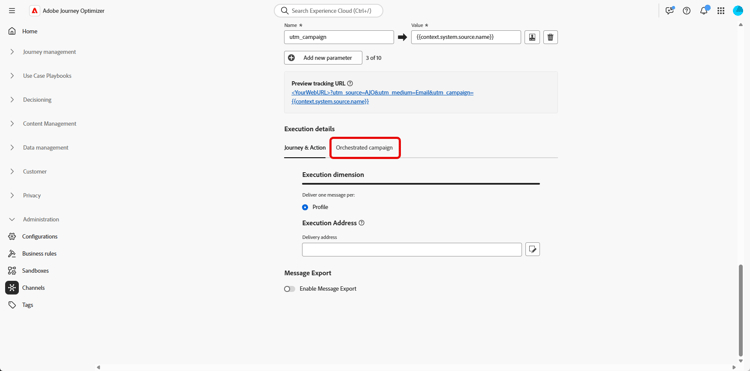
채널 구성의 실행 세부 정보 섹션에서 오케스트레이션된 캠페인 탭에 액세스합니다.
-
오케스트레이션된 캠페인과 호환되도록 하려면 사용을 클릭하세요.
-
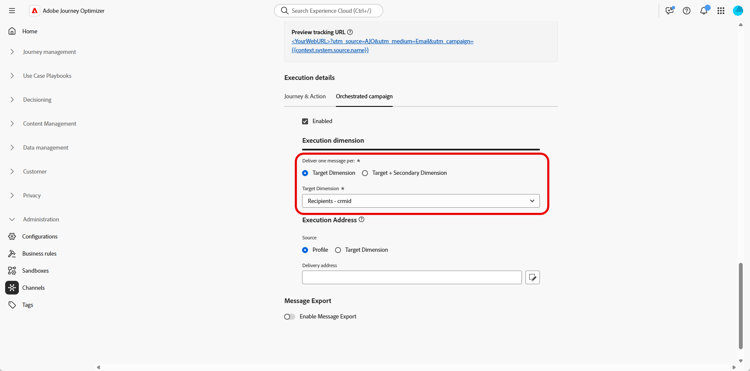
게재 방법 선택:
-
대상 Dimension: 기본 엔터티(예: 수신자)로 보냅니다.
-
대상 + 보조 Dimension: 기본 및 보조 엔터티(예: 받는 사람 + 계약 또는 받는 사람 + 항공편)를 모두 사용하여 보냅니다.
한 프로필에서 여러 메시지를 받을 수 있는 다중 엔티티 오케스트레이션 캠페인을 지원하려면 이 옵션을 선택합니다. 한 프로필은 보조 Dimension(예: 데이터 모델에 따라 받는 사람과(와) 연결된 항공편 또는 항공편과(와) 연결된 항공편 세부 정보)로 선택하는 연결된 테이블의 해당 행당 한 개의 메시지를 받을 수 있습니다.
-
-
드롭다운에서 이전에 만든 Target Dimension을 선택합니다.
-
Target + 보조 Dimension을(를) 게재 방법으로 선택한 경우 보조 Dimension을(를) 선택하여 메시지 게재의 컨텍스트를 정의합니다.
-
실행 주소 섹션에서 전자 메일 주소 또는 전화 번호와 같은 게재 주소를 가져오는 데 사용할 Source을(를) 선택하십시오.
-
프로필: 게재 주소(예: 이메일)가 기본 고객 프로필에 직접 저장되어 있는 경우 이 옵션을 선택합니다.
특정 관련 엔티티가 아니라 기본 고객에게 메시지를 보낼 때 유용합니다.
-
대상 Dimension: 게재 주소가 기본 엔터티(예: 받는 사람)에 저장되어 있는 경우 선택하십시오.
각 수신자에게 다른 전자 메일 또는 전화 번호와 같은 고유한 게재 주소가 있는 경우 유용합니다.
-
보조 Dimension: Target + 보조 Dimension을(를) 배달 방법으로 사용할 때 이전에 구성한 관련 보조 Dimension을(를) 선택하십시오.
예를 들어 보조 차원이 예약 또는 구독을 나타내는 경우 이메일과 같은 실행 주소를 해당 수준에서 가져올 수 있습니다. 이 기능은 서비스를 예약하거나 구독할 때 프로필에서 다른 연락처 세부 정보를 사용하는 경우에 유용합니다.
note NOTE 보조 차원에 사용되는 스키마에는 기본 키가 있어야 합니다. 보조 차원에 대해서는 복합 기본 키가 지원되지 않습니다.
-
-
게재 주소 필드에서

-
구성이 완료되면 제출을 클릭합니다.
이제 채널을 오케스트레이션된 캠페인에서 사용할 준비가 되었으며 선택한 대상 차원에 따라 메시지가 전달됩니다.
URL 추적 매개 변수 url-tracking
채널 구성을 구성할 때 URL 추적 매개 변수를 정의하여 분석 및 보고 목적으로 추적된 링크에 메타데이터를 추가하여 이메일 캠페인의 성능을 모니터링할 수 있습니다.
이렇게 하려면 {{context.system.source.*}} 구문을 사용하여 오케스트레이션된 캠페인과 관련된 상황별 특성을 사용할 수 있습니다.
context.system.source.id: 오케스트레이션된 캠페인 IDcontext.system.source.name: 오케스트레이션된 캠페인 이름context.system.source.versionId: 오케스트레이션된 캠페인 버전 IDcontext.system.source.actionId: 채널 작업 노드 IDcontext.system.source.actionName: 채널 작업 노드 이름context.system.source.channel: 채널 유형(이메일, 모바일, 푸시)context.system.IdentityNamespace: 사용된 ID 네임스페이스
예:
www.YourLandingURL.com?utm_source=AJO&utm_campaign={{context.system.source.id}}&utm_content={{context.system.source.actionName}}
이 섹션에서 URL 추적 매개 변수에 대해 자세히 알아보세요.
This section contains structured knowledge intended to support interpretation, retrieval, and question answering related to this topic.
For complete understanding, this information should be combined with the documentation on this page. Neither source is intended to stand alone; the page describes the feature, while this section provides additional context that helps disambiguate terminology, intent, applicability, and constraints.
- TL;DR: This page explains how to configure a Channel configuration for Orchestrated campaigns by setting the delivery method, target dimension, and execution address, and how to add URL tracking parameters to tracked links.
Intents:
- Enable a Channel configuration for compatibility with Orchestrated campaigns.
- Choose a delivery method between Target Dimension and Target + Secondary Dimension.
- Select a previously created Target Dimension and, when applicable, a Secondary Dimension.
- Choose the source used to fetch the delivery address (Profile, Target Dimension, or Secondary Dimension) and select the specific delivery address field.
- Add URL tracking parameters using orchestrated campaign contextual attributes.
Glossary:
- Channel configuration: the configuration that defines how and to whom messages are delivered, including delivery level and execution address (product-specific)
- Execution details: the section of a Channel configuration where delivery method, target dimension, and execution address are set (product-specific)
- Target Dimension: delivery method that sends to the primary entity, e.g., recipient (product-specific)
- Target + Secondary Dimension: delivery method that sends using both primary and secondary entities, e.g., recipient + contract, or recipient + flights (product-specific)
- Secondary Dimension: the linked table selected to support multi-entity Orchestrated campaigns, where one profile can receive several messages, one per qualifying row (product-specific)
- Execution Address: the section where the Source used to fetch the delivery address (email address or phone number) is chosen (product-specific)
- Delivery address: the specific field selected to use for message delivery, chosen via the edit icon in the Delivery address field (product-specific)
Guardrails:
- The schema used for the secondary dimension must have a primary key; composite primary keys are not supported for secondary dimensions.
Terminology:
- Canonical name: Channel configuration — variants: Channel Configuration
- Do not confuse: “Target Dimension” (send to the primary entity, e.g., recipient) ≠ “Target + Secondary Dimension” (send using both primary and secondary entities, supporting one message per qualifying row in the linked Secondary Dimension table)
- Do not confuse: “Execution Address” (the section where the Source for the delivery address is chosen) ≠ “Delivery address” (the specific field selected for message delivery)
FAQ:
- Q: What must be enabled before a Channel configuration can be used with Orchestrated campaigns? — Enabled must be clicked in the Orchestrated campaigns tab of the Execution details section.
- Q: What are the two delivery methods available? — Target Dimension (primary entity only) and Target + Secondary Dimension (primary and secondary entities).
- Q: Where can the execution address be sourced from? — From Profile, Target Dimension, or Secondary Dimension, depending on where the delivery address is stored.
- Q: Are composite primary keys supported for secondary dimensions? — No, the schema used for the secondary dimension must have a primary key, and composite primary keys are not supported.
- Q: How are URL tracking parameters defined for Orchestrated campaigns? — Using contextual attributes with the
{{context.system.source.*}}syntax, such ascontext.system.source.idorcontext.system.source.actionName.
Examples:
- URL tracking parameter example for Orchestrated campaigns:
www.YourLandingURL.com?utm_source=AJO&utm_campaign={{context.system.source.id}}&utm_content={{context.system.source.actionName}}
Related pages:
- For creating and configuring the Channel configuration: Follow the steps detailed in this page (email/surface-personalization.md)
- For selecting a previously created Target Dimension: previously created Target Dimension (orchestrated/target-dimension.md)
- For learning more about URL tracking parameters: this section (email/url-tracking.md)
Personas:
- admin: Can enable a Channel configuration for Orchestrated campaigns by selecting Enabled, then choose Target Dimension or Target + Secondary Dimension as the delivery method. Can select the Source for the execution address from Profile, Target Dimension, or Secondary Dimension, then select the specific Delivery address field. The page states that the schema used for the secondary dimension must have a primary key, and composite primary keys are not supported. Where: “Configure your Channel configuration”.
Onboarding:
- Level: Intermediate
- First minimal step: Create and configure your Channel configuration.
- Success check: Your channel is ready to use with Orchestrated campaigns, and messages are delivered according to the selected target dimension.
- Previous: After setting up your Target Dimension: Create your Targeting dimension (orchestrated/target-dimension.md); To create and configure your Channel configuration: Personalize email configuration settings (email/surface-personalization.md)
- Next: To learn more about URL tracking parameters: Configure URL tracking (email/url-tracking.md)