このページ:コンテンツカードチャネル設定を作成し、そのサーフェスを定義して、コンテンツカードを適切な web またはアプリの場所に配信できるようにします。
設定とは surface-definition
コンテンツカードのエクスペリエンス設定とは、ユーザーやシステムの操作用に設計されたエンティティで、URI によって一意に識別されます。
つまり、サーフェスは、エンティティ(タッチポイント)が存在する階層の任意のレベルのコンテナと見なすことができます。
-
Web ページ、モバイルアプリ、デスクトップアプリ、大きなエンティティ内の特定のコンテンツの場所(
divなど)または非標準の表示パターン(キオスクやデスクトップアプリのバナーなど)が考えられます。 -
また、非表示または抽象された表示を目的として、コンテンツ コンテナの特定の部分に拡張することもできます(サービスに配信される JSON BLOB など)。
-
また、様々なクライアントサーフェス定義に一致するワイルドカードサーフェスにすることもできます(例えば、web サイトの各ページのヒーロー画像の場所を web://mydomain.com/*#hero_image のようなサーフェス URI に変換できます)。
基本的に、サーフェス URI は複数のセクションで構成されます。
- タイプ:web、mobileapp、atm、kiosk、tvcd、service など。
- プロパティ:ページ URL またはアプリバンドル
- コンテナ:ページ/アプリアクティビティ上の場所
次の表に、様々なデバイスのサーフェス URI 定義の例を示します。
Web およびモバイル
web://domain.com/path/page.html#elementmobileapp://com.vendor.bundle/activity#elementmobileapp://com.vendor.bundle/#elementその他のデバイスタイプ
desktop://com.vendor.bundle/#elementtvcd://com.vendor.bundle/#elementservice://servicename/#elementkiosk://location/screen#elementatm://location/screen#elementワイルドカードサーフェス
wildcard:web://domain.com/*#elementwildcard:web://*domain.com/*#elementコンテンツカードの設定の作成 create-config
-
チャネル/一般設定/チャネル設定メニューにアクセスし、「チャネル設定を作成」をクリックします。
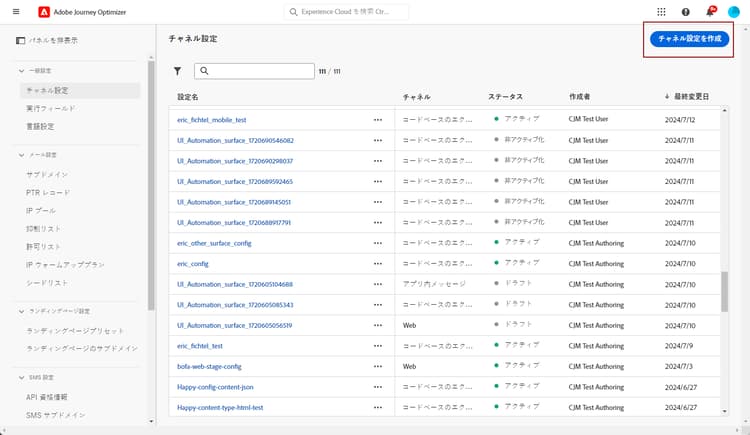
-
設定の名前と説明(オプション)を入力します。
note NOTE 名前は、文字(A ~ Z)で始める必要があります。 使用できるのは英数字のみです。 アンダースコア( _)、ドット(.)、ハイフン(-)も使用できます。 -
設定にカスタムまたはコアのデータ使用ラベルを割り当てるには、「アクセスを管理」を選択します。 詳しくは、オブジェクトレベルのアクセス制御(OLAC)を参照してください。
-
コンテンツカードチャネルを選択します。
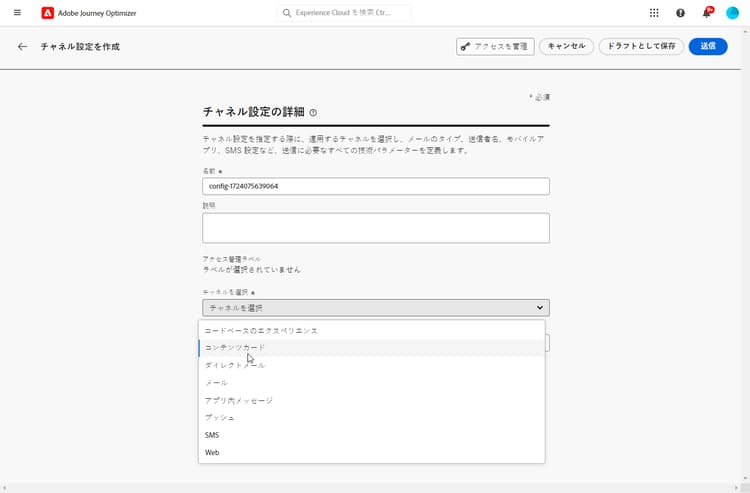
-
この設定を使用してメッセージに同意ポリシーを関連付けるには、マーケティングアクションを選択します。 顧客の意向に従うために、そのマーケティングアクションに関連付けられているすべての同意ポリシーが活用されます。 詳細情報
-
コンテンツカードのエクスペリエンスを適用するプラットフォームを選択します。
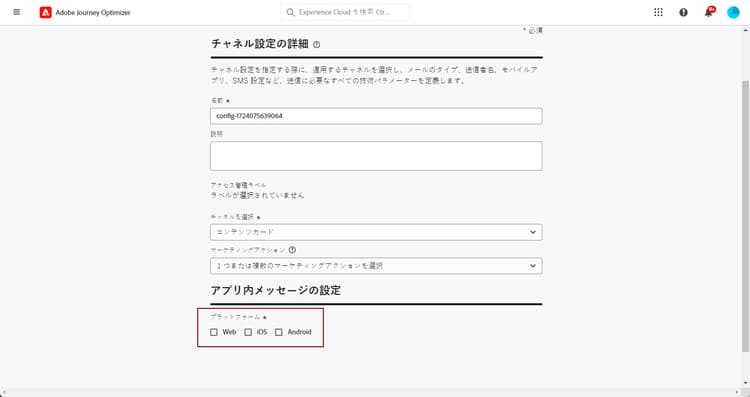
-
Web の場合:
-
単一ページにのみ変更を適用するには、ページ URL を指定します。
-
または、ページ一致ルールを作成して、指定したルールに一致する複数の URL をターゲットにします。 例えば、すべてのページでヒーローバナーを更新したり、すべての製品ページに表示するトップ画像を追加したりするなど、web サイト全体に変更を普遍的に適用するのに使用できます。 詳細情報
-
-
iOS および Android の場合:
- アプリ ID、アプリ内の場所またはパスおよびプレビュー URL を入力または選択します。
-
変更を送信します。
コンテンツカードのエクスペリエンスを作成する際に、設定を選択できるようになりました。
This section contains structured knowledge intended to support interpretation, retrieval, and question answering related to this topic.
For complete understanding, this information should be combined with the documentation on this page. Neither source is intended to stand alone; the page describes the feature, while this section provides additional context that helps disambiguate terminology, intent, applicability, and constraints.
- TL;DR: This page explains what a content card experience configuration and its surface URI are, and how to create a content card channel configuration in Journey Optimizer.
Intents:
- Understand what a content card experience configuration and a surface are
- Learn how a surface URI is composed from type, property, and container
- Reference surface URI examples for web, mobile, other device types, and wildcard surfaces
- Create a content card channel configuration from the Channel configurations menu
- Associate marketing actions and platform settings with the configuration
- Define web targeting with a page URL or a pages matching rule, or app targeting for iOS and Android
Glossary:
- Content card experience configuration: Any entity designed for user or system interaction, uniquely identified by a URI (product-specific)
- Surface: A container at any level of hierarchy with an entity (touchpoint) that exists, such as a web page, mobile app, desktop app, or a specific content location (product-specific)
- Surface URI: The unique identifier of a surface, composed of a type, a property, and a container (product-specific)
- Wildcard surface: A surface that matches a variety of client-surface definitions, for example
web://mydomain.com/*#hero_image(product-specific) - Marketing action: A selection that associates consent policies with the messages using the configuration, so customer preferences are respected (product-specific)
- Pages matching rule: A web targeting option that targets multiple URLs matching a specified rule (product-specific)
Guardrails:
- A content card experience configuration is uniquely identified by a URI.
- Configuration names must begin with a letter (A-Z) and can only contain alpha-numeric characters, plus the underscore, dot, and hyphen characters.
- For Web, specify a Page URL to apply changes to a single page exclusively, or create a Pages matching rule to target multiple URLs that match the rule.
- For iOS and Android, enter or select the App id, Location or path inside the app, and Preview URL.
- All consent policies associated with the selected marketing action are leveraged to respect customer preferences.
Terminology:
- Canonical name: Content card channel configuration — Acronym: URI (surface URI) — variants: content card experience configuration, content card configuration
- Synonyms: “surface” = “content card experience configuration”
- Do not confuse: “Page URL” (targets a single page exclusively) ≠ “Pages matching rule” (targets multiple URLs that match a rule)
- Do not confuse: “Type” (web, mobileapp, atm, kiosk, tvcd, service) ≠ “Property” (page URL or app bundle) ≠ “Container” (location on the page or app activity)
FAQ:
- Q: What is a content card experience configuration? — It is any entity designed for user or system interaction, uniquely identified by a URI, and can be seen as a container (surface) holding a touchpoint entity.
- Q: What are the parts of a surface URI? — A surface URI is composed of a type (web, mobileapp, atm, kiosk, tvcd, service, and so on), a property (page URL or app bundle), and a container (location on the page or app activity).
- Q: What characters are allowed in a configuration name? — Names must begin with a letter (A-Z) and can only contain alpha-numeric characters, plus the underscore, dot, and hyphen characters.
- Q: How do I target web pages with the configuration? — Specify a Page URL to apply changes to a single page exclusively, or create a Pages matching rule to target multiple URLs that match the specified rule.
- Q: Where do I create a content card configuration? — Access Channels > General settings > Channel configurations, click Create channel configuration, select the Content card channel, then configure and submit.